Simulation and Layout
What is this?
Three problems where the specification is the algorithm. Text justification has three separate rules about where spaces go and every one of them is a distinct code path. The robot asks about infinite repetition and needs a single pass. Sparse multiplication is textbook matrix multiplication with the zeros skipped — which requires reordering the loops so that skipping is possible.
None of these rewards cleverness. They reward getting every case right the first time.
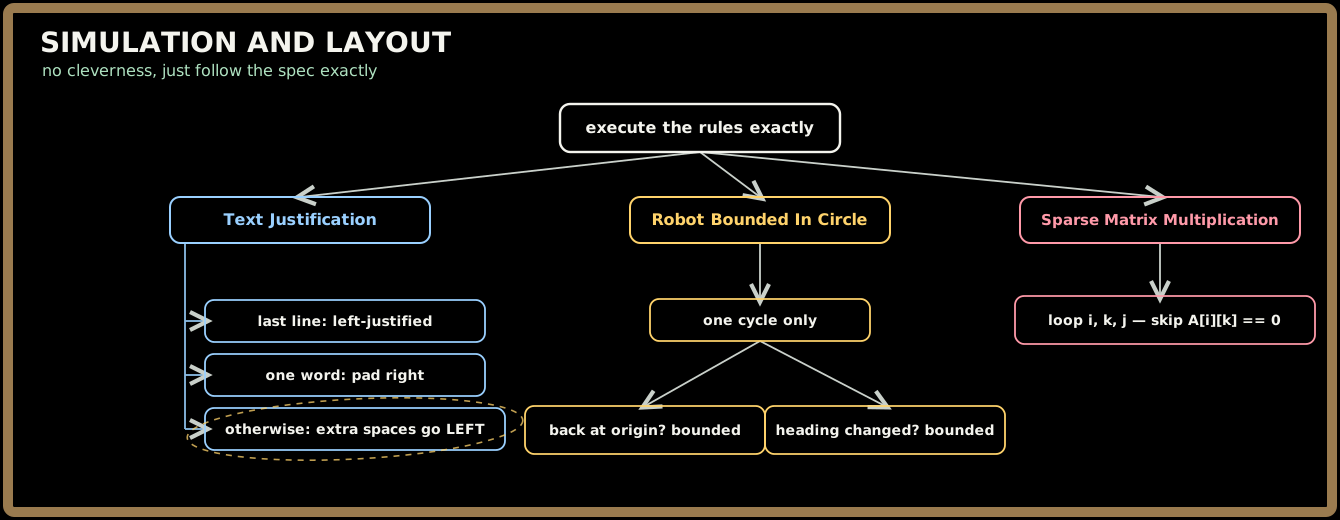
💡 Fun fact: Sparse Matrix Multiplication becomes efficient through a loop reorder, not a data structure. The textbook
i, j, korder computes one output cell at a time and must touch everykregardless. Swapping toi, k, jputsA[i][k]in the outer position — so when it is zero, the entire inner loop overjis skipped, because a zero contributes nothing to any output cell in that row. Same arithmetic, same results, and the work drops to the number of non-zero entries. Thei, k, jordering is also the cache-friendlier one on dense matrices, which is why numerical libraries use it anyway.
🔓 The 3 problems in this chapter are free. Sign in with Google or Microsoft to start solving.
The one-line idea: enumerate the cases on paper first. In this chapter the specification is the algorithm, and every failure is a rule discovered halfway through an implementation.
1. Three rules about spaces
if width + len(line) + len(word) > maxWidth:      # len(line) = minimum 1 space per gap
    if len(line) == 1:
        out.append(line[0].ljust(maxWidth))       # rule 2: single word, pad right
    else:
        spaces, gaps = maxWidth - width, len(line) - 1
        q, r = divmod(spaces, gaps)               # q each, plus one extra for the first r
        out.append("".join(line[i] + " " * (q + (i < r)) for i in range(gaps)) + line[-1])
    line, width = [], 0
line.append(word); width += len(word)
...
out.append(" ".join(line).ljust(maxWidth))        # rule 1: last line, left-justified
divmod does the whole distribution: q spaces in every gap, and the remainder r handed one at a time to the leftmost gaps. That left-loading is the rule most often missed, and it is a single (i < r).
The overflow test uses len(line) as the count of minimum single spaces already committed — one per gap plus one for the word about to be added — which is why it reads as width + len(line) + len(word).
2. One pass settles infinity
x = y = 0; dx, dy = 0, 1                          # facing north
for c in instructions:
    if   c == 'G': x, y = x + dx, y + dy
    elif c == 'L': dx, dy = -dy, dx               # rotate left 90°
    else:          dx, dy = dy, -dx               # rotate right 90°
return (x, y) == (0, 0) or (dx, dy) != (0, 1)
Two acceptance conditions, and the second is the interesting one. If the heading changed, four repetitions of the cycle rotate the same displacement by 90° each time, and four vectors at right angles sum to zero — so the robot returns to the origin no matter what that displacement was. If the heading is unchanged and the position is not, every cycle adds the identical vector and the robot escapes.
Rotation without trigonometry is worth internalising: left is (dx, dy) → (−dy, dx), right is (dx, dy) → (dy, −dx).
3. Skip the zeros by reordering
for i in range(m):
    for k in range(n):
        if A[i][k] == 0: continue                 # ← the entire j loop is skipped
        for j in range(p):
            if B[k][j]: C[i][j] += A[i][k] * B[k][j]
The continue is only possible because k is in the middle rather than innermost. With the textbook i, j, k order the zero check would have to run inside the innermost loop and would save almost nothing.
For genuinely sparse inputs, converting each matrix to a list of (index, value) pairs per row is the further step — and worth mentioning even if you do not write it.
4. A 30-second worked example (justification)
words = ["This","is","an","example","of","text","justification."], maxWidth = 16
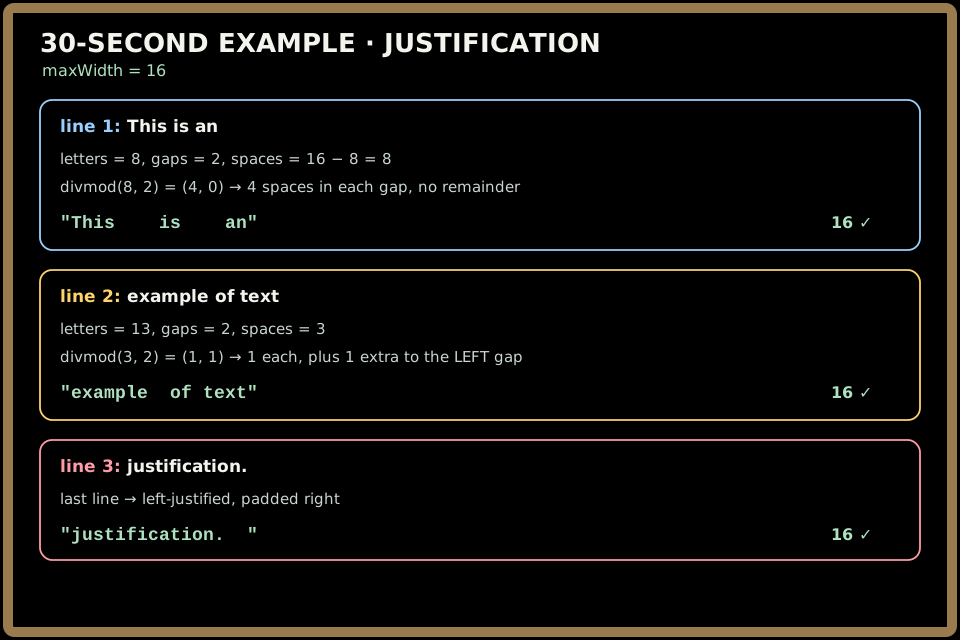
Line 2 is the whole chapter in one line of output. The extra space goes into the left gap, giving example two spaces after it and of one — and a solution that loads the remainder to the right produces "example of text", which is 16 characters, looks reasonable, and is wrong.
5. Where you'll actually meet this
- Typesetting engines. Justification is what word processors, browsers and PDF renderers implement.
- Terminal and CLI output. Wrapping and aligning help text under a width limit is this code.
- Robotics safety. Determining whether a repeated command sequence stays within a bounded region is a real pre-flight check.
- Graph analytics. Sparse matrix multiplication is the core primitive behind PageRank and BFS-as-linear-algebra.
- Machine learning pipelines. Sparse feature matrices are the normal case, not the exception.
6. Problems in this chapter
▶ Text Justification
Format words into fully justified lines of exact width. Pack greedily, distribute spaces with divmod loading the remainder left, and left-justify the last line.
Pattern: greedy packing + explicit case rules. Target: O(total characters).
▶ Robot Bounded In Circle
Decide whether a repeated instruction sequence keeps the robot bounded. Simulate one cycle; bounded if it returns to the origin or its heading changed.
Pattern: one-pass invariant. Target: O(n) time, O(1) space.
▶ Sparse Matrix Multiplication
Multiply two matrices that are mostly zeros. Loop i, k, j so a zero in A skips an entire inner loop.
Pattern: loop reordering to skip work. Target: proportional to the non-zero count.
7. Common pitfalls 🚫
- Loading extra spaces to the right. They go to the leftmost gaps.
- Justifying the last line. It is left-justified and padded on the right.
- Forgetting the single-word line, which has no gaps and would divide by zero.
- Simulating the robot for many cycles. One is provably enough.
- Getting the rotation formulas backwards. Left is
(−dy, dx), right is(dy, −dx). - Keeping the
i, j, kloop order and then wondering why skipping zeros saved nothing. - Not padding every line to exactly
maxWidth. Trailing spaces are part of the required output.
8. Key takeaways
- The specification is the algorithm. Write the cases down before writing code.
divmoddistributes remainders — and which side receives them is a stated rule, not a preference.- One pass can decide a question about infinity when the structure repeats.
- Four right-angle rotations sum to zero, which is the whole boundedness proof.
- Loop order determines what you can skip. Put the value you want to test outside the loop it controls.
- Every output line must be exactly the requested width, padding included.
- Why interviewers like it: there is nothing to be clever about, so completeness and care are the only things visible.
Order: Text Justification → Robot Bounded In Circle → Sparse Matrix Multiplication.
Sparse Matrix Multiplication
Core idea: You're multiplying two matrices
A(m×k) andB(k×n), but almost every entry is0. The textbook triple loop computes everyC[i][j]as a full dot product overkterms — yet a termA[i][p] * B[p][j]is0(and contributes nothing) the instant either factor is0. So the only products that matter are nonzero × nonzero. The trick: walk the nonzero entries ofAdirectly. For each nonzeroA[i][p], the matching columnpofAlines up with rowpofB; scatterA[i][p] * B[p][j]intoC[i][j]for each nonzeroB[p][j]. Precompute a compressed form — for each row, a list of(col, value)pairs of just its nonzeros — and you never touch a single zero. Work drops fromO(m·n·k)(dense) toO(nonzeros).
Problem, rephrased
You run a co-purchase recommender. A is a users × items matrix — A[i][p] is how much user i likes item p — and B is an items × tags matrix linking items to genre tags. Each user has rated only a handful of items and each item carries only a few tags, so both matrices are mostly zeros. You're given A of shape m × k and B of shape k × n as plain dense lists of lists.
Return the product C = A · B — the m × n table with C[i][j] = Σ_p A[i][p] * B[p][j], scoring every user against every tag. The binding constraint is the word sparse: the naive triple loop grinds through m·n·k products, nearly all of them multiplications by zero, so structure your computation to do work proportional to the nonzero entries instead.
Strip the story away and this is LeetCode 311 — Sparse Matrix Multiplication: given sparse matrices A (m × k) and B (k × n), return their product C (m × n) without wasting work on zeros.
| Input | Means | Output |
|---|---|---|
A = [[1,0,0],[-1,0,3]], B = [[7,0,0],[0,0,0],[0,0,1]] |
2×3 times 3×3 | [[7,0,0],[-7,0,3]] |
A = [[0]], B = [[0]] |
1×1 times 1×1, both empty | [[0]] |
A = [[1,0],[0,1]], B = [[2,3],[4,5]] |
identity-ish times dense 2×2 | [[2,3],[4,5]] |
The word sparse is the whole story. If the matrices were dense, the triple loop is unavoidable — you genuinely need all m·n·k products. Because they're sparse, the overwhelming majority of those products are 0 × something or something × 0, and a 0 term adds nothing to the sum. Identifying and skipping those zero terms — ideally without even visiting them — is what turns a wasteful O(m·n·k) into work proportional to how much real data there is.
Sign in to continue reading
The rest of this lesson is available with a free account. Signing in with Google or Microsoft is free.
Sign in to read the full lesson