Coding, system design, behavioral, and AI/ML — taught from brute force to the elegant solution, with hand-drawn diagrams and real-world framing. Not flashcards. Understanding.
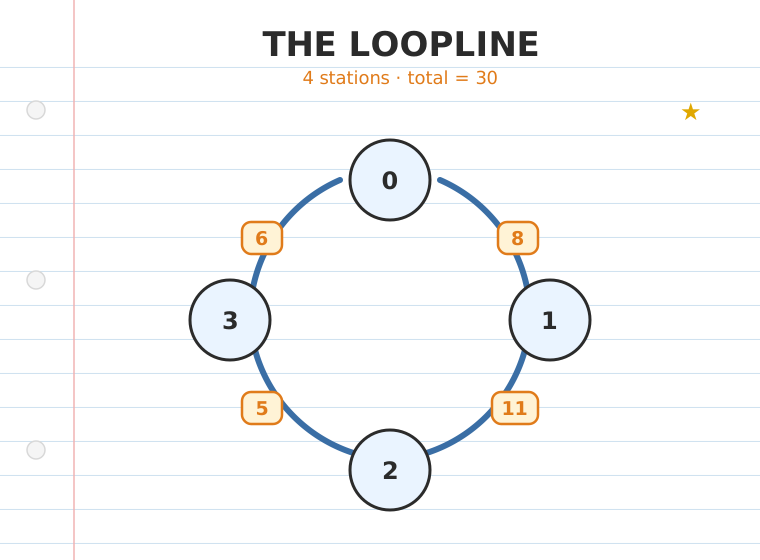
# Optimal: one arc + its complement — O(n), O(1) def loop_distance(gap, start, dest): lo, hi = min(start, dest), max(start, dest) arc = sum(gap[lo:hi]) # one contiguous arc return min(arc, sum(gap) - arc) # the other is free
Each track is structured 101 → 401, so you ramp from fundamentals to staff-level depth.
Patterns over memorization — arrays, graphs, DP — brute force first, then optimized.
ExploreReal architectures: rate limiters, feeds, payments — with the tradeoffs interviewers probe.
ExploreSTAR stories that land. Frameworks for leadership, conflict, and ambiguity.
ExploreFrom classic ML to LLM systems — modeling, evaluation, ML-system-design.
ExploreEvery solution earns its complexity. You see the bottleneck before the trick.
Real sketches — the picture that makes the idea obvious.
Where each pattern shows up in production — consistent hashing, ring buffers, CDNs.
Prev/next moves you through a track in the right order.
Continue with Google or Microsoft. No passwords.
Edge cases, complexity tables, and the follow-ups interviewers actually ask.
Take “Minimum Distance Between Bus Stops.” We reframe it as a circular metro, draw the ring, then climb from a Dijkstra overkill to a one-line insight — with complexity at every step.
Open the full lessonother = total − arc.Start at your level (101–401) in coding, system design, behavioral, or AI/ML.
Read the lesson, follow the sketch, watch each solution improve.
Move lesson-to-lesson with guided prev/next until the pattern is yours.
“The brute-force-first approach finally made DP click. I stopped memorizing and started seeing the pattern.”
“The system design diagrams are exactly what I drew on the whiteboard.”
“Real-world framing made answers memorable. I could explain why, not just recite.”
Free to start. No credit card. Just the method that gets engineers hired.
Use your Google or Microsoft account — no password to remember.
Continue with Google Continue with Microsoft