Circular Array Operations
What is this?
Imagine a clock face: after 12 comes 1 again — the numbers loop back instead of running off the edge. A circular array works the same way: the last slot connects back to the first, so you can keep stepping forward forever and you'll just go round and round. This is exactly how a running track, a carousel, or "whose turn is next" in a board game behaves, and it shows up constantly in real software like the buffers that smooth out streaming audio.
💡 Fun fact: The "wrap around with a remainder" trick (modular arithmetic) was formalized by Carl Friedrich Gauss in 1801, more than a century before computers existed. The very same idea now powers the consistent-hashing rings that let services like Cassandra and DynamoDB spread data across thousands of machines.
🔓 The problem in this chapter is free. Sign in with Google or Microsoft to start solving.
The one-line idea: a circular array is just an ordinary array whose ends are glued together. Learn two reflexes — index with
% n, and always consider "the other way around" — and a whole family of problems collapses into easy ones.
1. What "circular" really means
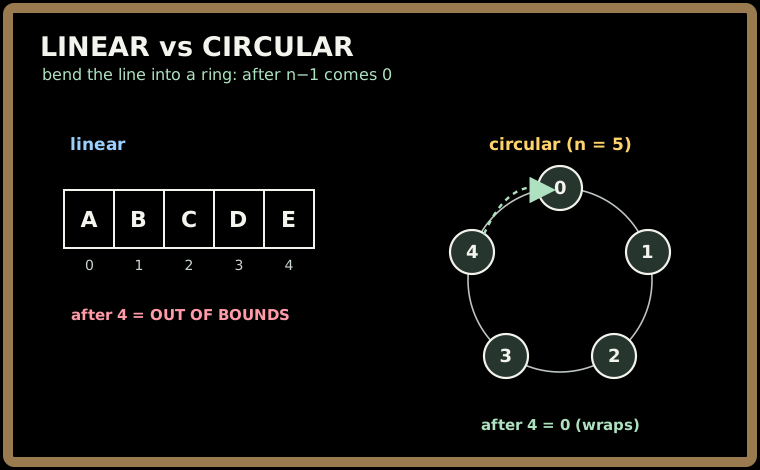
In a normal array, index 0 is the start and n‑1 is the end — fall off either edge and you're out of bounds. In a circular array, the element after n‑1 is 0 again. Bend the line into a ring:
Two tiny tools handle 95% of the wrap-around:
| Move | Formula | Note |
|---|---|---|
| step forward | (i + 1) % n |
clean |
| step backward | (i - 1 + n) % n |
add n first so it never goes negative |
jump k forward |
(i + k) % n |
⚠️ In many languages
-1 % nis negative (-1, notn‑1). Always normalise with(i - 1 + n) % n. (Python's%is non-negative, but write it the safe way out of habit — interviews are polyglot.)
2. Where you'll actually meet this
Circular arrays aren't a toy — they're how real systems reuse fixed memory and bounded structure:
- Ring buffers / circular queues. Audio & network I/O buffers, Linux kernel ring buffers, Kafka-style append-with-wrap logs, lock-free SPSC queues — a fixed array with head/tail indices that wrap with
% n. - Consistent-hashing rings (Cassandra, DynamoDB). Nodes and keys sit on a ring; ownership and replica walks go around it, often choosing the shorter direction.
- Round-robin scheduling / load balancing. Pick the next worker with
(i + 1) % n— CPU schedulers, nginx upstreams, task queues. - Ring network topologies (SONET/SDH, Token Ring). Traffic between two nodes can travel either arc; pick the shorter healthy one.
- Games & UI. Circular tracks, carousels, turn order that wraps back to player 0.
If a problem says circular, ring, wrap around, cyclic, rotate, or next … going around — this chapter is the toolkit.
3. The circular toolkit (patterns to recognise)
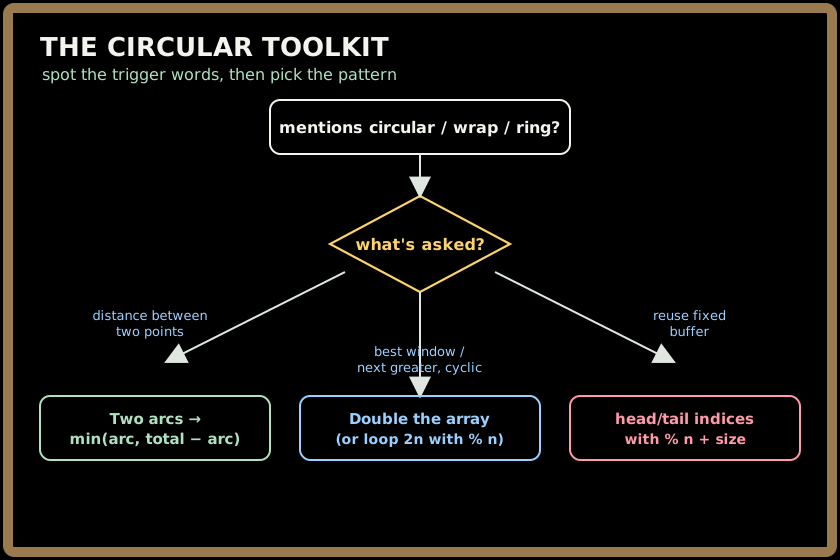
- Two directions, then
min. Between two points on a ring there are exactly two arcs. Their lengths sum to the whole loop, soother = total − arc. Compute one, subtract, take the smaller. (This is the bus-stops problem below.) - "Double it" to linearise. Many circular problems (max circular subarray, next-greater-element-in-a-circular-array) become linear if you imagine the array written twice back-to-back — or iterate
2ntimes using% ninstead of actually copying. - Prefix sums on a ring. Range sums that wrap =
total − (sum of the non-wrapping middle). - Head/tail with modulo (ring buffer). Enqueue at
tail = (tail + 1) % n, dequeue athead = (head + 1) % n; track size to tell "full" from "empty".
4. A 30-second worked example (wrap-around distance)
Ring of 5 segment costs gap = [4, 3, 9, 2, 6] (so total = 24). Shortest way from stop 1 to stop 4?
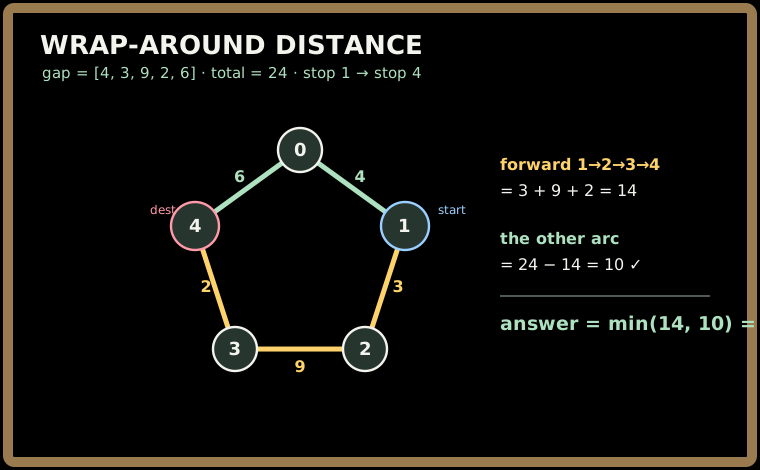
No second loop, no modular gymnastics — just one arc and a subtraction. That single trick is the heart of the first problem in this chapter.
5. Problems in this chapter
▶ Minimum Distance Between Bus Stops
A circular metro loop; find the shorter of the clockwise / counter-clockwise distance between two stations. Teaches the other = total − arc reflex and why reaching for Dijkstra is overkill on a ring.
Pattern: two-directions → min. Target: O(n) time, O(1) space.
(More circular problems — circular subarray, ring-buffer design, next greater element II — slot in here as the chapter grows; they reuse tools #2–#4 above.)
6. Common pitfalls 🚫
- Negative modulo when stepping backward — use
(i - 1 + n) % n. - Double-counting the full loop — the two arcs already sum to
total; don't add the shared endpoints twice. - Forgetting
start == dest— distance is0, not the whole loop. - Actually copying the array to "double" it — usually you can just iterate
2ntimes with% nand save theO(n)space. - Off-by-one between "edges" and "nodes" —
gap[i]is the segment betweeniandi+1, not a stop itself.
7. Key takeaways
- Circular = linear +
% n. Master forward/backward stepping and most boundary bugs vanish. - On a ring, there are two arcs;
other = total − arcturns two traversals into one. - "Double the array" linearises cyclic window / next-greater problems.
- Ring buffers are this pattern in production — fixed memory, head/tail with modulo.
- Recognise the trigger words (circular, wrap, ring, cyclic, rotate) and reach for the toolkit above.
Minimum Distance Between Bus Stops
The one-line idea: on a circle, any two points are joined by exactly two arcs. Add up one arc, and the other is just
total − arc. The answer is the shorter of the two.
1. The Problem (in plain language)
A city runs a circular metro loop called LoopLine. There are n stations placed around the loop, numbered 0, 1, 2, … , n‑1, and after the last station the track curves back to station 0.
You're given an array gap, where gap[i] is the travel time (in minutes) along the track segment that connects station i to its next neighbour station (i+1) mod n.
A train can run either direction around the loop. Given a start station and a dest station, return the minimum travel time to get from start to dest.
This is a rephrasing of the classic "Distance Between Bus Stops" interview problem — but the circular, bidirectional structure is exactly what shows up in real distributed systems (below), so it's worth really understanding rather than memorizing.
Inputs & outputs
| Name | Meaning |
|---|---|
gap |
gap[i] = cost of the edge between stop i and stop (i+1) mod n |
start |
index of the origin station |
dest |
index of the destination station |
| return | minimum total cost going clockwise or counter‑clockwise |
Sign in to continue reading
The rest of this lesson is available with a free account. Signing in with Google or Microsoft is free.
Sign in to read the full lesson