Prefix, Pairs and Slope
What is this?
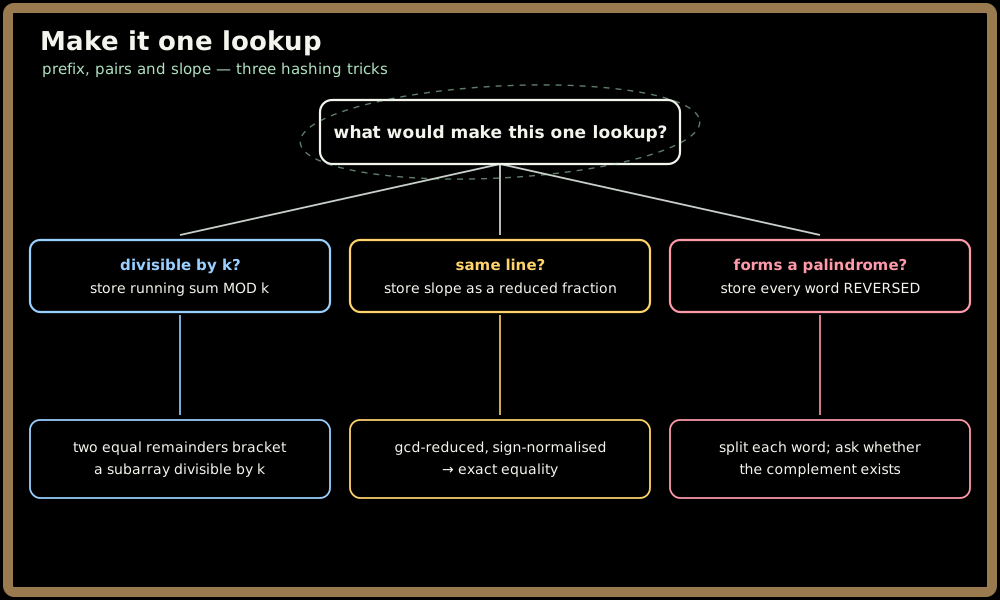
A hash map answers "have I seen this?" instantly. The difficulty at this level is that the thing worth asking about is never the thing you were given. You are handed numbers and asked about divisibility, handed points and asked about collinearity, handed words and asked about palindromes. In each case there is a derived quantity that makes the question a single lookup — and finding it is the entire problem.
💡 Fun fact: the remainder trick rests on a small piece of modular arithmetic. If two prefix sums leave the same remainder when divided by
k, their difference is a multiple ofk— and that difference is the subarray between them. So a question about every possible subarray collapses into "have I seen this remainder before?", and the map never grows beyondkentries no matter how long the array is.
🔓 The 3 problems in this chapter are free. Sign in with Google or Microsoft to start solving.
The one-line idea: derive a key that makes the question trivial — remainder, reduced fraction, reversed word — and store that. The hash map is never the insight; the transformation into it is.
1. Remainder, not sum
seen = {0: -1}                 # remainder -> earliest index it appeared at
running = 0
for i, x in enumerate(nums):
    running = (running + x) % k
    if running in seen:
        if i - seen[running] >= 2:      # the subarray must be at least two long
            return True
    else:
        seen[running] = i               # FIRST occurrence only
Two details carry it. The map stores the earliest index for each remainder, because a later one can only produce a shorter subarray — and this problem demands length at least two. And seen = {0: -1} seeds the empty prefix, so a subarray starting at index 0 is counted.
In languages where % can return a negative, normalise with ((x % k) + k) % k before using it as a key.
2. Fractions, not floats
For each pivot point, key every other point by the slope between them — but as a reduced fraction, never a division:
dy, dx = y2 - y1, x2 - x1
g = gcd(dy, dx) or 1
dy, dx = dy // g, dx // g
if dx < 0 or (dx == 0 and dy < 0):      # normalise the sign
    dy, dx = -dy, -dx
key = (dy, dx)
The sign normalisation matters as much as the reduction: (1, 2) and (-1, -2) are the same direction and must hash to the same key. Vertical lines give dx == 0 and horizontal dy == 0, both handled by the same code once the sign rule covers them.
3. Reversed words, and the split
For palindrome pairs, index every word by its reverse. Then for each word, split it at every position into left and right:
- if
leftis a palindrome and the reverse ofrightexists, that word can go after the found one; - if
rightis a palindrome and the reverse ofleftexists, it can go before.
That is L + 1 splits per word and one lookup each — O(n · L²) in total, against O(n² · L) for comparing every pair. The empty-string case is the one to state explicitly: a word paired with "" works in both directions when the word is itself a palindrome, and it is easy to emit that pair twice.
4. A 30-second worked example
nums = [23, 2, 4, 6, 7], k = 6:
![Chalkboard worked example table: value, running sum, and running-sum-mod-6 rows; remainder 5 repeats at index 0 and index 2, so subarray [2,4] sums to 6](https://maangioassets.blob.core.windows.net/diagrams/coding-interview/301/chapters/hashtable/prefix-pairs-and-slope/prefix-pairs-and-slope-summary-diagram-2.svg)
Note the remainder 5 also appears at index 3, but the map kept index 0 — the earliest — which is what makes the length check meaningful.
5. Where you'll actually meet this
- Financial reconciliation. Finding a run of entries that nets to a multiple of some unit, used to match balancing transactions.
- Computer vision and GIS. Collinearity and vanishing-point detection over point sets, where exact rational slopes avoid the float problem entirely.
- Search infrastructure. Reverse indexes for suffix and palindrome lookup; the same structure powers "words ending in".
- Data deduplication. Canonical keys — reduced, normalised, sorted — decide when two differently-shaped records are the same.
- Hash-based cycle detection. Remainder keys appear wherever a value space needs to be folded into a bounded map.
6. Problems in this chapter
▶ Continuous Subarray Sum
Is there a subarray of length at least two summing to a multiple of k? Store each running remainder's earliest index; a repeat with a gap of two or more is the answer.
Pattern: remainder-keyed prefix map. Target: O(n) time, O(min(n, k)) space.
▶ Max Points on a Line
The most points sharing a straight line. Fix each point as a pivot and key the others by a gcd-reduced, sign-normalised slope.
Pattern: exact-fraction slope map. Target: O(n²) time, O(n) space.
▶ Palindrome Pairs
Every pair of words whose concatenation is a palindrome. Index the words reversed, then split each word at every position and look up the complement.
Pattern: reversed-word index + split. Target: O(n · L²) time.
7. Common pitfalls 🚫
- Storing the latest index rather than the earliest. It silently breaks any minimum-length requirement.
- Forgetting the
{0: -1}seed, which drops every subarray starting at index 0. - Negative remainders.
-7 % 6is not5in every language; normalise before keying. k = 0. The modulus problem needs an explicit guard — the question becomes "is there a subarray summing to zero".- Floating-point slopes. Collinear points disagree at the fifteenth decimal and the count comes back short.
- Skipping sign normalisation.
(1,2)and(-1,-2)are the same line and must produce the same key. - Duplicate points in the slope problem: they lie on every line through the pivot and must be counted separately, not keyed.
- Emitting the empty-string palindrome pair twice — once from each direction.
8. Key takeaways
- Derive the key. Remainder, reduced fraction, reversed word — the input never hands it to you.
- Two equal prefix remainders bracket a divisible subarray. That identity is the whole first problem.
- Earliest index, always, when length is part of the question.
- Exact beats approximate. Reduce with
gcdand normalise the sign rather than dividing. - Reversing the data reverses the question — a suffix problem becomes a prefix lookup.
- Handle the degenerate cases explicitly: zero modulus, duplicate points, empty strings.
- Why interviewers like it: the map is assumed. What they are watching is whether you can name the derived quantity and then defend it against modulus, sign and precision.
Order: Continuous Subarray Sum → Max Points on a Line → Palindrome Pairs.
Palindrome Pairs
Core idea: You want every ordered pair
(i, j)where gluing two words together —words[i] + words[j]— reads the same forwards and backwards. The brute force tries alln²pairs and palindrome-checks eachO(L)concatenation:O(n²·L). The unlock is to notice what makes a concatenation a palindrome. Split a wordwat every position into aprefixand asuffix. If the prefix is itself a palindrome, thenwbecomes a palindrome the moment you stickreverse(suffix)in front of it — so any other word equal toreverse(suffix)pairs withwon the left. Symmetrically, if the suffix is a palindrome, thenreverse(prefix)placed afterwcompletes a palindrome — that partner pairs on the right. So build one hash mapword -> index, and for each word walk itsL+1split points doing two O(L) lookups apiece. Guard the empty-string boundary so equal-length reverse pairs (likeabc/cba) aren't counted twice. That collapses the search to O(n·L²) —nwords,Lsplits each,O(L)palindrome-check-plus-lookup per split.
Problem, rephrased
A box of fridge-magnet word tiles sits in front of you, and you want every way to lay two tiles side by side so the combined strip reads the same left-to-right as right-to-left — cat next to tac spells cattac, a palindrome. You're given the tiles as an array of distinct strings words (lowercase letters; one tile may be blank).
Return all ordered index pairs [i, j] with i != j such that the concatenation words[i] + words[j] is a palindrome. Order matters — [i, j] and [j, i] are different layouts of the same two tiles — so when both concatenations read as palindromes, report both pairs.
Strip the story away and this is LeetCode 336 — Palindrome Pairs: given an array of distinct strings words, return all index pairs [i, j] (i != j) for which words[i] + words[j] is a palindrome.
| Input | Means | Output |
|---|---|---|
["abcd","dcba","lls","s","sssll"] |
abcd+dcba, dcba+abcd, lls+s→s+sssll… |
[[0,1],[1,0],[3,2],[2,4]] |
["bat","tab","cat"] |
only bat/tab are reverses |
[[0,1],[1,0]] |
["a",""] |
empty tile + single char | [[0,1],[1,0]] |
The third row is the one people fumble in interviews: the empty string is a palindrome, and it pairs with every word that is itself a palindrome (here "a"), in both orders. Handling "" cleanly without double-counting is the test of whether you really understand the split.
Sign in to continue reading
The rest of this lesson is available with a free account. Signing in with Google or Microsoft is free.
Sign in to read the full lesson