Views and Layout
What is this?
Drawing a tree on paper means giving every node a column and a row. Once those exist, "what does it look like from above?" is a grouping question, not a traversal question — and the traversal only has to record coordinates.
The 301 difficulty is in the tie-breaks. When two nodes land on the same column and the same row, the specification decides the order, and getting that rule wrong produces output that is right almost everywhere.
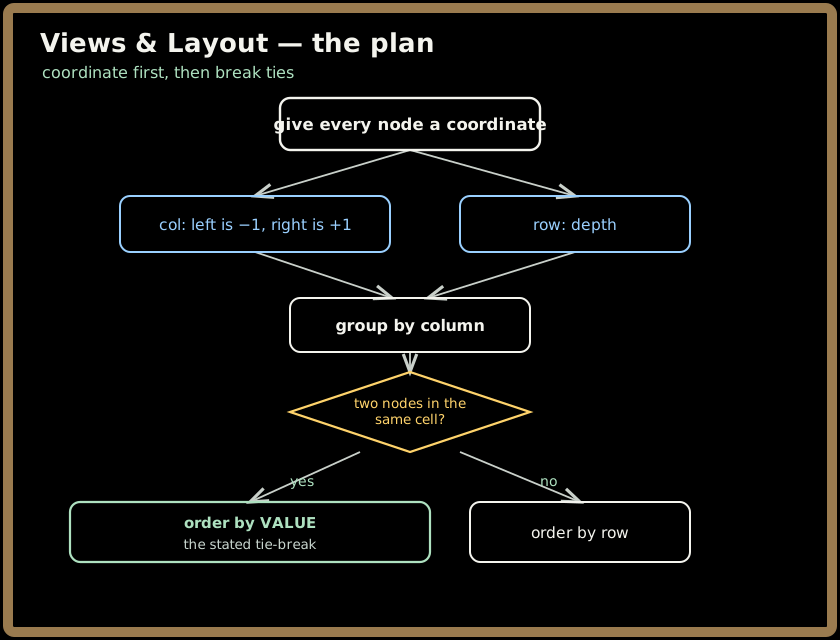
💡 Fun fact: Vertical Order Traversal II differs from the easier vertical-order problem by exactly one clause: nodes sharing a column and a row are ordered by value, not by arrival. That single sentence is why BFS alone is no longer enough — arrival order is what BFS gives you for free, and here it is explicitly not the answer. The fix is to collect
(col, row, value)triples and sort them, which makes the tie-break part of the data rather than part of the traversal.
🔓 The 2 problems in this chapter are free. Sign in with Google or Microsoft to start solving.
The one-line idea: record a coordinate per node during one traversal, then let sorting or grouping produce the view. The traversal never needs to know what the view is.
1. Coordinates, then a sort
nodes = []                                     # (col, row, value)
def walk(node, row, col):
    if not node: return
    nodes.append((col, row, node.val))
    walk(node.left,  row + 1, col - 1)
    walk(node.right, row + 1, col + 1)

walk(root, 0, 0)
nodes.sort()                                   # col, then row, then value
Sorting the triples applies all three ordering rules at once, in exactly the stated priority — which is why building the key correctly removes the need for any comparator logic later. Group the sorted list by column and the answer falls out.
The alternative — BFS with a per-column list — gets column and row order for free but must still sort within a cell, so the triple-sort version is both shorter and easier to defend.
2. Stitching a level from the level above
Populating Next Right Pointers II drops the guarantee that the tree is perfect, so a node's right neighbour may be several subtrees away. The trick is to build each level using the links you have already established on the level above:
head = root
while head:
    dummy = Node(0); tail = dummy              # dummy absorbs the "is this the first child?" case
    node = head
    while node:                                # walk the current level via its own next pointers
        if node.left:  tail.next = node.left;  tail = tail.next
        if node.right: tail.next = node.right; tail = tail.next
        node = node.next
    head = dummy.next                          # the level just built
The dummy head is what removes every special case. Without it, each child has to ask "am I the first node on this level?" — and that question, asked in four places, is where the bugs live.
3. A 30-second worked example (the tie-break)
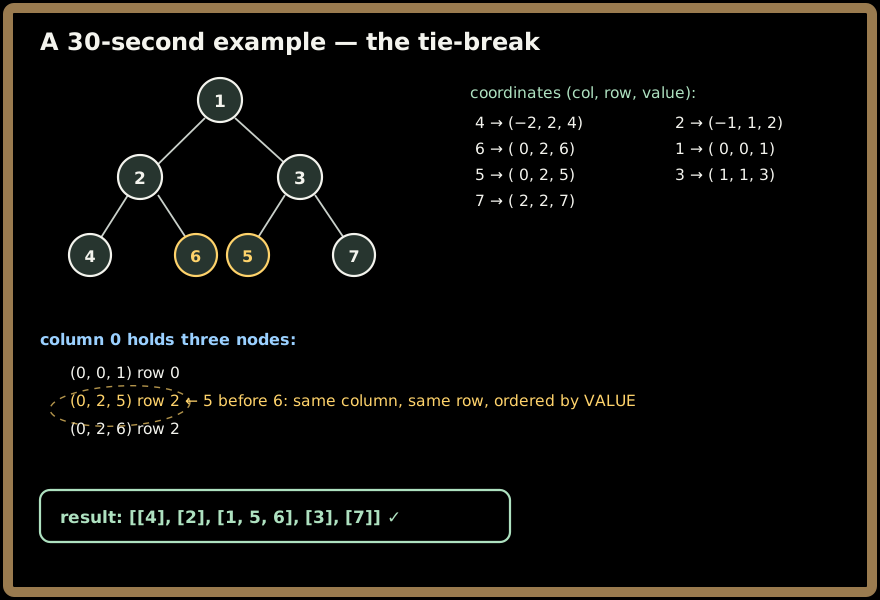
Nodes 6 and 5 share a cell. BFS would emit 6 first because it is the left child of the earlier node — and that is the wrong answer. The value tie-break puts 5 first.
4. Where you'll actually meet this
- UI and diagram layout. Assigning columns to nested elements is exactly this computation, deterministic tie-break included.
- Org-chart and family-tree rendering. Producing a stable left-to-right ordering that does not shift between renders.
- Compiler visualisation. Laying out syntax trees for debuggers and explorers.
- Linked structures in serialised formats. Sibling pointers make level traversal O(1)-space, which matters when trees are huge.
- Spreadsheet and grid mapping. Placing hierarchical data into rows and columns for display.
5. Problems in this chapter
▶ Vertical Order Traversal II
Group nodes by column, ordered by row, and by value within a cell. Collect (col, row, value) triples in one traversal and sort them.
Pattern: coordinates + sort. Target: O(n log n) time, O(n) space.
▶ Populating Next Right Pointers in Each Node II
Link each node to its right neighbour on a tree that is not perfect. Walk each level through the next pointers you already built, using a dummy head to stitch the level below.
Pattern: build level k+1 from level k. Target: O(n) time, O(1) extra space.
6. Common pitfalls 🚫
- Relying on BFS arrival order for the within-cell tie-break. The specification says by value, and those differ.
- Sorting only by column. All three keys matter, in order.
- Reaching for a queue in the next-pointer problem. That is
O(width)space; the point of part II is doing it inO(1). - Omitting the dummy head, which forces a "first child on this level?" check in several places.
- Assuming the tree is perfect. Part II exists precisely because it is not — a node's neighbour can be in a distant subtree.
- Tracking min and max columns and then iterating the range is fine, but only after the sort; doing it instead of sorting loses the tie-break.
7. Key takeaways
- Record coordinates, then sort. The traversal should not know what the view is.
- Put every ordering rule in the sort key — column, row, value — and no comparator logic is needed.
- Read the tie-break clause carefully. It is the entire difference from the easier version.
- Build each level from the one above to link siblings in
O(1)space. - A dummy head deletes a class of edge cases wherever a list is being stitched.
- Why interviewers like it: the traversal is trivial, so the whole signal is whether you implement the stated ordering exactly rather than the one BFS hands you.
Order: Vertical Order Traversal II → Populating Next Right Pointers in Each Node II.
Populating Next Right Pointers in Each Node
Core idea: The tree is perfect, and that guarantee is what removes the need for a queue. Once a level is threaded, you can walk it left to right and thread the level below using two rules: a node's left child points to its right child, and a node's right child points to
node.next.left— the first node of the next subtree along. Both are available because the current level is already linked. Walk level by level from the leftmost node each time, and the whole traversal costs O(1) extra space rather than the O(n) a BFS queue would need. On a non-perfect tree neither rule holds, which is exactly what makes the follow-up harder.
Problem, rephrased
A single-elimination tournament bracket is a perfect binary tree: the field is a power of two, every match feeds from exactly two matches below it, and all first-round matches sit on the same bottom level. You're given the root of such a tree, where each node carries left, right, and an extra pointer next that starts as NULL. The bracket UI renders one round at a time as a horizontal strip, sliding rightward from match to match without re-walking the tree from the top.
Populate every next pointer to point to the node immediately to its right on the same level; the rightmost node of each level keeps next = NULL. The bracket is rendered on constrained devices, so do it in O(1) extra space — no level-order queue buffering a whole round (implicit recursion stack space doesn't count against you).
Strip the story away and this is the classic Populating Next Right Pointers in Each Node (LeetCode 116): given a perfect binary tree whose nodes carry an unused next pointer, connect every node to its immediate right neighbor on the same level, leaving next = NULL where no such neighbor exists.
Real-World Applications:
- Network Protocols: Setting up communication channels in network hierarchies
- Database Indexing: Connecting B-tree nodes for efficient traversal
- Organizational Charts: Linking managers at the same hierarchy level
- Social Networks: Connecting users in the same network layer
- Tree-based Data Structures: Efficient level-order processing in trees
- Parallel Computing: Organizing processes in hierarchical clusters
Sign in to continue reading
The rest of this lesson is available with a free account. Signing in with Google or Microsoft is free.
Sign in to read the full lesson