Serialize and Reconstruct
What is this?
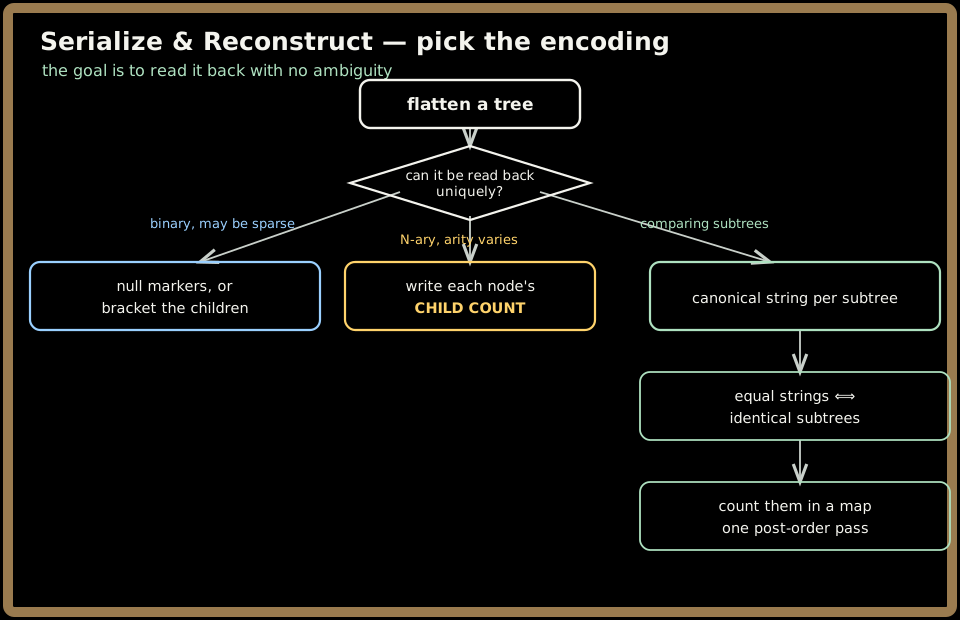
Flattening a tree is easy. Flattening it so that exactly one tree can be read back is the problem. Every decision — whether to write null markers, whether to record how many children each node has, where the delimiters go — is a decision about ambiguity, and an encoding that loses information cannot be rescued by a clever parser.
The third problem here turns the same act sideways: if a subtree's serialisation is canonical, then two subtrees are identical exactly when their strings match, so the encoding becomes an equality test.
💡 Fun fact: an N-ary tree cannot be serialised as a bare preorder list. The sequence
1,2,3might be a root with two children, or a chain of three, and nothing in the string distinguishes them. Writing the child count after each value —1,2 2,0 3,0— makes the parse deterministic and single-pass. This is precisely why real formats carry length prefixes: protobuf, DNS messages and TLV encodings all solve the same ambiguity the same way.
🔓 The 3 problems in this chapter are free. Sign in with Google or Microsoft to start solving.
The one-line idea: choose an encoding that cannot be misread — null markers, brackets, or an explicit child count — and the parser becomes a single left-to-right consumption with no lookahead.
1. Parse with a cursor, not with slicing
Construct Binary Tree from String takes input like "4(2(3)(1))(6(5))": a value, then optionally a bracketed left subtree, then optionally a bracketed right. The natural implementation is a shared cursor consumed as you go:
i = 0
def parse():
    global i
    sign = 1
    if s[i] == '-': sign = -1; i += 1
    start = i
    while i < len(s) and s[i].isdigit(): i += 1
    node = TreeNode(sign * int(s[start:i]))
    if i < len(s) and s[i] == '(':
        i += 1; node.left = parse(); i += 1      # consume '(' … ')'
    if i < len(s) and s[i] == '(':
        i += 1; node.right = parse(); i += 1
    return node
Two details matter. Negative values mean the digit scan must handle a leading -, which is easy to miss when the samples are all positive. And the cursor must be shared, not passed by value — slicing substrings instead is O(n²) and loses the position.
The rule that the first bracketed group is always the left child is what makes the grammar unambiguous: a node with only a right child is impossible to express, and the problem guarantees it never occurs.
2. Encode arity for N-ary trees
serialize:   value, childCount, then each child recursively
deserialize: read value, read count, then read exactly that many children
The count tells the parser precisely when a node's children end, so no sentinel and no lookahead is needed. The alternative — a null marker after each child list — also works; what does not work is omitting both.
3. Serialisation as identity
For Find Duplicate Subtrees, serialise every subtree post-order and count the strings:
def walk(node):
    if not node: return "#"
    key = f"{node.val},{walk(node.left)},{walk(node.right)}"
    count[key] += 1
    if count[key] == 2: result.append(node)     # append on the SECOND sighting only
    return key
Appending on exactly the second occurrence is what stops a subtree appearing three times in the output when it occurs three times in the tree. And the # for null is essential — without it, a left-only and a right-only child serialise identically.
Worth stating: building a string per subtree makes this O(n²) in the worst case, because the strings' lengths sum quadratically on a skewed tree. Assigning each distinct subtree an integer id instead brings it back to O(n), and mentioning that trade unprompted is the senior answer.
4. A 30-second worked example (ambiguity)
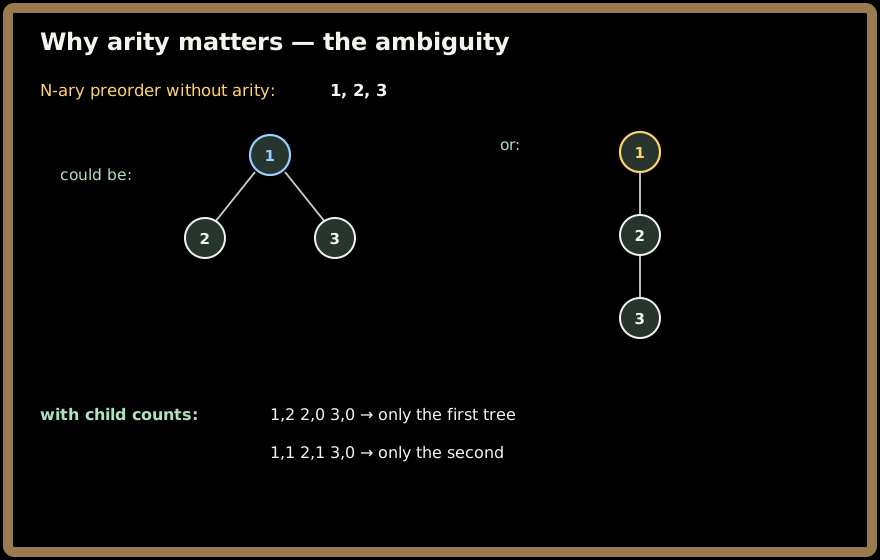
The bare list is one string describing two trees; the annotated list describes exactly one. That is the entire content of "choose an unambiguous encoding".
5. Where you'll actually meet this
- Wire formats. Length-prefixed encodings — protobuf, TLV, DNS — exist to solve this exact ambiguity.
- Compilers. Common-subexpression elimination hashes canonical subtree forms to find repeated computation.
- Caching and memoisation. Structural keys let identical subproblems share a cache entry.
- Version control and diffing. Detecting moved or duplicated subtrees between revisions.
- Document and config parsing. Bracketed nested formats are parsed with exactly this cursor discipline.
6. Problems in this chapter
▶ Construct Binary Tree from String
Rebuild a tree from "4(2(3)(1))(6(5))". A shared cursor, digit scanning with sign handling, and the rule that the first bracket is the left child.
Pattern: recursive descent with a shared cursor. Target: O(n) time, O(h) space.
▶ Serialize and Deserialize N-ary Tree
Round-trip a tree with arbitrary arity. Write each node's child count so the parser knows exactly when to stop.
Pattern: arity-encoded preorder. Target: O(n) both ways.
▶ Find Duplicate Subtrees
Every subtree occurring more than once. Serialise each subtree canonically and count; report on the second sighting.
Pattern: serialisation as a hash key. Target: O(n²) with strings, O(n) with subtree ids.
7. Common pitfalls 🚫
- Omitting null markers. A left-only child and a right-only child serialise identically without them.
- Serialising an N-ary tree without arity. The result cannot be parsed back at all.
- Slicing substrings while parsing instead of advancing a shared cursor —
O(n²)and it loses position. - Not handling negative values in the digit scan.
- Appending on every occurrence in the duplicate search, which emits a subtree once per repetition.
- Claiming
O(n)for the string-keyed version. It isO(n²)on a skewed tree; the id-based variant is the linear one. - Assuming the first bracket could be a right child. The grammar forbids it, and relying on that should be stated rather than assumed silently.
8. Key takeaways
- The encoding is the problem. Ambiguity cannot be parsed away.
- Explicit arity or explicit nulls — an N-ary tree needs one of them.
- Parse with a shared cursor, never by slicing.
- A canonical serialisation is an identity, which makes subtree comparison a map lookup.
- Report on the second sighting to emit each duplicate once.
- Know the cost of your keys. Strings are quadratic on skewed trees; integer ids are linear.
- Why interviewers like it: the traversal is trivial and the format decisions are everything, which makes it a direct test of how carefully you reason about representation.
Order: Construct Binary Tree from String → Serialize and Deserialize N-ary Tree → Find Duplicate Subtrees.
Construct Binary Tree from String
Core idea: The string
"4(2(3)(1))(6(5))"is a tree written down — it follows a tiny grammar: a number, then an optional(left-subtree), then an optional(right-subtree), where each subtree is itself a string in the same grammar. So the parser should mirror the grammar exactly: read the (possibly negative, multi-digit) integer to make the current node; if the next char is(, consume it, recurse to build the left child, and consume the matching); if another(follows, recurse again for the right child. The only state shared across the recursion is a single index pointer into the string that every call advances as it consumes characters. Each character is read exactly once → O(n). The two traps are entirely local: parse the whole number (handle a leading-and several digits), and treat both parentheses groups as optional (a node can have a left child but no right, or no children at all).
Problem, rephrased
A legacy export tool flattens a binary tree of integer codes into one line of text using a tiny grammar: a node is written as its integer value (possibly negative, possibly multi-digit), then an optional (...) group holding its left subtree in the same format, then an optional second (...) group holding its right subtree. A leaf is just a bare number. You're given such a string s — an export you must load back into memory.
Rebuild the tree and return its root as linked TreeNode objects. The grammar settles every ambiguity for you: the first parenthesized group after a value is always the left child — a node with only a right child simply cannot be encoded — and both groups are optional, so a node may have a left child but no right, or no children at all. An empty s encodes the empty tree (None). Exports can be long, so parse in O(n), consuming each character exactly once.
Strip the story away and this is LeetCode 536 — Construct Binary Tree from String: given a string s consisting of an integer followed by zero, one, or two parenthesized substrings in the same recursive format — left subtree first — construct the binary tree it describes and return its root.
Input s |
Means | Output (tree, level order) |
|---|---|---|
"4(2(3)(1))(6(5))" |
root 4; left subtree 2(3)(1); right subtree 6(5) |
4 / [2,6] / [3,1,5] |
"" |
empty string | None |
"-7" |
a single negative-valued node, no children | node -7, no children |
The negatives and multi-digit numbers are the easy-to-miss part: "-12(3)" is a root -12 with a left child 3, not some token soup involving -, 1, 2.
Sign in to continue reading
The rest of this lesson is available with a free account. Signing in with Google or Microsoft is free.
Sign in to read the full lesson