Section 2: The Contract Is Two Functions - Requirements (Functional & Non-Functional)
Executive Summary: Section 1 reduced the prompt to one sentence: the user writes two functions, and the framework owns every failure. This section turns that sentence into a contract. Functionally: submit a job, get R sorted output files, plug in a combiner or partitioner, read counters, survive a poisoned record. Non-functionally: Riya's 10 TB inlinks job finishes in about 8 minutes, within 15 even if a machine dies, every job completes despite worker failures, and output matches a sequential run. Each number gets a mechanism, and each non-goal a reason.
The interviewer leans back. "Fine, two functions. Now tell me what the framework promises the person who writes them, in numbers I could hold you to."
You: "Riya writes map and reduce, about 40 lines. Everything they don't write is a requirement on me. So the functional list is short, and the obligations behind it are long."
What the user writes, and what that leaves for the framework
The user's side of the contract is tiny on purpose. Any responsibility the user doesn't hold lands on the framework as a requirement.
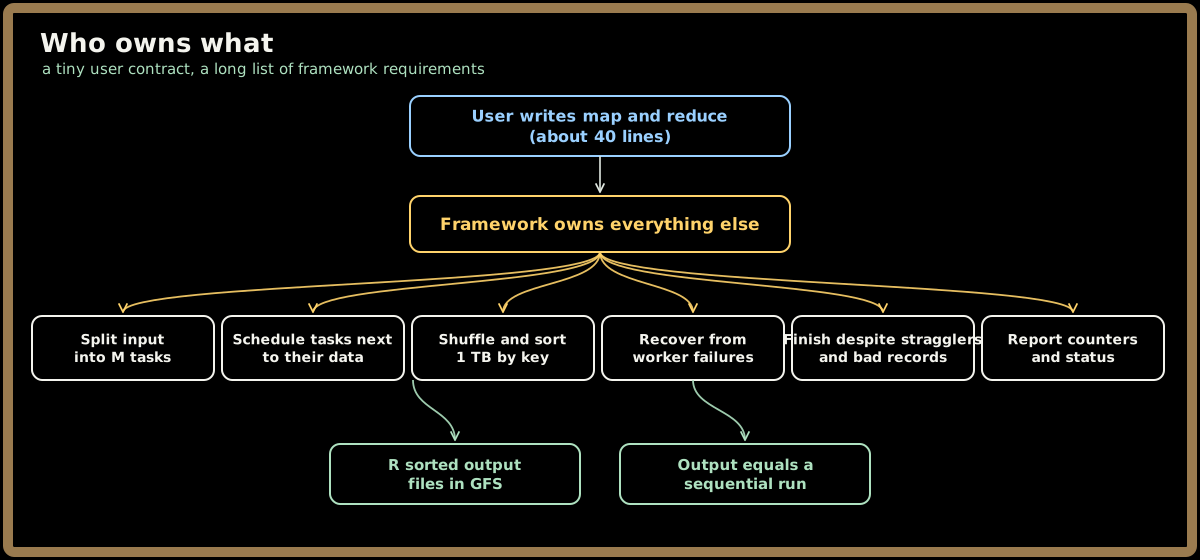
Key Insight: Every box under "Framework owns everything else" is something a one-off distributed program used to get wrong. The requirement isn't that these things can be done, but that the user never thinks about them.
Sign in to continue reading
The rest of this lesson is available with a free account. Signing in with Google or Microsoft is free.
Sign in to read the full lesson