Section 13: The Judges' Table - Final Summary & Candidate Scorecard
Executive Summary: This closing section turns the module into a way to grade yourself. It replays the arc as the signal each phase recorded, ledgers the eleven decisions with what would reverse each, and scores the interview on a 100-point card weighted toward architecture and deep dives, with readiness bands and the prompts that are this question in disguise.
The panel never graded the word "MapReduce." They listened for three things. Did "without knowing anything about distributed systems" become a restriction, two deterministic functions, that buys parallelism and fault tolerance? Did 32 GB/s of map demand against a 25 GB/s root, rather than the 10 TB input, force locality into the design? And when w-0417 died at minute 6, did you say "its ≈ 75 completed map tasks re-run, because their ≈ 500 MB of output sat on its dead disk," or just "we retry failed tasks"?
The Arc, Replayed as Signal
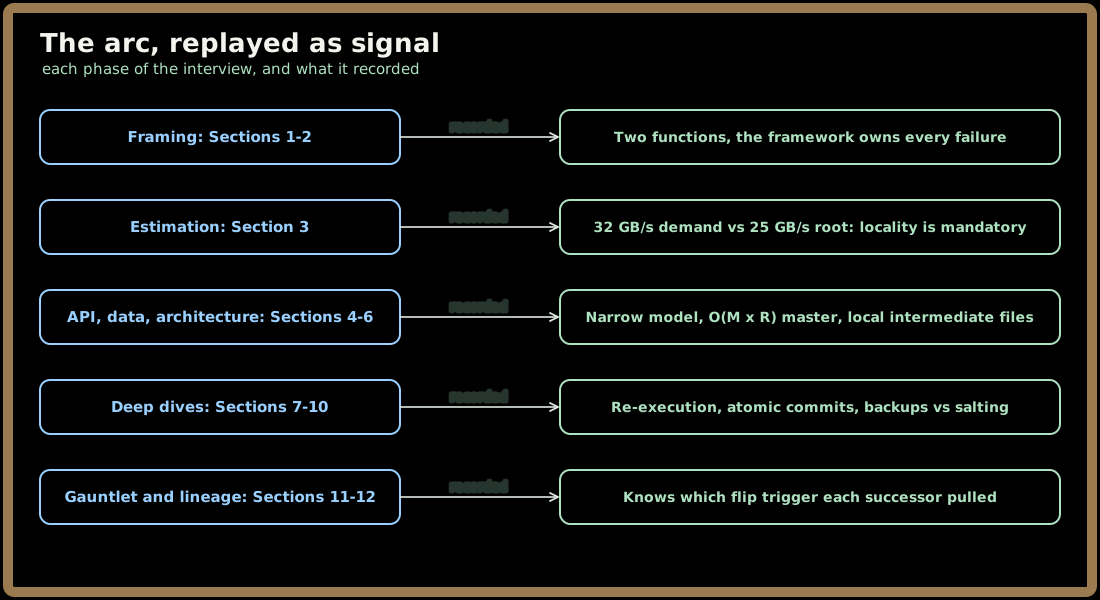
- Framing (Sections 1–2): batch jobs over data already in GFS, trusted code, record-at-a-time transforms plus group-by-key. The NFR is ≤ 15 min end-to-end, including one machine failure, against a nominal ≈ 8 min.
- Estimation (Section 3): 1 B pages × 10 KB = 10 TB → M ≈ 156,000 splits → 39 waves × 8 s ≈ 5.2 min of map → 1 TB intermediate → R = 4,000 partitions of 250 MB. The network binds, not CPU or disk.
- API, data and architecture (Sections 4–6):
reducetakes an iterator, not a list. The master holds one byte per (map, reduce) pair, ≈ 624 MB. Riya's record lands in/gfs/inlinks/part-01729. - Deep dives (Sections 7–10): split 88,213 runs replica-local on w-0417. The shuffle averages ≈ 13% of the root. A dead worker's map re-runs cost at most ≈ 25 s (15 s detection plus one 8-s task, if it dies as the map phase ends), a rack lost at minute 4 re-runs ≈ 1,800 completed maps in about half a wave, and the hot portal key needs salting, not a backup task.
- Gauntlet and lineage (Sections 11–12): atomic rename covers GFS output only, and thirty PageRank iterations break Decision 1.
Key Insight: Not one of those signals is "has read the 2004 paper." Each checks which constraint a mechanism pays for. Locality pays for a 10:1 network. Local intermediate files pay for not writing a terabyte three times. Determinism pays for re-execution being safe.
Quick check before moving on:
Sign in to continue reading
The rest of this lesson is available with a free account. Signing in with Google or Microsoft is free.
Sign in to read the full lesson