Section 7: The Machine Assembled - High-Level Architecture & Request Path
Executive Summary: Sections 5 and 6 built the two load-bearing ideas — the ring that locates data and the quorums that define "written." This section bolts them into a running machine: a ring-aware client SDK, any node as per-request coordinator, gossip-based membership, a storage engine per node, and the background repair services. Just as important are the boxes that aren't on the whiteboard — no cache tier, no queue, no central metadata service — each absence defended with a number. Then we walk one read and one write hop by hop against the latency budget and find where the p99 actually hides: not in the diagram, but in a garbage-collection pause on one straggler replica — which makes Section 6's quorum, quietly, your tail-latency defense too.
The interviewer gestures at the whiteboard: "You've given me a ring and a quorum. Draw me the system — and then take one request all the way through it." This is the assembly moment, and it's where the two failure archetypes diverge visibly. The Paper Reciter draws eight boxes — cache, queue, ZooKeeper — because the reference diagrams do. The Single-Node Thinker draws one beautiful storage engine and a cloud labeled "replication." You're going to draw five boxes, defend three absences, and then account for every millisecond of a 10ms read budget.
The Five Boxes — and the Boxes That Aren't There
- Client SDK (ring-aware): Tenants like Mira's checkout team link a library, not just an HTTP endpoint. The SDK holds a cached copy of the ring — all 16,384 tokens across 64 nodes — refreshed via gossip-fed updates, so it hashes
cart:8842and sends the request directly to a replica that owns it. Routing costs zero network hops. It also owns timeouts and the idempotent retry discipline from Section 4. - Coordinator — any node, per request: Whichever node receives the request coordinates it: fans out to the preference list, counts quorum acks, assembles the response. There is no coordinator tier — every node carries the role, so there's nothing special to fail over.
- Gossip membership: Every node, once per second, exchanges its view — who's alive, who holds which tokens, who's suspected — with one random peer. No master, no election, no external dependency.
- Per-node storage engine: The WAL, memtable, and SSTables of Section 8. The ring doesn't care what's inside the box — which is exactly why Section 8 can swap it.
- Background repair services: Hinted handoff delivery, read repair, and Merkle anti-entropy (Section 9) — the three healing layers from Section 6's story of n17 dying mid-write, running as low-priority residents on every node.
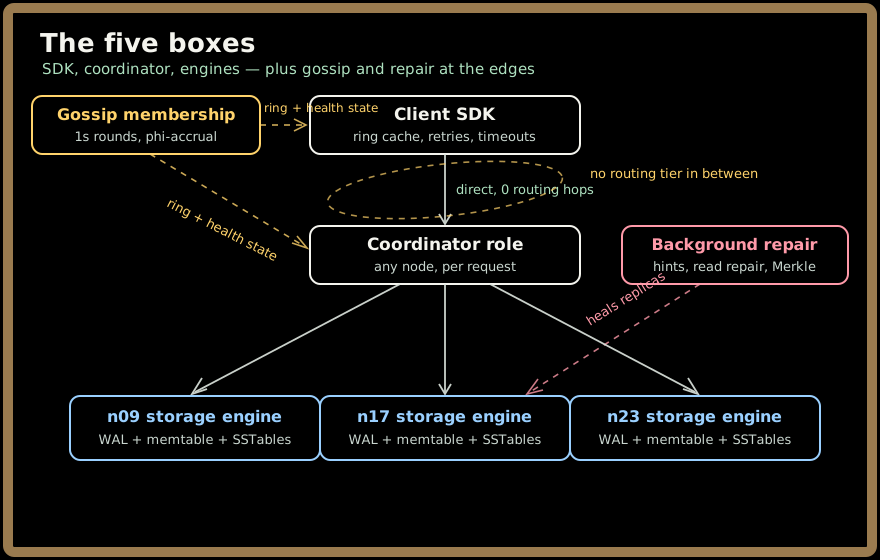
Now the absences — because at 401, what you leave out is scored as hard as what you draw (this is the same discipline the Like Counter module applies to its own missing cache):
| Absent box | Why it's tempting | Why it's absent | Flip trigger |
|---|---|---|---|
| Cache tier (Redis in front) | "Reads should be fast" | Reads hit p50 ~1ms — the store is the latency tier. A cache adds invalidation and breaks read-your-writes for everyone to serve the 0.001% of hot keys | A tenant whose entire workload is hot-read — they get a purpose-built read tier, not the platform |
| Queue in front of writes | "Absorb bursts, guarantee durability" | Durability is the WAL's job — 2 of 3 fsyncs before ack. A broker adds a hop to the 20ms p99 budget and weakens "written" to "enqueued" | Change streams in Section 12 — where a log finally earns a seat, behind the store |
| Central metadata service (ZooKeeper/etcd) | "Someone must own the ring" | Gossip converges 64 nodes in ~6s with zero ops-critical dependencies; a consensus service is a scaling ceiling and a new 2 a.m. pager for Mira (HBase chose it legitimately; our availability story leans decentralized) | Range partitioning's control plane in Section 12 — strongly consistent metadata earns its seat there |
Key Insight: Every box you draw is a thing that can fail, a thing Mira gets paged for, and a hop inside your latency budget. At 401, "I considered a cache tier and here is the number that says no" scores higher than any box you could add.
Quick check before moving on:
Sign in to continue reading
The rest of this lesson is available with a free account. Signing in with Google or Microsoft is free.
Sign in to read the full lesson