Section 13: The Derivation Test - Final Summary & Candidate Scorecard
Executive Summary: This closing section converts the module into an evaluation instrument. We replay the arc and name the signal each phase was recording, score the two failure archetypes — the Paper Reciter and the Single-Node Thinker — against the full 100-point rubric to show where each caps out, and explain the rubric's 401-shifted weights: mechanism depth counts for more here than in any app-design question. Score bands map to readiness levels, and a final catalog shows where this question hides inside real loops.
The interviewer spent the past hour running one test, twelve times. It was never "do you know what a Merkle tree is." It was: can you derive each mechanism from the failure it prevents? Consistent hashing exists because mod-N reshuffles ~98.5% of keys when the 65th node joins. Hinted handoff exists because n17 died mid-write to cart:8842 and the checkout team's W=2 ack still had to mean something. A candidate who can replay those derivations owns this question anywhere; one who can only recite the mechanisms owns a bibliography.
The Arc, Replayed as Signal
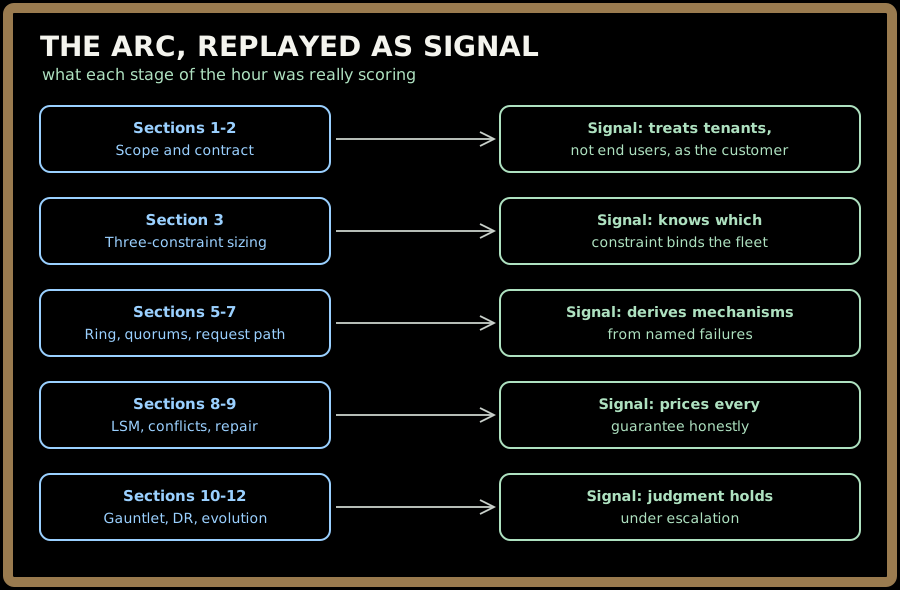
Read the right-hand column: not one signal is about reciting the Dynamo paper. Section 1's clarifying questions were scored on whether each answer killed a problem class. Section 3's 30/40/30-node derivation was scored on whether you noticed that throughput, not storage, binds the 64-node fleet. Sections 5 through 9 were scored on derivation order: failure first, mechanism second. And the Section 10 gauntlet was scored on whether your own earlier claims survived contact — the clock-skew challenge exists to catch candidates who oversold last-write-wins one section earlier.
Key Insight: At 401, the interviewer assumes you have read about this system — Dynamo is the most-cited paper in system design interviews. They are asking whether you could have written it: whether, handed the failures, you would arrive at the same mechanisms, and know when you would arrive at different ones.
Quick check before moving on:
Sign in to continue reading
The rest of this lesson is available with a free account. Signing in with Google or Microsoft is free.
Sign in to read the full lesson