Section 13: The Judges' Table - Final Summary & Candidate Scorecard
Executive Summary: This closing section turns the module into a way to grade yourself: the arc replayed as signal, a 100-point scorecard weighted toward the deep dives, score bands with remediation, and the prompts that are this question in disguise.
The panel never graded the box labeled "master." They listened for whether you reached for inodes, whether your arithmetic fitted ~80 GB of metadata into a 256 GB machine before you drew one, and whether, when cs-0412 died mid-chunk, you said "the master waits out the 60 s lease, grants cs-0153 version 2, and cs-0412 comes back stale" rather than "a replica takes over."
The Arc, Replayed as Signal
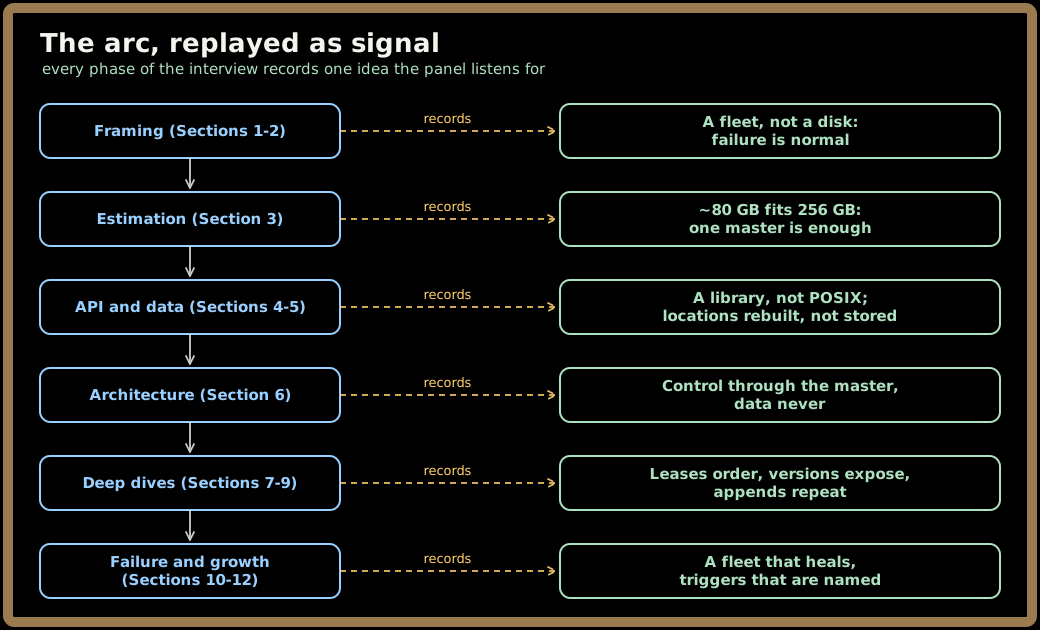
- Framing (Sections 1–2): internal batch clients we can change, so POSIX dies early; ~2 machine failures a day make failure normal; a throughput contract with non-goals stated.
- Estimation (Section 3): 500 million chunks, ~80 GB of metadata, ~12,000 RPC/s against ~100,000/s (more than 8× headroom), so one master suffices; the NIC at 42% of peak is the real bottleneck; the 8 TB small-file counterfactual limits the system to large files.
- API and data (Sections 4–5): a library with
recordAppendandsnapshot; locations and leases never persisted, because the chunkserver has the final word. - Architecture (Section 6): control through the master, data never; map tasks run beside their chunk's replica.
- Deep dives (Sections 7–9): op log on 3 machines and a ~20 s shadow failover; the version bump 1 → 2 that strands cs-0412; chain push at 1.1 ms against 2.4 ms for a star; crawler-217's record at 18 MB and 19 MB, deduped by (crawler-217, seq 90311).
- Failure and growth (Sections 10–12): three racks per chunk, a machine healed in ~30 min, priority repair cutting loss events from ~1.3 to ~0.04 a year; 3-day lazy GC; Colossus reached through named triggers.
Key Insight: None of those signals is "knows the GFS paper." The panel tests whether you know which mechanism keeps which promise: the op log keeps metadata durable, the lease keeps one mutation order, the version number keeps stale replicas out, checksums keep corruption out, and the record ID makes at-least-once safe.
Quick check before moving on:
Sign in to continue reading
The rest of this lesson is available with a free account. Signing in with Google or Microsoft is free.
Sign in to read the full lesson