Section 11: The Escalation Gauntlet - Interviewer Deep-Dive Challenges
Executive Summary: The interviewer spends the last stretch trying to break the design seven ways. Each answer follows one pattern: the number first, then the mechanism Sections 7 to 10 already built, then what it costs and when the design should flip. Two of the seven are won by saying that the request belongs to a different system.
The interviewer puts the pen down. "Fine, it heals itself. Now let me push on it."
Challenge 1: Ten Times the Files
"Next year it's 300 million files."
What they're really asking: do you know which limit you hit first, and what you'd do about it?
Metadata today is ~80 GB. Ten times the files at today's shape is ~800 GB, against a 256 GB master and a ~192 GB flip trigger. First, ask whether the files are getting smaller. If 30 PB arrives as 1 MB files, that's about 8 TB of master RAM (Section 3), and no single machine holds that.
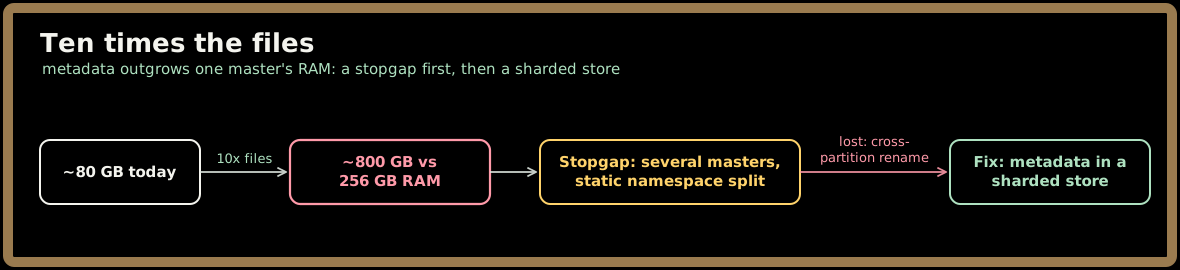
The stopgap is several masters, each owning a fixed subtree (/crawl, /logs, ...). That buys time and costs atomic rename across partitions. The real fix moves metadata into a sharded, replicated store, which is Section 12's subject.
The senior line: "The master's RAM is a budget I can forecast. I'd start the namespace split a year before the trigger, not on the day we hit it."
Sign in to continue reading
The rest of this lesson is available with a free account. Signing in with Google or Microsoft is free.
Sign in to read the full lesson