Section 13: The Judges' Table - Final Summary & Candidate Scorecard
Executive Summary: This closing section turns the module into a way to grade yourself. We replay the arc and name the signal each phase was recording, then lay out a 100-point scorecard weighted toward the data model and the deep dives, where a 401 calendar interview is won or lost. We map score bands to remediation, list the questions that are this one in disguise, and close by restating the four hard problems as the four signals the panel was listening for.
The interviewer wasn't grading boxes. They were grading whether you saw that an event is a rule, not a row, whether your numbers decided anything, and which parts you let be a few seconds wrong.
The Arc, Replayed as Signal
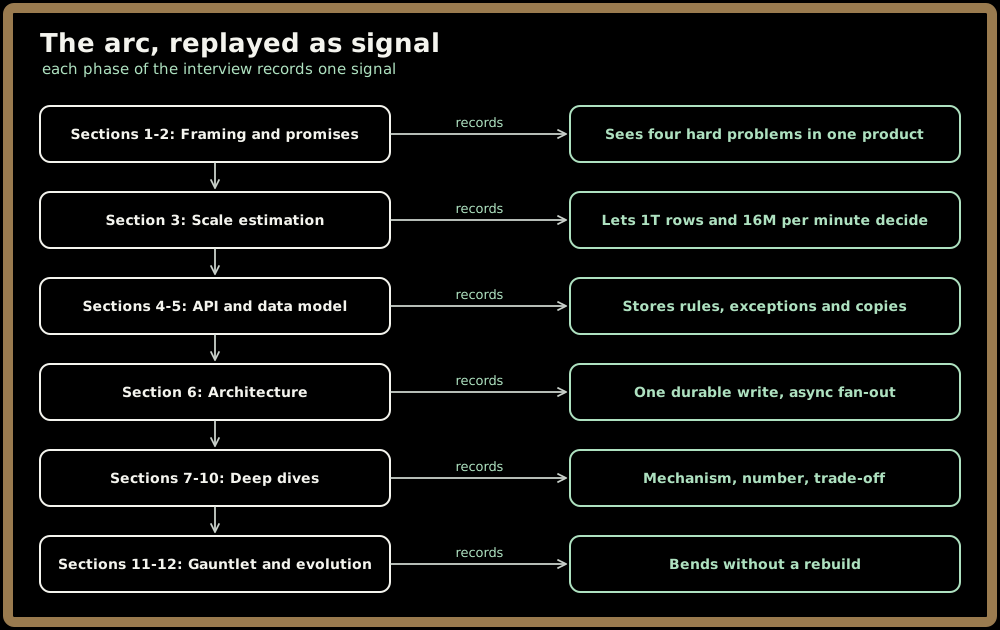
No signal is "knows Spanner." Section 3 earned credit not for ~35K mutations/s at peak but for the trillion instance rows that justify storing the rule and expanding on read. Section 9 earned credit the same way: 16M reminders due in one minute is a push-gateway problem at ~600K/s, not a database problem.
Key Insight: At 401 the panel assumes you know the parts and tests whether you know which promise each part keeps. Answer "Priya edits Platform Sync, what happens?" with "durable on her calendar in 300 ms, on Tomás's and Ana's within 5 s, the room answers within 2 s, the reminder horizon rewritten from the change stream," and you've shown the whole design in one reply.
Sign in to continue reading
The rest of this lesson is available with a free account. Signing in with Google or Microsoft is free.
Sign in to read the full lesson