Section 13: The Judges' Table - Final Summary & Candidate Scorecard
Executive Summary: This closing section turns the module into a way to grade yourself. We replay the twelve sections as the signal each one recorded, lay out a 100-point scorecard that puts 35 points on the deep dives, give calibration rules and score bands with remediation, recap the decisions that carry the design, and list the prompts that are this question in disguise.
The panel never graded the box labeled "lock service." They listened for whether you heard "distributed lock" and reached for SET key NX PX 30000, whether your arithmetic found that the load is 8,300 KeepAlives/s rather than locks, and whether, when master-b froze for 40 s, you said "generation 41 is rejected because the tablet server has seen 42" instead of "the lease expires, so it's fine."
The Arc, Replayed as Signal
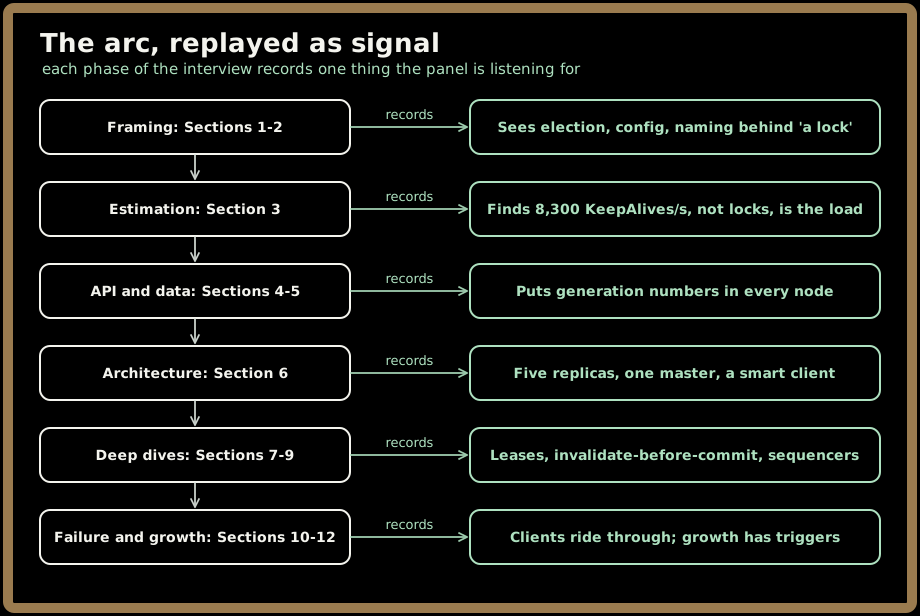
- Problem Understanding & Clarifications: election, config, naming and membership named as the real jobs; a service chosen over an embedded consensus library.
- Requirements (Functional & Non-Functional): "correct" defined as one exclusive holder in the service's state, with the honest limit that a paused holder can only be fenced.
- Scale Estimation & Workload Analysis: 8,300 KeepAlives/s; 1,000 reads/s after the 99% cache; ≈10,000 RPC/s is 20% of the ceiling; ≈1.3 GB fits in RAM.
- API Design (with pushback): a namespace with handles, sessions, advisory locks, events and sequencers, each defended.
- Data Modeling: generations on every node; replicated state separated from master-memory state.
- High-Level Architecture: five replicas, all traffic to the master, a client library that caches and survives failover.
- Deep Dive: Consensus, the Replicated Log & Master Leases: commit on 3 of 5 in 2–3 ms; reads checked against the 10 s lease after reading.
- Deep Dive: Sessions, KeepAlives & Consistent Caching: 12 s long-poll, 45 s grace, invalidate-before-commit across 24,000 cachers in ~1–2 s.
- Deep Dive: Fencing, Sequencers & Lock-Delay: the 40 s GC pause ends with generation 41 rejected.
- Master Failover & Disaster Recovery: ~12 s failover, fresh 60 s leases, one resume per client that validates its cache instead of flushing it, jittered over 10 s, with writes held until sessions have resumed.
- Interviewer Deep-Dive Challenges: Redlock refused for correctness; 50,000 acquires/s refused with an alternative.
- Follow-up Feature Evolution: proxies at 150,000 sessions, partitioning at ~5,000 writes/s, each with its trigger.
Key Insight: None of those signals is "knows Paxos." The panel tests whether you know which mechanism keeps which promise: the master lease keeps reads linearizable, invalidation keeps caches honest, the sequencer keeps the resource safe, and the grace period makes failover invisible.
Quick check before moving on:
Sign in to continue reading
The rest of this lesson is available with a free account. Signing in with Google or Microsoft is free.
Sign in to read the full lesson