Section 11: The Escalation Gauntlet - Interviewer Deep-Dive Challenges
Executive Summary: The design survived its deep dives; now the interviewer tries to break it. Seven challenges follow, each pushing on an earlier decision. Every answer follows one pattern: name what is being tested, put a ledger number on it, give the mechanism and the rejected alternative, and finish with the senior line. The numbers remain this interview's assumptions: orders peaks at 50,000 msg/s across 64 partitions on 30 brokers in three zones.
Interviewer: "Good. Now I'm going to try to break it."
You: "Please do. I'll name the decision each one stresses and what would flip it."
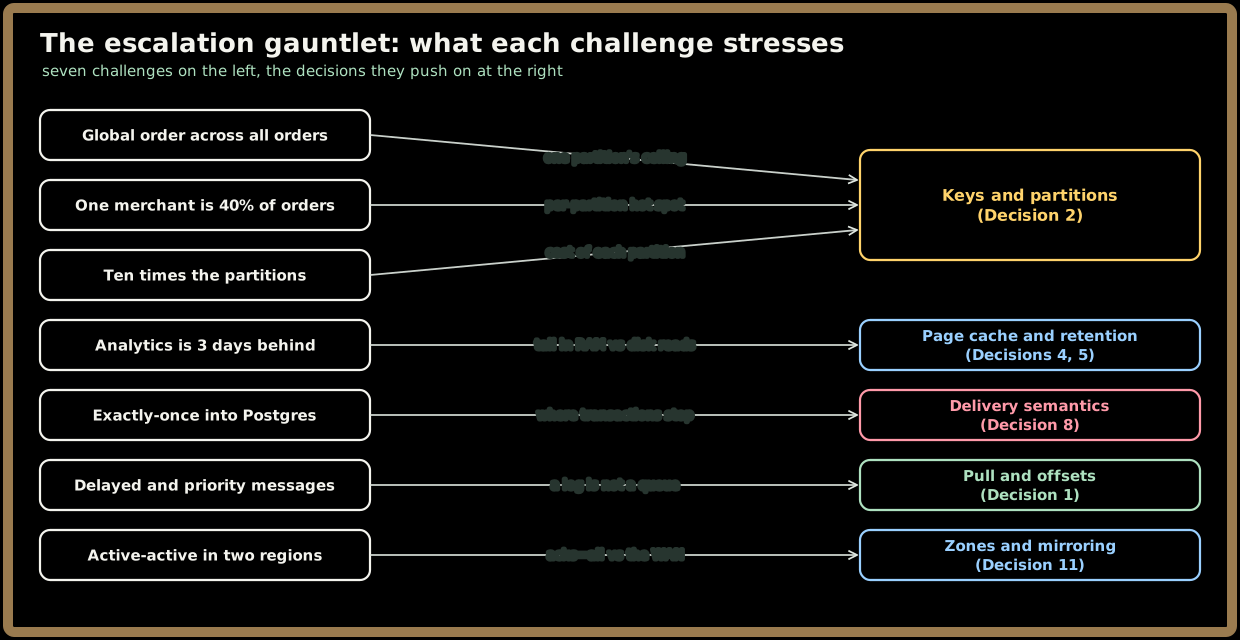
Challenge 1: "I need a global order across all orders"
What they're testing: that order and parallelism both come from the partition.
Total order requires a single log. One partition puts the 50 MB/s peak on one leader, at the tens-of-MB/s ceiling a partition can sustain, and cuts every group to one active member: fulfillment's 16 consumers become 1, fraud's 32 too. So I ask what invariant they need. "Placed comes before shipped for order-58213" is a per-key guarantee, and Decision 2 already provides it. If a job truly needs one timeline, I'd sequence at the consumer, merging the 64 partitions by event timestamp behind a watermark for a bounded delay. A sequencer stamping every event before produce just moves the bottleneck.
The senior line: "Global order is usually per-entity order in disguise. I'll pay for a total order only on the stream that needs one, ceiling stated."
Sign in to continue reading
The rest of this lesson is available with a free account. Signing in with Google or Microsoft is free.
Sign in to read the full lesson