Section 13: The Judges' Table - Final Summary & Candidate Scorecard
Executive Summary: This closing section turns the module into a way to grade yourself. It replays the interview arc as the signal each phase recorded, scores it on a 100-point card weighted toward architecture and deep dives, and maps totals to readiness bands with remediation. It sets the candidate who recites the 2007 paper against the one who derives it, and lists the prompts that are this question in disguise.
The panel never graded the word "Dynamo." What they listened for was this. Did "add to cart must never fail" turn into a consistency model you reconcile rather than enforce? Did 75,600 replica ops/s, not 1.5 TB, size the fleet? And when DC1 dropped off the network, did you say "the phone's write lands as D3 [B:2, F:1], the laptop's as D3′ [B:3], and the next read returns both," rather than "it's eventually consistent"?
The Arc, Replayed as Signal
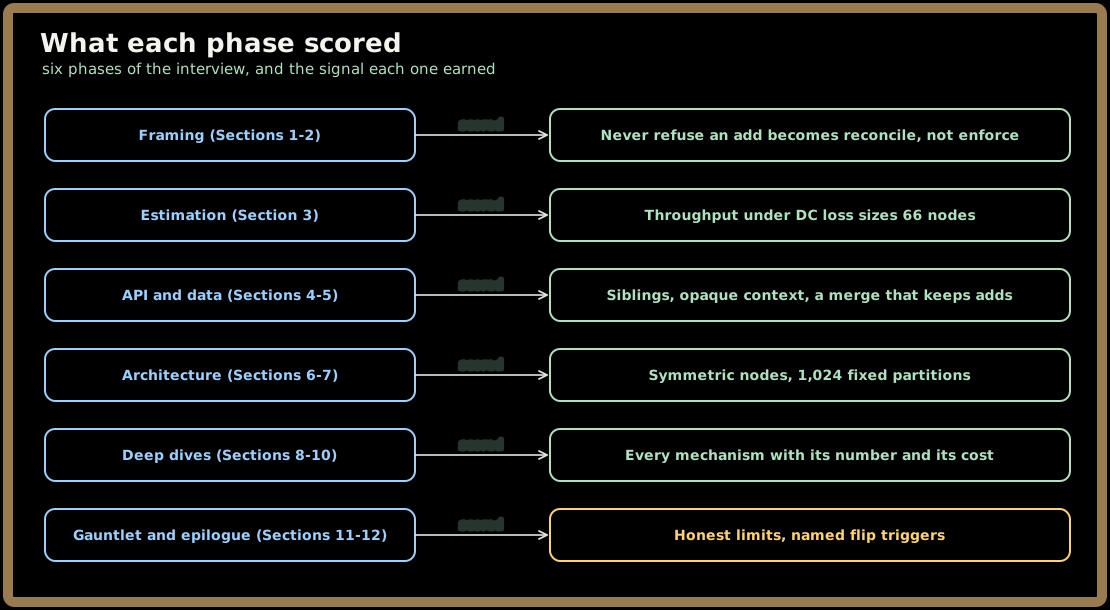
- Framing (Sections 1–2): primary-key only, single-key ops, trusted nodes, so joins, transactions and Byzantine tolerance die early. The SLA is p99.9 ≤ 300 ms at peak, and write availability ≥ 99.99%.
- Estimation (Section 3): 30 M shoppers → 25,000 requests/s at peak → 75,600 replica ops/s → 66 nodes, sized to lose a DC at 86% utilization. Storage never binds.
- API and data (Sections 4–5):
getreturns a list plus an opaque context. The cart is an observed-remove set, so Dana's merge keeps the gift card and leaves the headphones removed. - Architecture (Sections 6–7): no master. Partition 517 sits on B, F and K, one per DC. Strategy 3 lets a 67th node bootstrap about 45 partitions in under an hour.
- Deep dives (Sections 8–10): D4 [B:4, F:1] supersedes both siblings. F's 30-minute outage leaves 344,000 hints, handed back in about 86 s. Buffered writes and client-driven routing pull in the tail.
- Gauntlet and epilogue (Sections 11–12): R + W > N is not strong consistency under sloppy quorum, and a timed-out put is "unknown," not "failed."
Key Insight: Not one of those signals is "has read the paper." Each one checks that you know which requirement a mechanism pays for. Hinted handoff pays for never refusing a write. Vector clocks pay for not dropping a concurrent add. One replica per DC pays for losing a data center while R and W are still met by home replicas.
Quick check before moving on:
Sign in to continue reading
The rest of this lesson is available with a free account. Signing in with Google or Microsoft is free.
Sign in to read the full lesson