Section 11: The Escalation Gauntlet - Interviewer Deep-Dive Challenges
Executive Summary: The interviewer stops asking how the design works and starts trying to break it. There are seven attacks. Each answer names what is really being tested, answers with a number or a mechanism Sections 7 to 10 already built, then states the cost and the flip trigger. Several are won by refusing a premise: this store never offered strong consistency, and a timeout doesn't mean the write failed.
The interviewer leans back. "Okay, it survives. Step out of 2006 for the rest of this: I'll use what came later, and so can you. Now let me push on it."
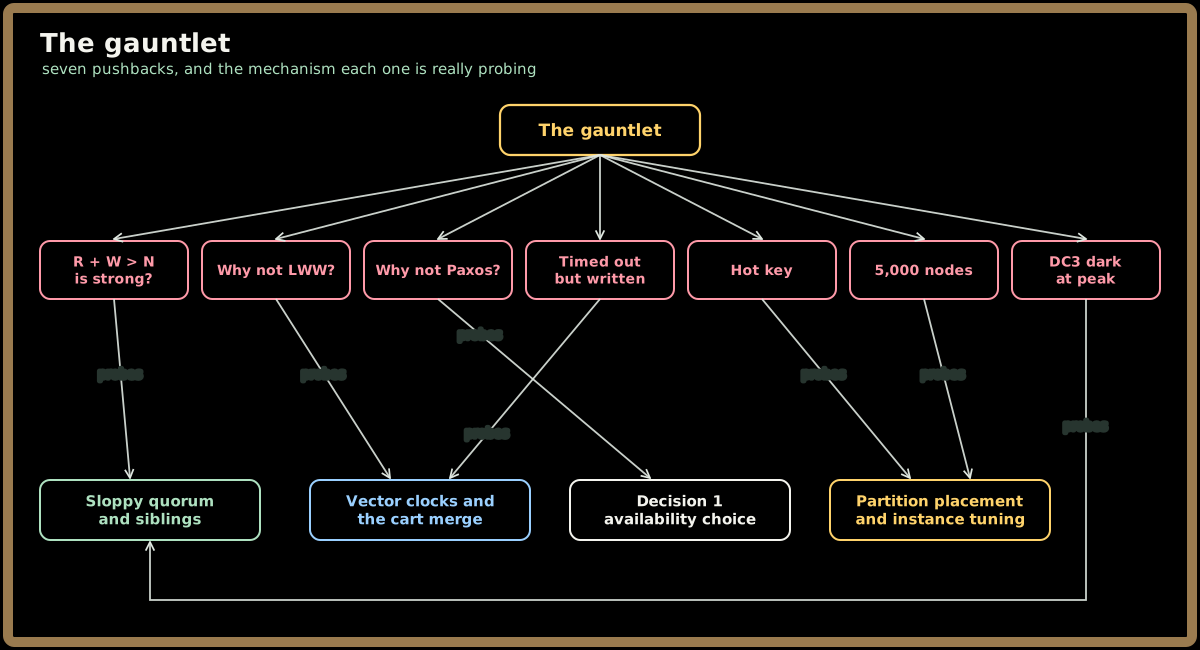
Challenge 1: "R + W > N, So Reads Are Consistent"
"You run (3, 2, 2). Two plus two is more than three, so every read sees the latest write. Right?"
What they're really asking: do you know the textbook guarantee, and do you know when Dynamo gives it up?
You: "That overlap only holds when the R readers and W writers come from the same three home nodes. A sloppy quorum breaks that on purpose. Look at Dana's partition. With DC1 cut off, the phone's removal was acked by F and K. The laptop's gift card was acked by B and stand-in C. A phone read in that minute is answered by F and K, so R = 2 is met, and it can't see the gift card: the read set {F, K} and the write set {B, C} don't overlap. Even without failures, two concurrent writers both succeed as siblings. So the store promises eventual consistency plus conflict detection, never linearizability."
The senior line: "R + W > N tells you how likely a read is to be fresh. It isn't a guarantee. What Dynamo does guarantee is that conflicts get detected, not prevented."
Sign in to continue reading
The rest of this lesson is available with a free account. Signing in with Google or Microsoft is free.
Sign in to read the full lesson