Section 13: Three Ads, Eighty Milliseconds - Final Summary & Candidate Scorecard
Executive Summary: This closing section turns the module into a way to grade yourself: the arc replayed as signal, a 100-point scorecard weighted toward the deep dives, score bands with remediation, the decisions that carry the design, and the prompts that are this question in disguise.
The panel never graded the model architecture. They listened for whether you treated Maya's feed load as a money-bearing request with a stopwatch on it, whether your arithmetic produced the cascade before you drew it, and whether you enforced Trailhead's budget with "a 10 s spend loop and a ~0.7 participation probability on every host" rather than "we decrement a counter."
The Arc, Replayed as Signal
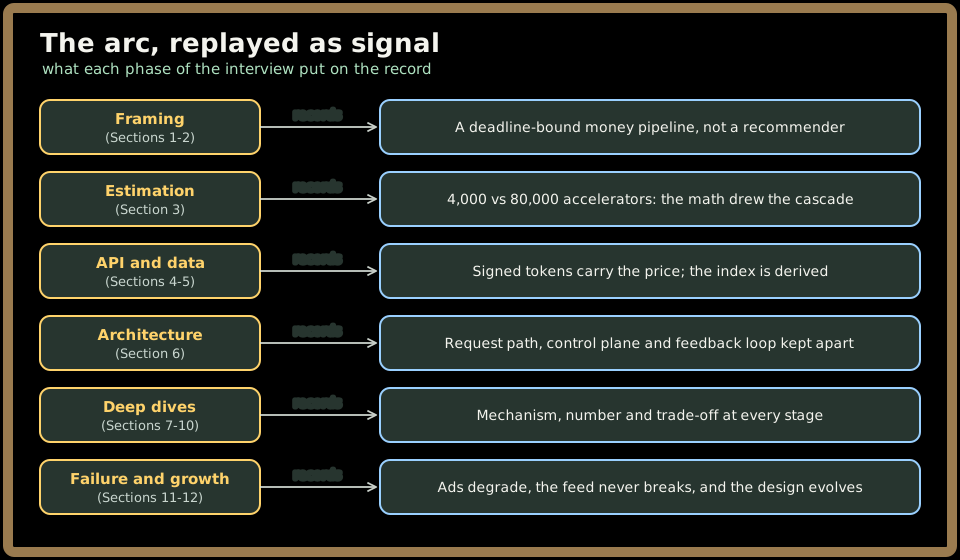
- Framing (Sections 1–2): an internal caller, 3 slots, 80 ms p99, ~1.2M QPS at peak; fail-open as a requirement, because a minute without ads costs ~$260K but a broken feed costs more.
- Estimation (Section 3): 50M ads → ~400K matches → 10,000 → 500 → 3; ~4,000 accelerators for the cascade against ~80,000 for heavy-ranking everything; 80 ms split into stage deadlines with 12 ms of slack.
- API and data (Sections 4–5):
SelectAdscarries an absolute deadline and returns no prices; the signed token carries Trailhead's $1.01; the campaign database is truth, the index a derived copy. - Architecture (Section 6): three planes; Maya's request at 38 ms p50; nothing ranked is cached.
- Deep dives (Sections 7–10): the six-rung ladder from
NONEthroughPARTIAL_SHARDS,REDUCED_CANDIDATES,LIGHT_SCORESandHOUSE_ADStoEMPTY, and 5%-capped hedges; 16 shards of ~12.5 GB returning 625 each; a ≤ 2 ms per-host batch window of ~4 requests, ~250 rows per device, and calibration at 1.00 ± 0.02; $25.20 against $21.00, so $1.01; pacing at $3,600 against $3,000. - Failure and growth (Sections 11–12): six regions at 240K QPS capacity against a 200K share, with a lost region's users moving feed and ads together; events acked only after the replicated append; a stale pacing loop decays toward conservative; a small-budget overspend traced to the burst rate plus clicks still to come; broad targeting flips exact scoring to filtered ANN.
Key Insight: None of those signals is "knows ad tech." Each asks whether you know which mechanism keeps which promise: the cascade bounds cost, the deadline keeps the feed fast, the ladder keeps it working, calibration keeps the auction honest, async pacing keeps budgets off the hot path, and the signed, deduplicated token keeps billing exact.
Quick check before moving on:
Sign in to continue reading
The rest of this lesson is available with a free account. Signing in with Google or Microsoft is free.
Sign in to read the full lesson