Section 2: Stale Is Fine, Harmful Is Not - Requirements (Functional & Non-Functional)
Executive Summary: This section turns Section 1's assumptions into a contract: seven functional requirements, four explicit exclusions, and a non-functional half that puts a number on latency, availability, scale, freshness, takedowns and privacy. One asymmetry ties them together: a stale suggestion is acceptable, an offensive or private one is not.
The interviewer nods at the whiteboard. "Fine. What are we actually promising?" "Suggestions should feel instant" is a wish. "Ninety-nine percent of suggestion requests render within 100 ms of being sent" is a promise. And here the most important promises aren't about speed. They're about what the platform is willing to say.
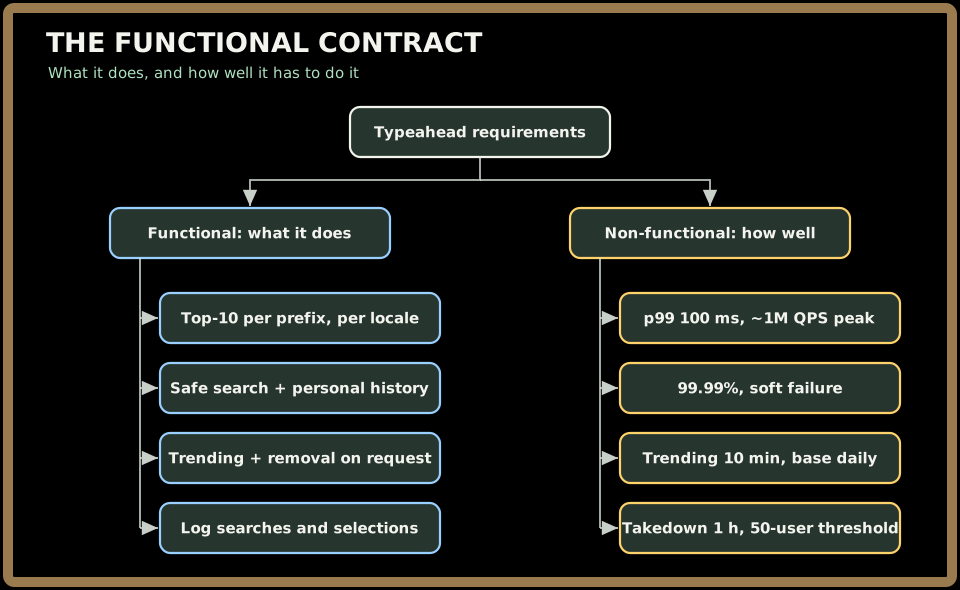
The Functional Contract
Seven requirements, each traceable to a part of the design:
- Top-10 completions per prefix. Return up to ten full queries that start with what's typed, ranked by likelihood. For Maya's
chicago mara: "chicago marathon 2026", "chicago marathon route", and so on. Prefix match on the start of the query only; mid-string matching is a Section 10 challenge. - Per-locale results. Every request carries one locale (
en-US). Suggestions come from that locale's queries, so a Chicago user and a Lyon user typingchsee different lists. - Safe-search aware. If safe search is on, explicit completions are excluded. This becomes part of the cache key in Section 4, not a per-user lookup.
- Recent personal history for signed-in users. Maya searched "chicago marathon bib pickup" yesterday, so it should appear first, marked as history. Users can delete one entry or clear it all.
- Trending queries. "chicago marathon results" isn't in yesterday's base index. It spiked this morning and must be suggestable while it still matters.
- Removal on request. A suggestion that breaks policy or a court order must disappear everywhere, quickly, without waiting for a rebuild.
- Logging to learn from. Every submitted search and every selected suggestion is logged. That log is the only input to tomorrow's index.
The interviewer pokes at the last one: "Why not log every keystroke too? More data." Because keystroke prefixes aren't queries: count them and chicago mar becomes a "popular query" in its own right. We rank on submitted searches and suggestion selections, never raw keystrokes (D8). Once there's enough selection data, ranking flips to a learned model (Section 12).
Quick check before moving on:
Sign in to continue reading
The rest of this lesson is available with a free account. Signing in with Google or Microsoft is free.
Sign in to read the full lesson