Section 12: New Candidates, Same Merge - Follow-up Feature Evolution
Executive Summary: The interviewer stops attacking and starts asking for more: typo tolerance, rich entity suggestions, suggestions before the user types, learned ranking, real personalization, a bigger index, and the same system for a store or a people directory. Most of these land as a new candidate generator feeding Section 9's query-time merge, or as a new value of the type field Section 4 already put in the response. The rest are flip triggers named in advance (D2, D3, D5, D8) finally firing, while the trie, the snapshot swap and the no-identity cache key stay put.
The interviewer leans back. "It's live. A billion people use it. Product now wants typo tolerance, a card when you type an event name, suggestions the moment the box gets focus, and a ranking team that wants to use machine learning. Evolve it."
Two ways to fail: discovering the trie was the whole system and must be torn down, or claiming you'd quietly built all of this already. The interviewer wants each feature arriving through a door the design left open.
Key Insight: The serving node already does one general thing: collect candidates from several sources, dedupe, filter through the blocklist, score, take ten. Section 9 built it for two sources. Any feature that is just another source of candidates inherits the dedupe, the blocklist and the cacheability.
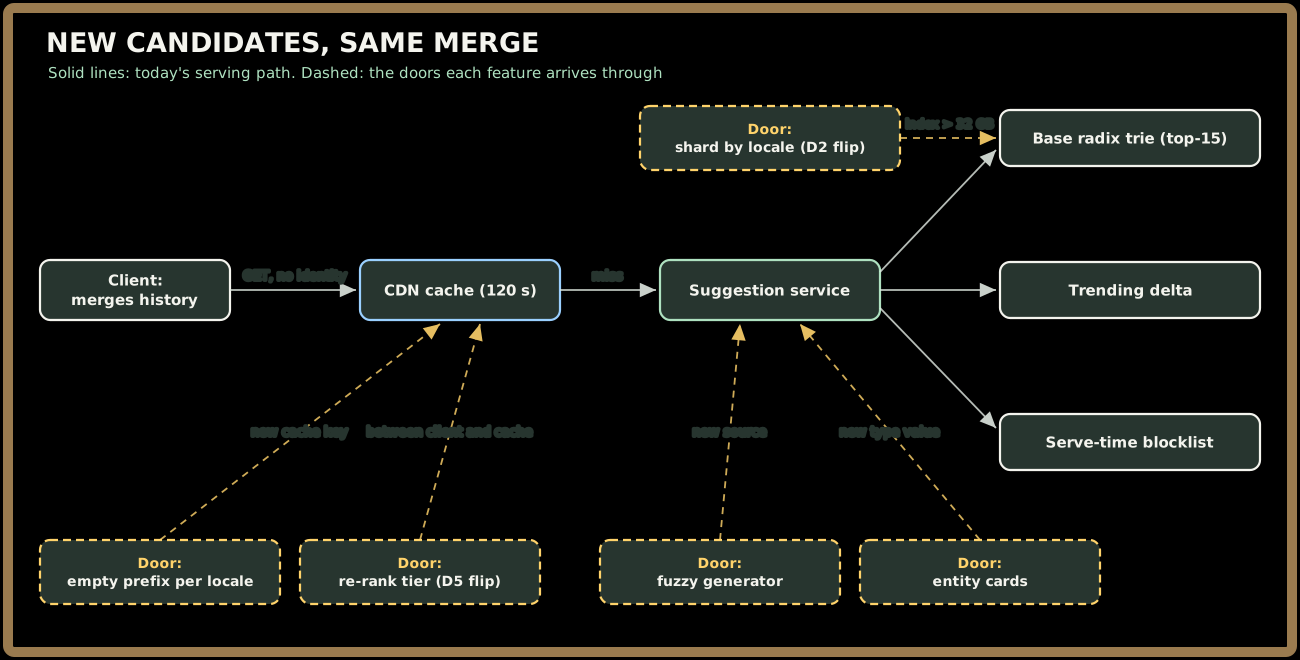
Fuzzy Matching: A Third Generator
You: "Maya fat-fingers chicgo mara. The trie walk dies at chicg: no such path. I'd add a fuzzy generator that runs only when the exact walk finds fewer than ten completions, and tries edit-distance-1 variants of the prefix against the same trie."
Interviewer: "Edit distance on every keystroke? That's a lot of walks."
You: "It is. An 11-character prefix like chicgo mara has about 600 distance-1 variants (Section 10), so the generator gets a hard budget inside the origin's 10 ms p99 (N14). It stops after a fixed number of node visits. Corrected candidates come back with type: "correction" so the client can label them. If the budget can't hold, a separate spelling service merges in the same way."
What stays: the trie, the snapshot and the cache key, because a corrected response still depends on the prefix alone.
Sign in to continue reading
The rest of this lesson is available with a free account. Signing in with Google or Microsoft is free.
Sign in to read the full lesson