Section 11: Doors Left Unlocked - Follow-up Feature Evolution
Executive Summary: With the design defended, the interviewer reads out the product backlog: private tags, synonyms, smart suggestions, subscriptions and automation, tag filters in work-item queries, and trending tags. Each request gets the same three beats: what it adds to the tables, the API and the events; what stays exactly as it is; and which leak channel it opens and how the existing rules close it. Almost everything lands as either one new column or table, or one new consumer of tag-events. Two requests reach flip triggers we named earlier, and we walk through them on purpose. The assignment table, the single-shard transaction and the rule "the index narrows, the owner decides" all come through unchanged.
The interviewer relaxes and reads from a list.
Interviewer: "Customers love it. Here's what product wants next. For each one, tell me what changes and what doesn't."
The trap has two sides: a design that must be torn down, or one that quietly built all of this already. The strong answer walks each feature through a door that Sections 5 and 6 left unlocked. There is one extra test that's specific to this system: every new feature is a new leak channel. If a feature shows a name, a count or a notification, it has to pass through the same funnel as the tag page.
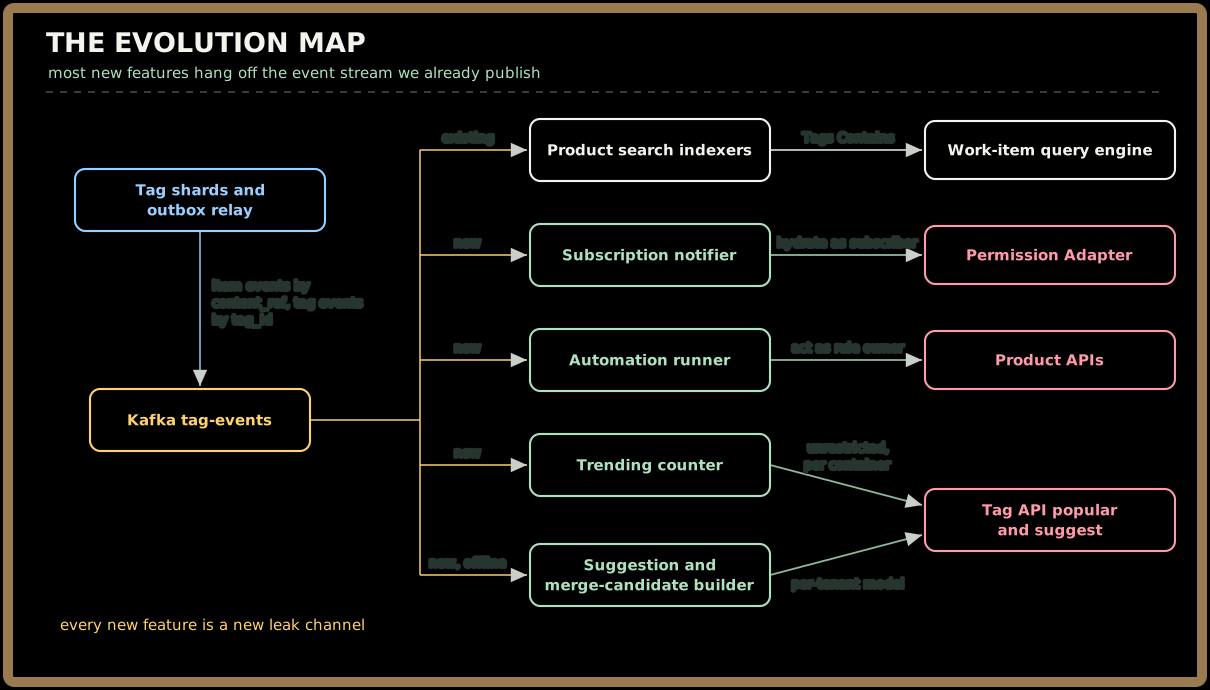
The Evolution Map
Start by drawing where the requests attach. Most of them hang off the event stream we already publish.
Sign in to continue reading
The rest of this lesson is available with a free account. Signing in with Google or Microsoft is free.
Sign in to read the full lesson