Section 12: The Pointer Was the Point - Final Summary & Candidate Scorecard
Executive Summary: This section turns the module into a grading tool. It replays the hour as the signals the interviewer was recording, then lays out a 100-point scorecard across five dimensions, each described by what a top answer and a point-losing answer sound like for this problem. Score bands map a total to a readiness level with a specific fix, and a final catalog shows where the question hides in real loops.
The boxes you drew for Night Heist were worth about a quarter of the points. The interviewer was grading something else. Did you ask what happens when an algorithm re-runs, before anyone told you? Did you find the 800× gap between bulk and steady writes, and let it put Kafka in front of the store? You can't reliably earn points you can't name, so this section names them.
The Arc, Replayed as Signal
The module moved in five phases. Each one was recording a different signal.
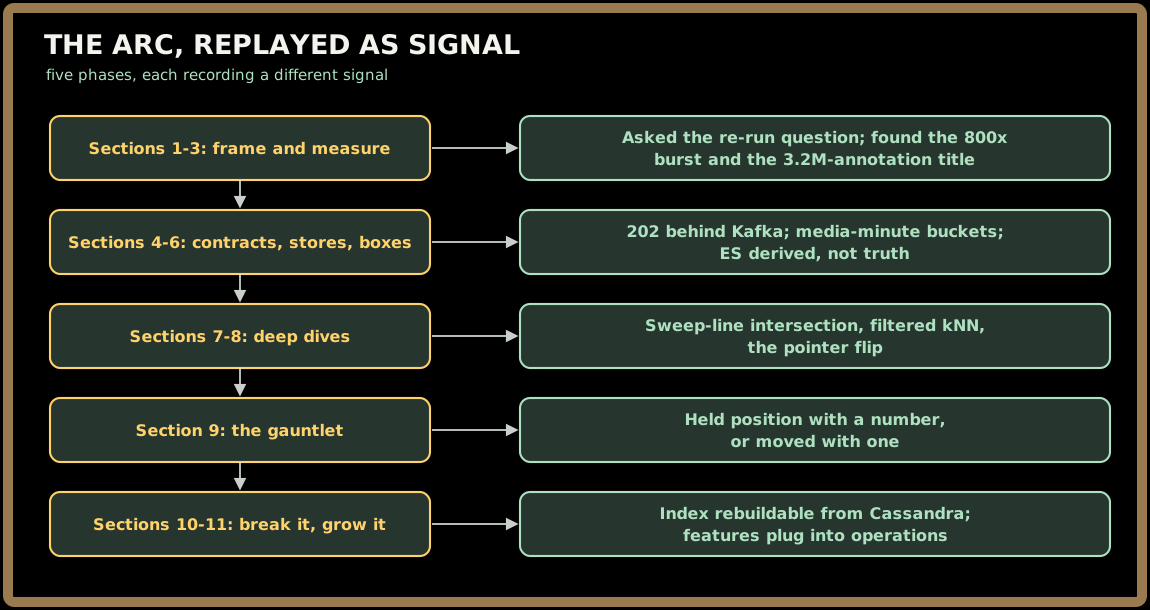
Four facts from Section 3 picked the architecture. A catalog-wide run of 30M annotations at a provisioned 50,000/s, against 62/s steady, put a buffer and a separate fleet in front of the store. A 3.2M-annotation title, whose subtitles alone would make a 3.3 GB partition, put a media-minute bucket in the key (5.5 MB each). 10B annotations queried many ways put Elasticsearch beside Cassandra as a derived index. And a re-run that replaces a title's results made visibility a property of an operation, not a row.
Key Insight: None of these signals is "knew Cassandra" or "knew HNSW." Each is about letting a number or a stated rule pick the mechanism. The re-run answer from Section 1, "never a mix of two runs," decides the most: the pointer row, the LWT, the pointer cache and the post-filter all come from it.
Quick check before moving on:
Sign in to continue reading
The rest of this lesson is available with a free account. Signing in with Google or Microsoft is free.
Sign in to read the full lesson