Section 13: Grading the Mailman - Final Summary & Candidate Scorecard
Executive Summary: This section turns the module into a grading tool. It replays the hour as the signals the interviewer was recording, then lays out a 100-point scorecard across five dimensions, each described by what a top answer and a point-losing answer sound like for this problem. Score bands map a total to a readiness level. A final catalog shows where the question hides in real loops, including the user-facing notification center that Section 2 put out of scope, and how it differs.
The boxes you drew for order #84721 were worth about a quarter of the points. The interviewer was grading something else the whole hour. Did you find that the number deciding the design was 90,000, not 150,000? When the partner webhook died for 40 minutes, did its messages arrive late or land in a DLQ? When told "just use Kafka," did you hold your ground with a reason? You can't reliably earn points you can't name, so this section names them.
The Arc, Replayed as Signal
The module moved in five phases. Here's what each one recorded.
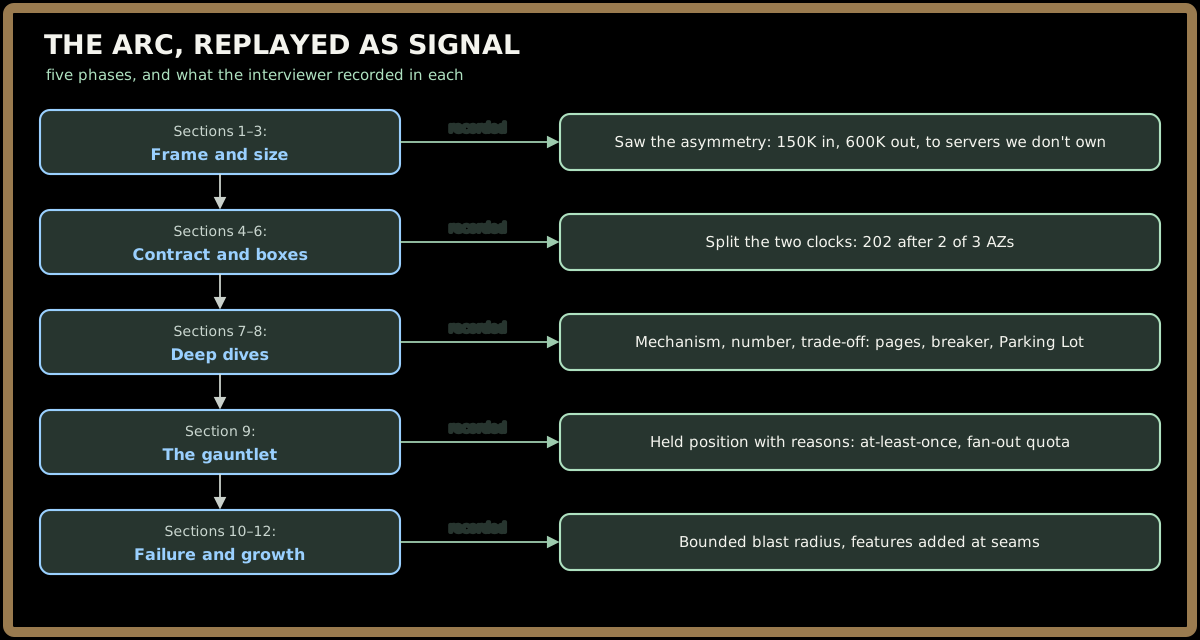
Key Insight: None of these signals is "knew Kafka" or "knew circuit breakers." Each is about letting a measured number pick the mechanism. Little's law turned one slow webhook into 90,000 requests in flight, which is why endpoints get their own cap and breaker. The 8-million-device broadcast is why subscriptions live in pages of 1,000 and payloads travel by reference.
Quick check before moving on:
Sign in to continue reading
The rest of this lesson is available with a free account. Signing in with Google or Microsoft is free.
Sign in to read the full lesson