Section 12: Late, Never Lost - Final Summary & Candidate Scorecard
Executive Summary: This closing section turns the module into a way to grade yourself. We replay the interview arc and name the signal each phase was recording, then lay out a 100-point scorecard across five dimensions. The weights favour correctness under failure over component count, because that is where this question separates Staff from Senior. Score bands map to readiness levels with a concrete next step for each, and a final catalogue shows where this question hides in real interview loops under other names.
The component diagram from Section 6 took about ten minutes to draw. Most of the hour went elsewhere: arguing about what "every run has to happen" means, finding the one second of the day that dominates the design, and walking through a GC-paused node, a zombie worker and a 2 AM that doesn't exist. A job scheduler is easy to draw and hard to make correct, and the interviewer was scoring the hard parts. This section names what they were writing down.
The Arc, Replayed as Signal
Every phase had a visible job (produce requirements, an API) and a hidden one (show a habit of mind). Read the right-hand column as the interviewer's notebook.
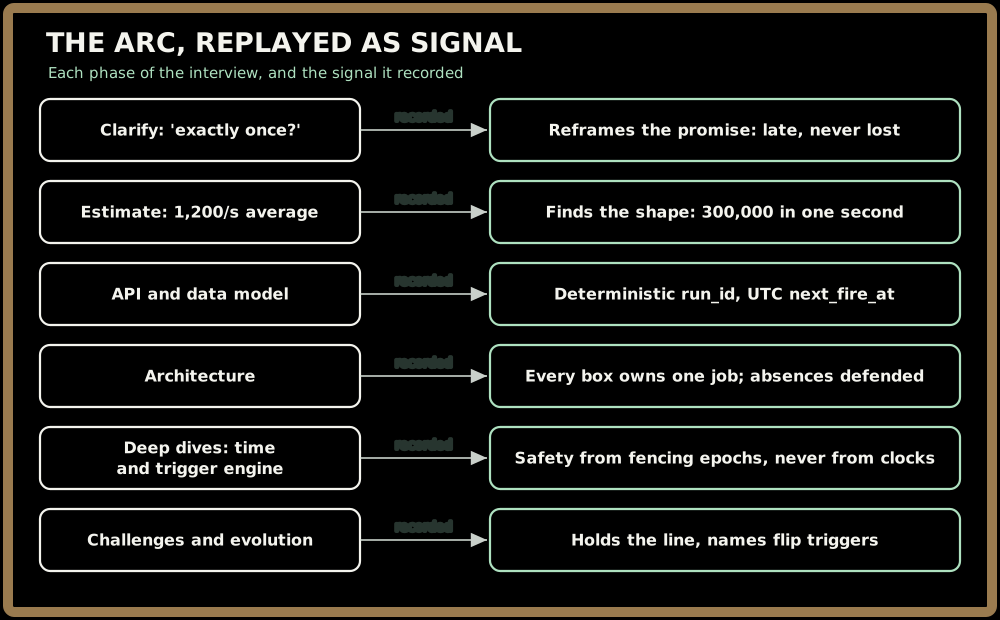
Key Insight: Not one signal is "knows etcd" or "has heard of Spanner." Every signal is about being honest about failure: refusing to promise exactly-once, designing for the worst second instead of the average, and making a stale owner harmless instead of hoping it never appears. Those habits carry over to any system that coordinates work across machines.
Quick check before moving on:
Sign in to continue reading
The rest of this lesson is available with a free account. Signing in with Google or Microsoft is free.
Sign in to read the full lesson