Section 13: The Address That No Longer Exists - Final Summary & Candidate Scorecard
Executive Summary: This closing section turns the module into a way to grade yourself. We replay the interview arc and name the signal each phase was recording, then lay out the 100-point scorecard: five dimensions, weighted so judgment counts for more than machinery. For each one you get what a top score sounds like and where candidates lose points, tied to this module's numbers and decisions. Score bands say what to practise next, a short list shows where this question hides in real loops, and we close Lena's story on day 23.
Think back to the moment Lena clicked "Delete my account". The button looked like the whole feature. It was really the front of a promise: 1,200 services would each do their part, inside one month, and the company could prove it afterwards without remembering her. The interview works the same way. The architecture diagram feels like the deliverable, but the interviewer spent the hour scoring something else: whether you saw a coordination-and-proof problem behind a storage-shaped prompt, whether your arithmetic changed your choices, and whether you held steady when the escalations started. You can't reliably earn points you can't name, so this section names them.
The Arc, Replayed as Signal
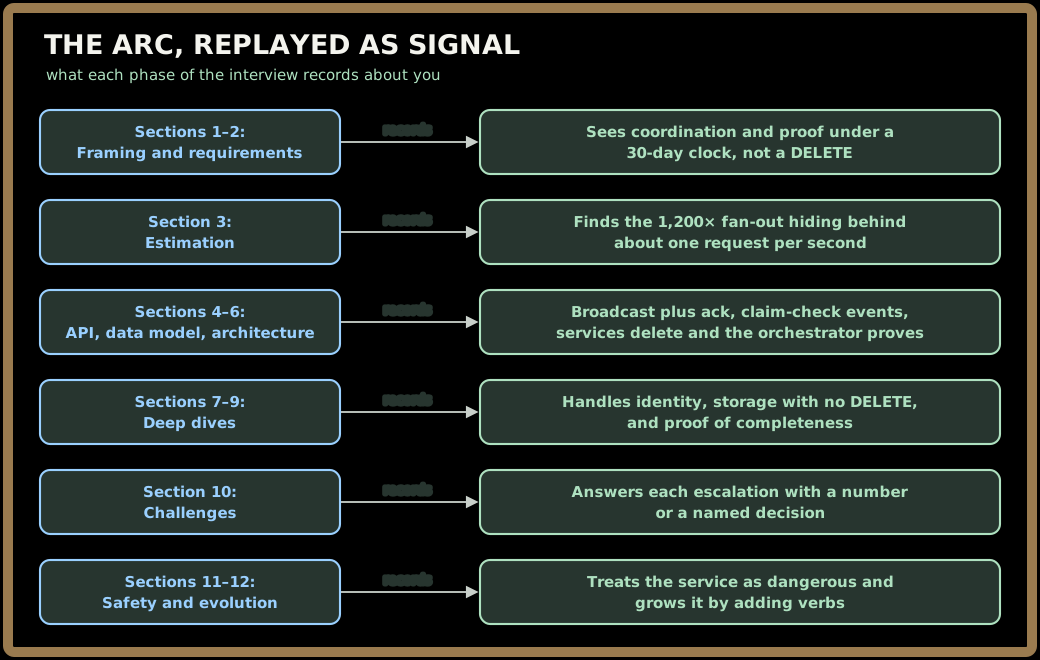
Walk down the phases and the pattern shows. Sections 1 and 2 check whether you turn "delete everything" into a contract: erasure and access in scope, global with jurisdiction as a field, backups and logs included, and completeness under a deadline as the main NFR. Section 3 checks whether you spot that intake is tiny while the work is not. About 0.95 requests per second becomes ≈634 tasks per second and ≈1,900 ledger writes per second, and exports alone need 5 Gbps of egress. Sections 4 through 6 check the contract and the split of duties: a durable broadcast log with authenticated acks instead of a DELETE webhook, events that carry only a subject_ref, and an orchestrator that holds no data-store credentials. Sections 7 through 9 check depth where it matters: identity snapshots, deletion vectors and crypto-shredding for storage that won't take a DELETE, and the four silent failure modes behind any claim that the data is gone. Section 10 checks composure. Sections 11 and 12 check whether you respect what you built: the most dangerous service in the company, and a pipeline later features reuse.
Key Insight: Not one of those signals is "knows an exotic technology." Kafka-style logs, transactional stores, Bloom filters and KMS are all well known. The marks go to fitting them to a measured problem with a legal clock attached, and to proving the result.
Quick check before moving on:
Sign in to continue reading
The rest of this lesson is available with a free account. Signing in with Google or Microsoft is free.
Sign in to read the full lesson