Section 13: Reading the Room Backwards - Final Summary & Candidate Scorecard
Executive Summary: This closing section turns the whole module into a scoring tool. We replay the interview arc and name the signal each phase was recording, then lay out a 100-point scorecard across five weighted dimensions. Each dimension pairs what a top-scoring answer sounds like for this problem with the phrases that cost points. Score bands map to readiness levels and what to practise next, and a final catalog shows where the same "watchlist + threshold + fan-out" shape turns up in real loops under other names.
The prompt sounded like a cron job and an HTTP call. Over twelve sections it turned out to be three hard problems: spending a fixed outbound budget of 500 calls/s across 15M products, turning one price change into exactly the right set of triggered watches, and getting one notification onto Maya's screen through crashes, retries and push services we don't control. The interviewer wasn't scoring whether you had heard of Kafka. They were scoring whether you found those three problems, put numbers on them, and spent your design effort there instead of on the parts that are easy.
The Arc, Replayed as Signal
Each phase was recording one thing:
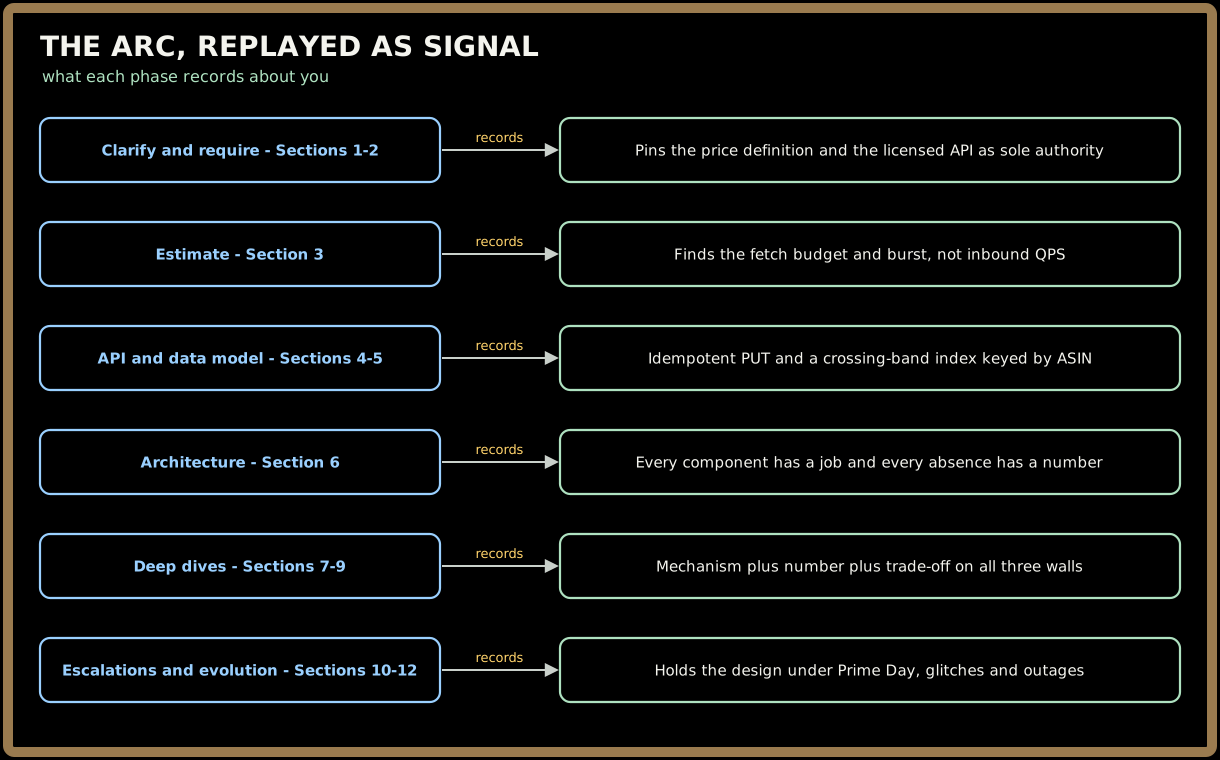
Key Insight: Read the right-hand column and notice how little of it is about knowing a technology. "Finds the fetch budget" is arithmetic. "Crossing-band index" is one line of reasoning: an armed watch with a target at or above the old price would already have fired, so only new ≤ target < old can fire now. "Effectively-once" is honesty about where your transaction boundary ends.
Sign in to continue reading
The rest of this lesson is available with a free account. Signing in with Google or Microsoft is free.
Sign in to read the full lesson