Section 9: The Escalation Gauntlet - Interviewer Deep-Dive Challenges
Executive Summary: Both deep dives have held, so the interviewer escalates on purpose: a 10,000-person town hall, a 100,000-viewer broadcast, CRDTs, exactly-once, three continents, an applause bot, Kafka. All test whether Section 1's firework/flag split survives pressure. Each answer names what is probed, gives a number and a mechanism, and says where your design stops working.
"Good. Now let's break it." Resist adding machinery: most challenges were answered by decisions you made an hour ago. Say which, and which were not.
Challenge 1: The 10,000-Person Town Hall
"Contoso moves the all-hands to a town hall. 10,000 attendees. What changes?"
What they're really asking: do you know which of your numbers grows with the square of the room?
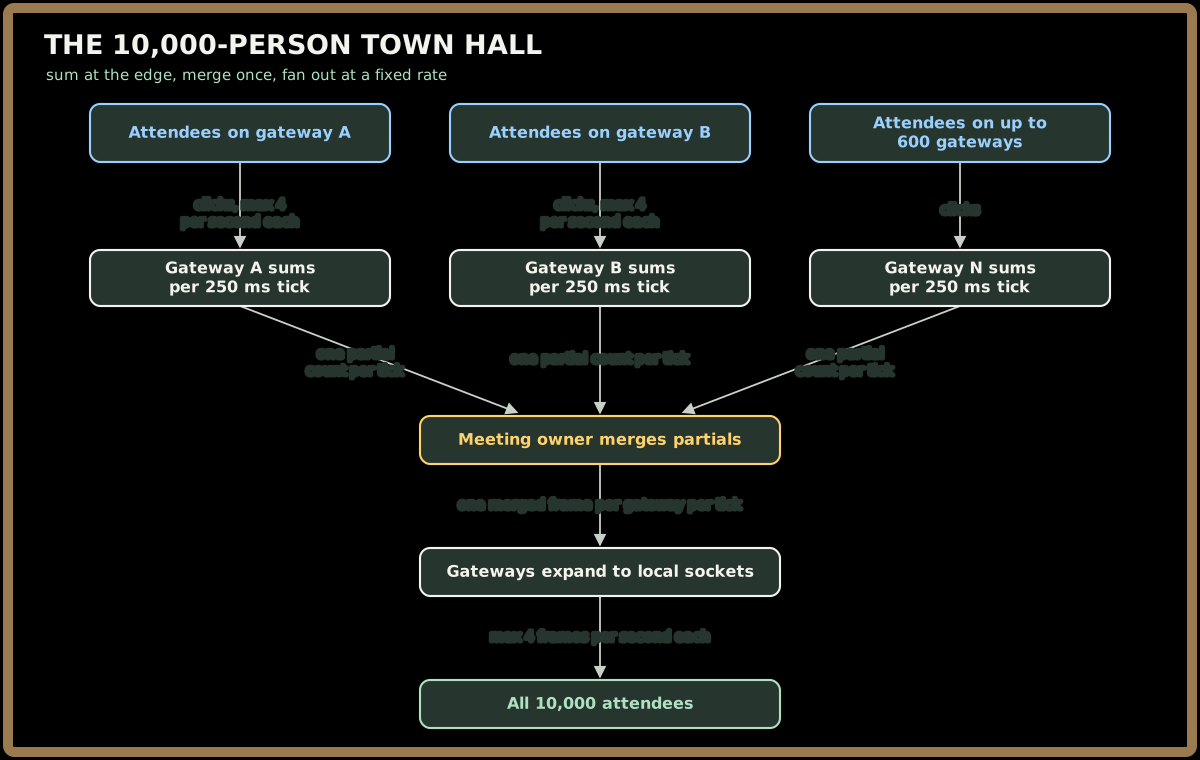
Section 3 previewed this burst: 6,000 people clap 3 times in 5 seconds, so 18,000 reactions arrive at 3,600 per second. Forwarded naively, that is 3,600 × 10,000 = 36M deliveries per second, roughly 28.8 Gbps. With Section 7's two-stage coalescing the meeting still emits at most 4 frames per second, so fan-out is 4 × 10,000 = 40K frames per second, about 96 Mbps. That is 900× fewer. Outbound is fine: the owner sends one frame per gateway, and this meeting spans at most all 600 gateways, so ≤ 2,400 inter-node frames per second.
The new pressure is inbound. Typical ingress is about 3,600 messages per second; the worst case is 10,000 clients × 4 coalesced messages = 40K messages per second into one actor sharing its node with thousands of meetings. One process copes, but here gateway pre-aggregation earns its place: each gateway sums its local clicks per 250 ms tick and sends the owner one partial count. Ingress drops to ≤ 600 × 4 = 2,400 messages per second, mirroring the outbound side. Gateways forward on the same leading-edge rule; under a burst the gateway stage adds at most one 250 ms window, which is why the client window shrinks to 100 ms for town halls.
Hands change too. With Section 8's role-scoped views, attendees see a count plus their own position; only presenters see the full queue. Otherwise every snapshot ships an unread list during the 75K-joins-per-second top-of-hour spike.
The senior line: "Outbound is already capped by the per-meeting throttle. At 10,000 the inbound side needs the same treatment, so the gateways pre-aggregate."
Quick check before moving on:
Sign in to continue reading
The rest of this lesson is available with a free account. Signing in with Google or Microsoft is free.
Sign in to read the full lesson