Section 6: One Meeting, One Owner - High-Level Architecture
Executive Summary: This section draws the whole system: edge gateways holding 30M sockets, a meeting owner service where each live meeting has exactly one owner, a placement directory that says where that owner lives, a hand-state store behind the owner, and an analytics stream on the side. We then trace two journeys through the same boxes. Maya's clap takes the lossy path and fits the 500 ms p95 budget. Maya's raised hand takes the durable path and is acknowledged within 300 ms. Along the way we defend the three choices the interviewer will press on: one owner per meeting, fan-out through gateways, and a store that only the owner can touch.
The interviewer slides the marker across: "Draw it." You have the numbers from Section 3, the messages from Section 4 and the data placement from Section 5. Each needs a home, and the firework and the flag must share a socket without the firework ever knocking down the flag.
The Whole System on One Whiteboard
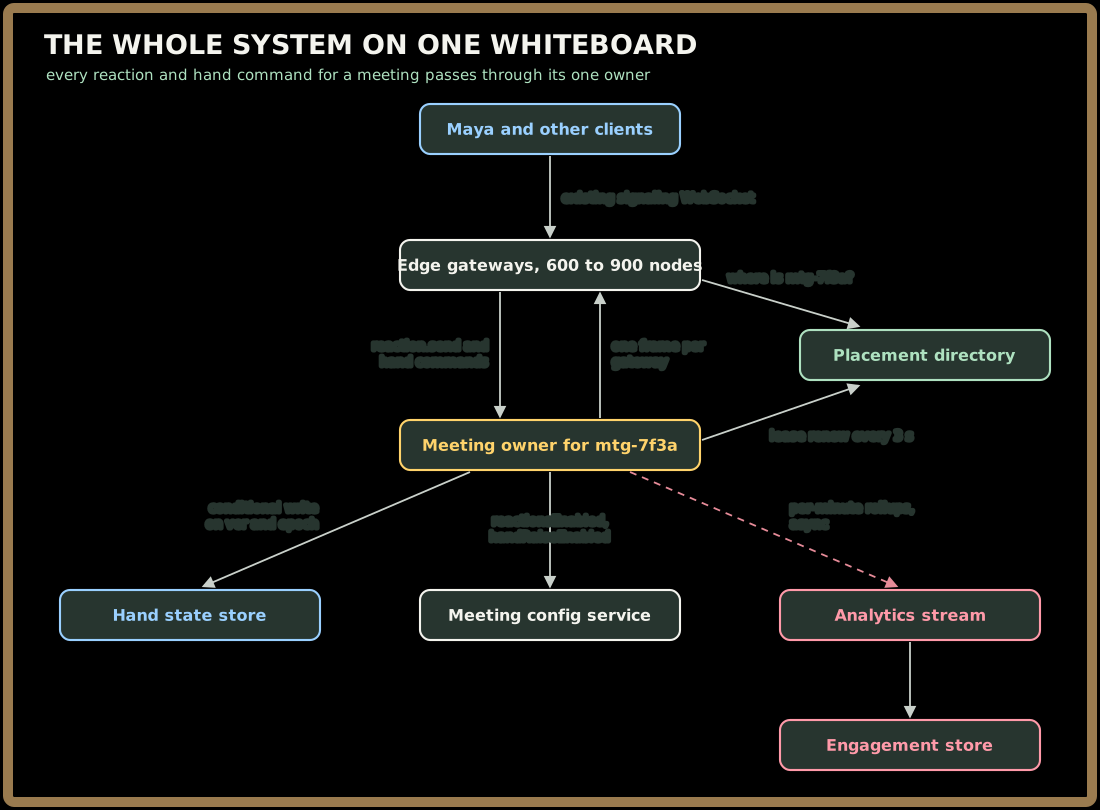
| Component | Its one job | Size at peak | What it refuses to do |
|---|---|---|---|
| Edge gateways | TLS, token validation, stamp participantId, local fan-out |
30M sockets, 50K per node, 600 nodes, ~900 with headroom | Make meeting-wide decisions |
| Meeting owner service | One actor per meeting: coalesce reactions, single writer for hands | ~3.9M meetings, ~10K per node, ~390 nodes | Talk to clients directly |
| Placement directory | meetingId to owner node, with lease and epoch |
One small record per live meeting | Carry any meeting traffic |
| Hand state store | Durable hand document, partition key meetingId |
17K writes/s, ~4 GB hot | Accept writes from anyone but the owner |
| Meeting config service | reactionsEnabled, handRaiseEnabled (already exists) |
Read when the meeting is placed, then pushed to the owner on change | Sit on the hot path |
| Analytics stream | Reaction rollups and hand events for reports | Async, droppable for reactions | Block a live meeting |
For transport, we reuse the signaling WebSocket every participant already holds for roster and mute; Section 4 covers why REST and the WebRTC media path lost.
Sign in to continue reading
The rest of this lesson is available with a free account. Signing in with Google or Microsoft is free.
Sign in to read the full lesson