Section 12: The Judges' Table - Final Summary & Candidate Scorecard
Executive Summary: This closing section turns the module into a scoring instrument. We replay the hour as signal, lay out a 100-point scorecard for this problem, map score bands to next steps, and show where the question hides in other loops. The thread through it all is our opening idea: a reaction is an event you can lose; a raised hand is state you must keep.
Everyone draws a gateway tier. The interviewer was listening for one moment: the instant you realized the prompt held two features with opposite physics, and that "now add raise hand" was the actual interview. The rest measures how well you built on that.
The Arc, Replayed as Signal
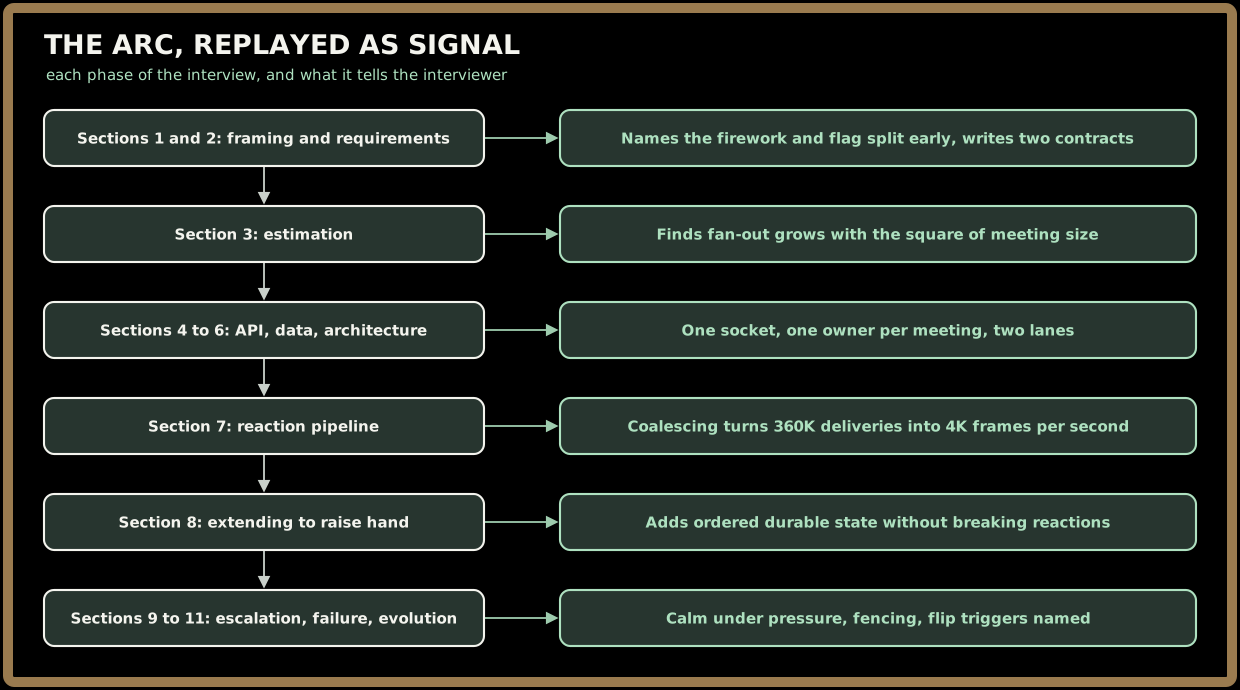
Not one signal is "knows a fancy technology." Each matches a mechanism to a measured property of the problem. The coalescing throttle exists because Section 3 showed town halls are 1% of participants but about 43% of naive deliveries. The conditional write exists because Section 2 promised zero acknowledged hand changes lost. The two lanes exist because reactions must never delay a hand delta, a mute, or audio.
Key Insight: The extension decides most of the score. Bolting raise hand onto the lossy reaction path fails framing, architecture and depth in one move. Saying "the socket, gateways, owner and fan-out tree carry over; durability, order, versioned deltas and idempotency are new" earns points in all three.
Sign in to continue reading
The rest of this lesson is available with a free account. Signing in with Google or Microsoft is free.
Sign in to read the full lesson