Section 6: Following g_8Kd2 Through the System - High-Level Architecture
Executive Summary: Clients hold one WebSocket to a Gateway, which authenticates them and does the timekeeping. Each live game is an actor on one Game Server, which persists every move to the regional Live Game Store before anyone sees it. The Placement Service (backed by etcd) maps games to servers, the Matchmaker pairs seekers, and Pub/Sub carries moves to spectators. One game-ended event on Kafka feeds everything else. We trace g_8Kd2 from seek to new rating, then defend the gateway/game-server split and the three-cell region model.
The interviewer slides the marker across. "You have the contract and the stores. Draw the boxes, then walk one game through them."
You say the rule before you draw: only the gateways, the game server and the live store touch a move. Spectators get a copy through Pub/Sub; everything else hears about the game after it ends.
The Boxes, Each With One Job
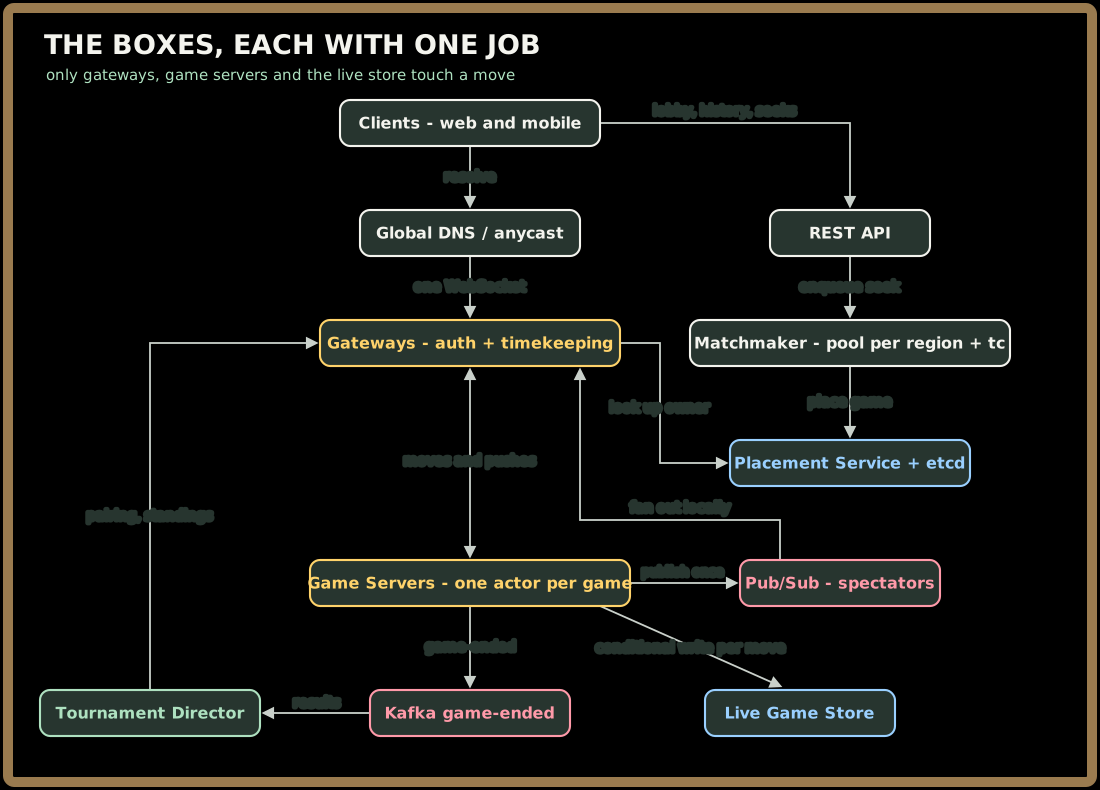
| Component | Its one job | The number that sizes it |
|---|---|---|
| Gateways | Hold the WebSocket, verify the JWT, stamp sent_at/arrived_at, route by game_id |
1M peak connections at 50K per node, 30 gateways |
| Game Servers | Host the game actors; validate, persist, broadcast, arm timers | 10K live games per node cap, 30 game servers |
| Live Game Store | One live_games item per game, one conditional write per move |
~28K writes/s peak fleet-wide, p99 ≤ 10 ms |
| Placement Service + etcd | Map game_id → (server, epoch); hold node leases |
Lease TTL 3 s, heartbeat 1 s |
| Matchmaker | Pair seekers inside a rating window | 21 pools, 700 seekers paired/s at peak |
| Pub/Sub | Carry each move to every gateway that has viewers | ~60K/s spectator pushes |
Kafka game-ended |
One event per finished game, keyed by game_id |
350/s peak, ~1.5 KB each |
| Rating Service | Glicko-2 update per rated game, in Postgres | ~560/s peak |
| Archive Writer | Copy into games + user_games; nightly PGN dump |
10 GB/day |
| Fair-Play Pipeline | Tiered post-game engine analysis | ~300 cores |
| Tournament Director | One actor per tournament: pairings, standings | Up to 20,000 players per Arena |
| REST API / Identity | Lobby, profiles, history, tournaments / OIDC login, 15-min JWTs | Everything that is not real-time |
Sign in to continue reading
The rest of this lesson is available with a free account. Signing in with Google or Microsoft is free.
Sign in to read the full lesson