Section 1: Two Players, One Board, Twenty Thousand Strangers - Problem Understanding & Clarifications
Executive Summary: This section covers the first ten minutes of a Staff interview on an online chess platform. We split the prompt into what, who, why and how, then name the trap: it sounds like a board game, but the product is a real-time referee with a stopwatch, and a tournament is a scheduled stampede. Eight clarifying questions follow. The one about where players live turns time itself into a distributed-systems problem. We close with written assumptions and the running cast: Priya in Bengaluru and Omar in Dubai, their rated 3+2 game g_8Kd2, and the Saturday Blitz Arena waiting as the second act.
The interviewer reads the prompt:
"Design an online chess platform. Start with two players: they find each other, play a live, timed game in the browser or on their phone, and the result counts toward their rating. Then we want to run online tournaments on it — anything from a 16-player club Swiss to an open Arena with 20,000 players."
Chess is familiar, and that familiarity is the danger. Nothing in the prompt is about drawing a board. It's about who decides what happened, and when.
Decomposing the Prompt
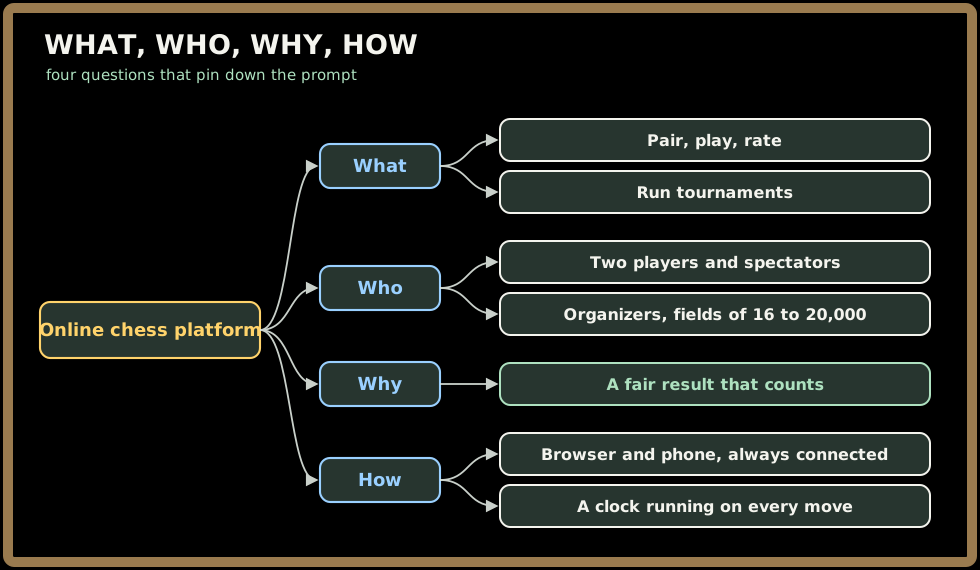
- What it does: three verbs for the game, pair, play, rate, and one for the event, run a tournament. Saying them aloud fixes the scope.
- Who uses it: two players per game, plus people watching. For tournaments, organizers create events and fields range from 16 players to 20,000.
- Why it exists: a fair result that counts. Casual players want a quick game; rated players want a number they trust. If the result or the clock can be disputed, the rating means nothing.
- How it's used: a browser or phone holding a live connection for minutes at a time, with a clock ticking on every move.
Sign in to continue reading
The rest of this lesson is available with a free account. Signing in with Google or Microsoft is free.
Sign in to read the full lesson