Section 1: The Comment Box Under a Five-Million-Person Stream - Problem Understanding & Clarifications
Executive Summary: This section covers the first ten minutes of the interview, before any box is drawn. We break the prompt into what, who, why and how, name the trap that makes live comments look like an ordinary chat system, and run the clarifying exchange where each answer removes or adds a piece of the design. It ends with the assumptions written down and the running example that every later section follows: one comment from Maya in São Paulo travelling to her friend Tomás in Lisbon during a stream watched by five million people.
The interviewer reads the prompt aloud and pushes the card across the table:
"Design the comments system for Facebook Live. While someone is broadcasting, viewers can post comments, and everyone watching sees new comments appear in near real time. Some streams have a handful of viewers; a few have millions."
The tempting move is to say "so it's a chat room" and start drawing a pub/sub topic per video. Hold that thought. The last sentence of the prompt is the whole interview. "A handful of viewers" and "millions" are not two sizes of the same problem. They are two different problems sharing one feature.
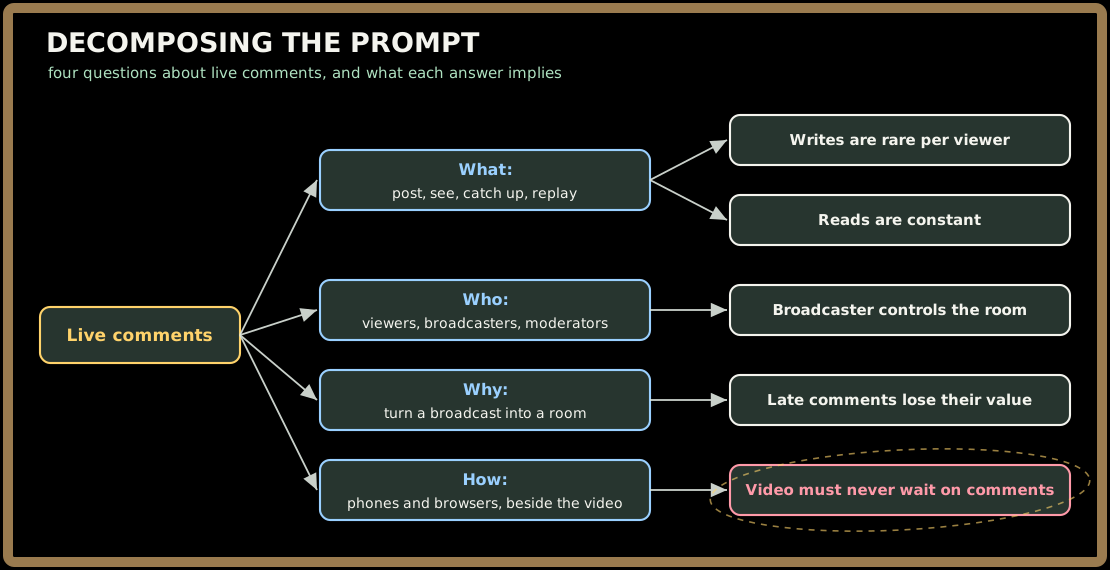
Decomposing the Prompt
Before asking anything, strip the prompt down to verbs and people.
- What it does: four verbs. Viewers post a comment. Everyone watching sees new comments as they arrive. A viewer who joins late catches up on the recent conversation. Someone watching the recording later replays the comments at the moments they were made.
- Who uses it: three roles. Viewers read a lot and write a little. Broadcasters own their stream and want control over its comment section. Moderators and the platform's safety systems remove what shouldn't be there.
- Why it exists: comments turn a broadcast into a room. The streamer reads and answers; viewers feel they aren't watching alone. A comment that arrives thirty seconds late has mostly lost its point.
- How it's used: on phones and browsers, often over mobile networks, beside a video already using most of the bandwidth. Video is the product; comments are a layer on top.
Sign in to continue reading
The rest of this lesson is available with a free account. Signing in with Google or Microsoft is free.
Sign in to read the full lesson