Section 12: The Interview's Own Postmortem - Final Summary & Candidate Scorecard
Executive Summary: This closing section turns the module into a grading instrument. We replay the interview as the signal each phase recorded, then give a 100-point scorecard with what a top score sounds like for this problem and where points leak. A sixty-second close, score bands, and a catalog of where the question hides in real loops finish the module.
Think back to the first minute. Someone said "ELK plus Prometheus," and for a single cluster that answer is fine. The interviewer was never scoring those names. They were scoring whether you saw three products behind one sentence, whether your arithmetic chose the storage design, and whether the system that pages Dana at 02:14 keeps working when everything else is on fire.
The Arc, Replayed as Signal
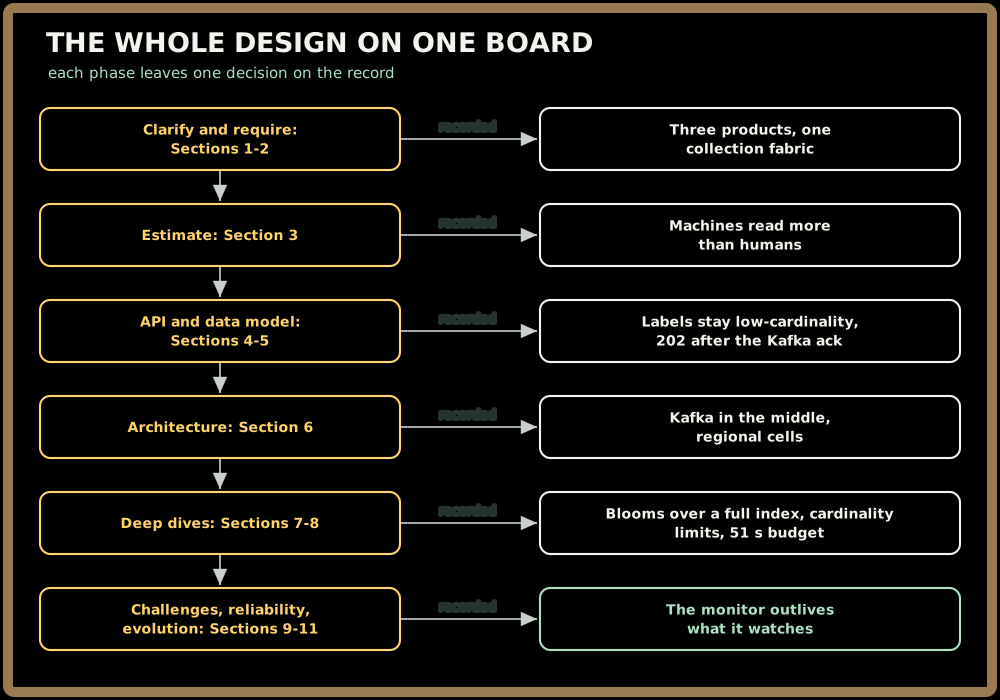
| Section | What you did | Signal recorded |
|---|---|---|
| 1-2 | Split the prompt into log search, metrics, alerting; scoped out traces and SIEM; set alerting at 99.99% and query at 99.9% | Scope discipline; the pager matters more than the search box |
| 3 | 2M lines/s, 86.4 TB/day raw, 285 TB retained; 100M series; 6,667 alert evaluations/s against 1,667 dashboard queries/s | Write-heavy by orders of magnitude, and ~80% of metric reads are machines |
| 4-5 | 202 only after Kafka acks; mandatory label selector; request_id kept as a field, not a label |
Contracts that protect the cluster from its users |
| 6 | Agents push to gateways, Kafka buffers 24 h, ingesters build chunks and head blocks, evaluators read ingesters | Every box has a job and a rejected alternative |
| 7-8 | Label, bloom, then scan; the user_id bomb; the 51 s detection budget |
Mechanism plus number on the load-bearing walls |
| 9-11 | Quotas, the 720 core-hour regex, the dead man's switch, traces added on the same fabric | Composure, independence, growth without a rebuild |
Key Insight: Two numbers carry most of this interview. 9.5 TB/day for chunks plus blooms, against 86–173 TB/day for a full inverted index, decides the log store. 100M series, where one bad label adds 50M more, decides the metrics risk. Derive both and let them choose the design.
Quick check before moving on:
Sign in to continue reading
The rest of this lesson is available with a free account. Signing in with Google or Microsoft is free.
Sign in to read the full lesson