Section 5: Where a Swipe Lands - Data Modeling
Executive Summary: Priya's right swipe on Marco writes two rows, reads one, and, because Marco liked her on Thursday, writes three more. This section derives where each row lives from the questions the system asks its data. Profiles sit in a sharded relational store. Swipes, the reverse likes index, matches, messages and blocks live in Cassandra, each partitioned by the key its hottest read needs. Redis and Elasticsearch hold only derived, rebuildable state. The decisions to defend are the 90-day TTL on swipes, the likes_received table that turns "did Marco like Priya?" into a point read, and the blocks table that never expires.
The interviewer points at Section 4's endpoint list: "Fine. What do these calls actually write?" Don't open with tables. Open with the questions, how often they're asked, and the key each one needs, because in a wide-column store the key is the query.
Access Patterns First
| Access pattern | Peak rate | Key it needs | Home |
|---|---|---|---|
| Record a swipe | ~70K rows/s | swiper, then swipee | Cassandra swipes |
| Did they already like me? (match check) | ~21K reads/s | me (the swipee), then them | Cassandra likes_received |
| Create the match, exactly once | ~700/s | the sorted pair | Cassandra matches |
| My matches list, newest first | low | user, by time | Cassandra matches_by_user |
| Chat history for one match | ~3.5K writes/s | match, by time | Cassandra messages |
| Is this pair blocked? | every send, every deck | user, then other | Cassandra blocks |
| My next 20 cards | ~3.5K fetches/s | user | Redis deck: queue |
| Have I seen this candidate? | ~1.4M checks/s, local | user | Redis Bloom filter |
| Who is near me and fits both ways? | ~1.4K refills/s | S2 cell + filters | Elasticsearch geo index |
| Hydrate a card (name, age, photos) | per card served | user | Profile DB + CDN |
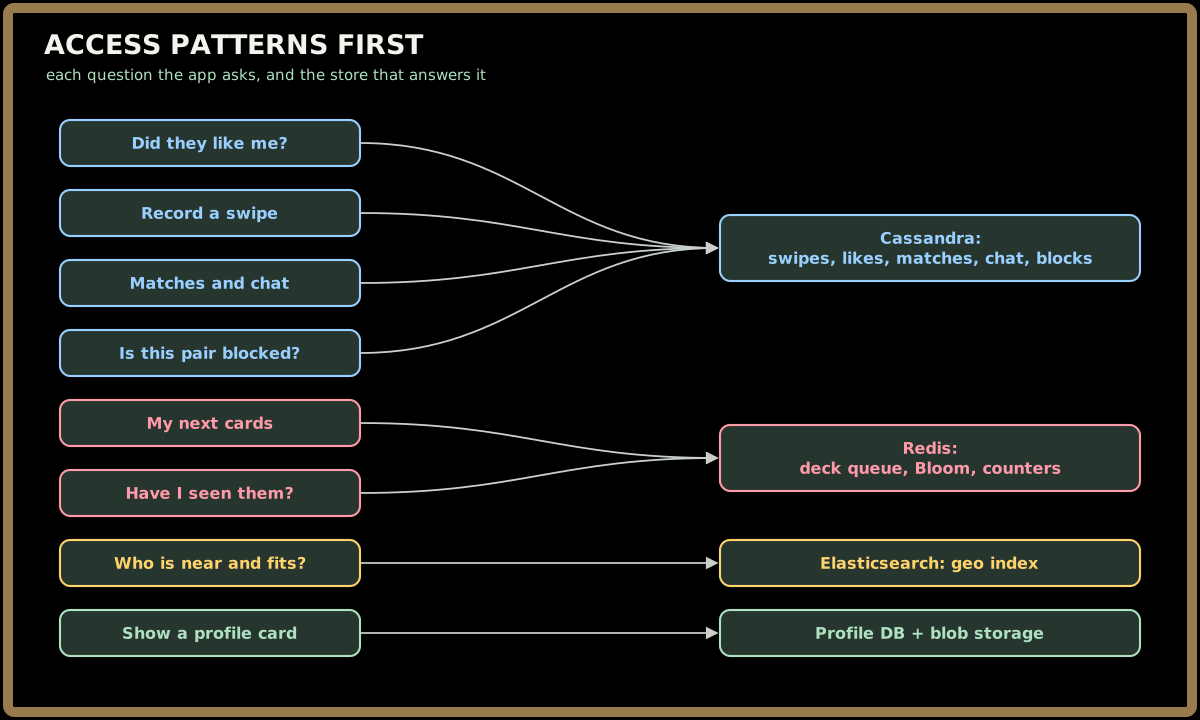
Cassandra and the profile DB are systems of record. Redis and Elasticsearch are derived: lose them and you rebuild.
Sign in to continue reading
The rest of this lesson is available with a free account. Signing in with Google or Microsoft is free.
Sign in to read the full lesson