Section 12: Swiping on Your Own Answer - Final Summary & Candidate Scorecard
Executive Summary: This closing section turns the module into a way to grade yourself. We replay the interview arc as the signal each phase recorded, then lay out a 100-point scorecard across six dimensions, weighted so the deep dives count for more than the box diagram. Score bands tell you what to practise next, a short catalog shows where this question hides in real loops, and we close Priya and Marco's Sunday night.
"Design Tinder" sounds like a swipe button and a database. That's the trap. The swipe is the cheapest operation in the system; the product is the deck (who Priya is shown) and the match (the moment two private likes become one shared fact). The interviewer was watching whether you saw that, whether your arithmetic chose your stores, and whether you could prove a match fires exactly once. This section names those points.
The Arc, Replayed as Signal
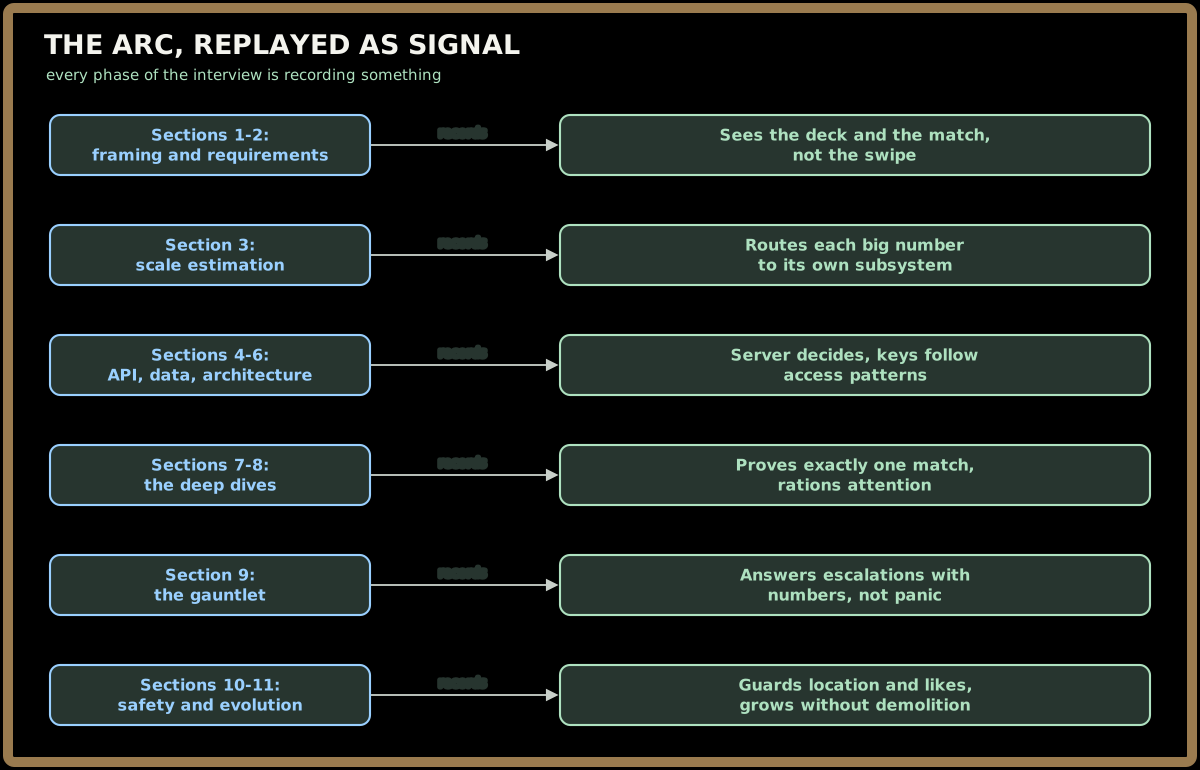
Sections 1 and 2 check whether you shrink the prompt: locally matched, 1:1 chat only between matches, paid features and undo parked with reasons. The strong candidate writes an invariant nobody asked for, exactly one match per mutually-liking pair, never zero, never two, and makes location privacy a requirement, not a later patch.
Section 3 checks whether the math points somewhere. Three "big" numbers each pick a subsystem: ~70K swipes/s at peak is the write firehose (Cassandra), ~110 Gbps of photo egress is bandwidth (the CDN), and ~1.4M candidate scorings/s is compute (model serving). The match, the part users care about most, is only ~700/s. Swipe storage of ~70 TB needs ~36 nodes while writes alone need ~27, so storage sizes the cluster.
Sections 4 through 6 check the contract and the seams: an idempotent PUT /v1/swipes/{target_id}, passes batched 10 at a time to cut 70K requests/s to **26K**, no liked_you flag in the deck, and a likes_received table that makes the match check one point read on the other person's partition.
Sections 7 and 8 check depth where the design bears weight. Section 9 checks composure when Dating Sunday doubles the peak to ~140K swipes/s. Section 10 checks that you see the stalker and the scraper first. Section 11 checks that new features plug into existing seams.
Key Insight: None of those signals is "knows an exotic technology." Cassandra, Redis, Elasticsearch, Kafka and a CDN are an ordinary parts list. The marks go to the reasoning that connects them: write-then-check instead of a lock, a Bloom filter instead of 1.4M point reads a second, a ranking objective with two probabilities in it instead of one.
Quick check before moving on:
Sign in to continue reading
The rest of this lesson is available with a free account. Signing in with Google or Microsoft is free.
Sign in to read the full lesson