Section 1: It's Not the Swipe - Problem Understanding & Clarifications
Executive Summary: The prompt sounds like a toy: show people cards, record left and right. But the swipe is the cheapest operation in the system. The product is two other things. The deck decides who you are shown at all, and the match is the moment two private signals become one shared fact. We decompose the prompt into what, who, why and how, run a clarification exchange where every answer removes or adds specific work, write the assumptions down, and meet Priya and Marco, whose Sunday-night match runs through all twelve sections.
The interviewer reads it off a card:
"Design a dating app like Tinder. People create a profile with photos, and the app shows them a stack of nearby people who fit their preferences. They swipe right to like or left to pass. When two people like each other, it's a match and they can chat. Assume tens of millions of daily users."
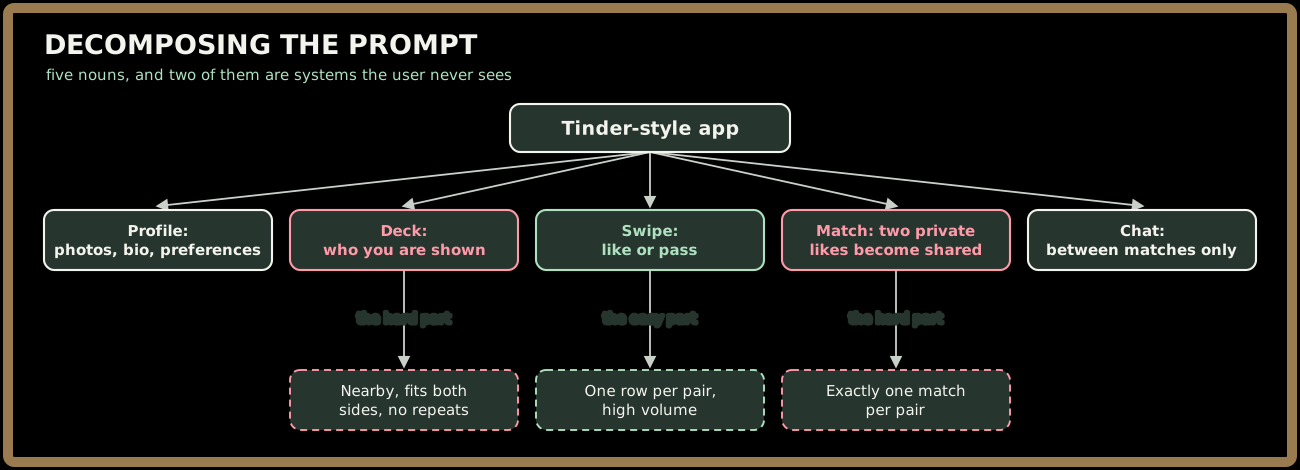
Most candidates hear "swipe" and start drawing a write path. But the swipe is the simplest thing in the app: one row saying A felt this way about B. The hard parts sit on either side of it. Before the swipe, something had to pick this face, out of millions, as worth showing to this person tonight. After it, two likes recorded seconds or days apart have to become exactly one match. Not zero matches, and not two.
Key Insight: Ask where the work actually is, not where the verbs are. A Tinder-style app is a recommendation system and a correctness problem, with a high-volume log of swipes between them. Candidates who design the log spend forty minutes on the easy part.
Decomposing the Prompt
Before asking anything, map the territory out loud:
- What it does: five nouns. A profile (photos, bio, preferences), a deck (the stack of candidates), a swipe (like or pass), a match (mutual like), and chat (between matches only). Two of them, building the deck and detecting the match, are systems the user never sees.
- Who uses it: a two-sided marketplace where every user is on both sides. Priya is a viewer when she swipes and a candidate in thousands of other decks while she sleeps. That symmetry shows up everywhere. Preferences have to fit in both directions, and a profile that's shown too often drowns in likes it can never answer.
- Why it exists: to produce a match that turns into a conversation. The success metric is mutual matches and conversations, not swipes. A design that maximizes swipes, for example by always showing the most attractive profiles, can make the product worse.
- How it's used: phone-only and thumb-driven. Sessions are short and fast, around a hundred swipes a day, and they cluster in the evening, worst on Sunday nights. Nobody waits for a card to load: if the next face isn't there instantly, the thumb is already gone.
Quick check before moving on:
Sign in to continue reading
The rest of this lesson is available with a free account. Signing in with Google or Microsoft is free.
Sign in to read the full lesson