Section 6: Follow the Ramen - High-Level Architecture
Executive Summary: This section turns Section 4's contract and Section 5's two stores into a running system. We draw the components once, walk Sam's "ramen, open now, within 1 km" search through them with a timing at every hop (about 120 ms), follow an owner's edit from PlaceDB to the index, and defend the boxes missing on purpose: no per-result Reviews call, no CDN for search, no sharded PlaceDB.
The interviewer slides the marker across: "You've got your API and your data model. Show me the boxes, then walk me through one request." The trap is drawing twenty boxes and narrating none. Draw the fewest components that meet Section 2's numbers, then push a real request down every arrow.
The Whole System on One Board
Everything sits in three active-active regions, each a full copy of the read path (D3, D11). Here is one region, plus the write path that feeds all three:
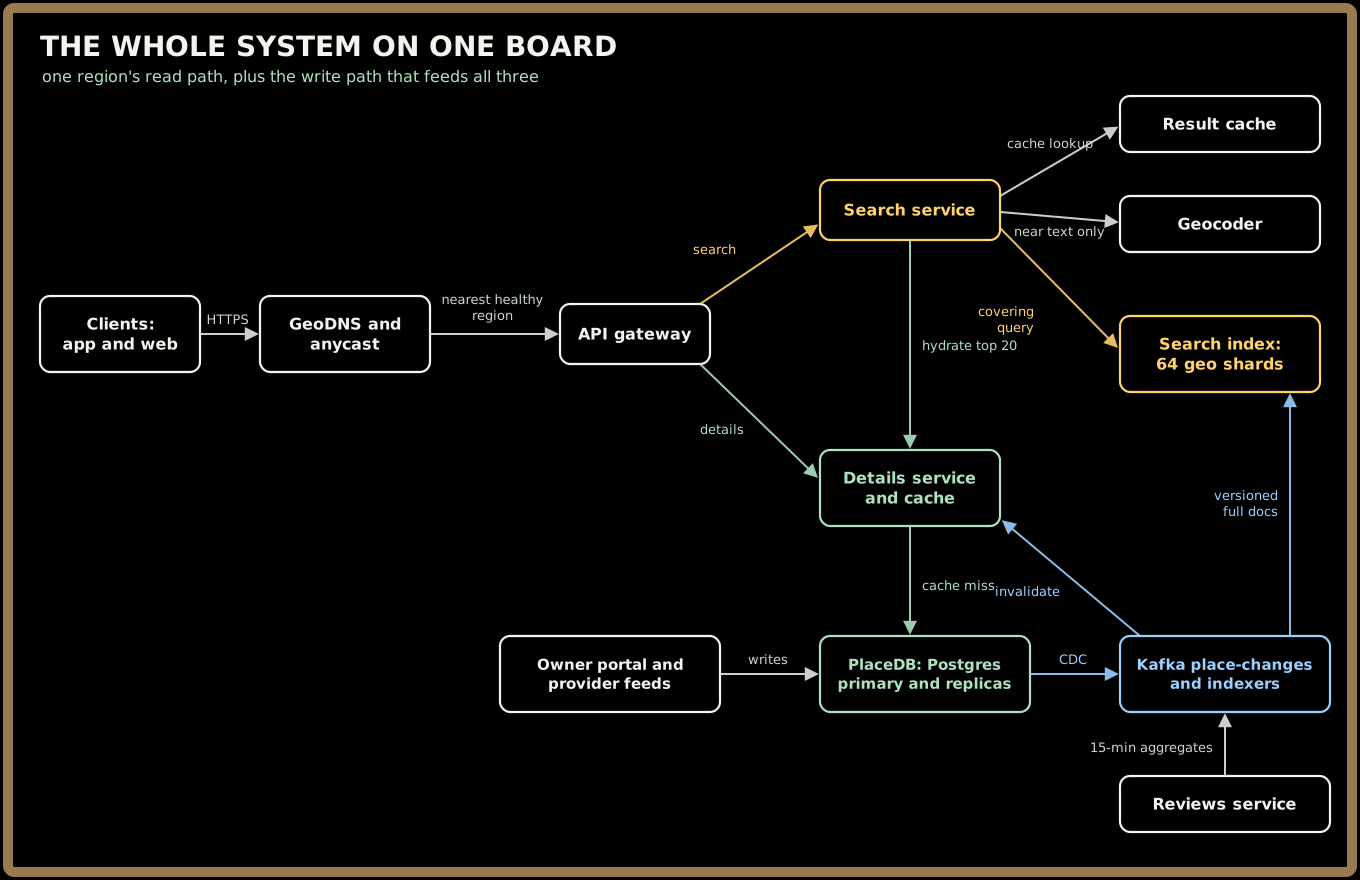
| Component | Job | Key number |
|---|---|---|
| API gateway | Auth, rate limits, location scrubbing | 60 / 120 searches per min; logs at geohash5 |
| Search service | Stateless query planner: covering, shard routing, L2 re-rank, cursors | ≤ 5,000 candidates per query |
| Result cache | Up to 200 candidates with coordinates per (geohash6, query, filters, sort) | TTL 60 s, ~40 GB per region |
| Search index | Inverted index with geohash cell tokens, sharded by geography | 64 shards, 24 nodes per region |
| Details service + cache | Read-through place details | 40 GB hot set, TTL 10 min |
| PlaceDB | Source of truth, one writer region | 400 GB, ~23 writes/s |
| Geocoder | "near Union Square" → coordinates, behind a cache | 80% hit, 50 ms timeout |
| Kafka + indexers | CDC events keyed by placeId, applied per region | edits visible p99 ≤ 5 min |
Key Insight: The read path and the write path share no synchronous dependency. Search never waits on PlaceDB's primary, and the index is a derived, rebuildable copy (50K docs/s → 200M in ~67 min). That is what lets every region keep serving while the writer region has a bad day.
Quick check before moving on:
Sign in to continue reading
The rest of this lesson is available with a free account. Signing in with Google or Microsoft is free.
Sign in to read the full lesson