Section 13: The Friend List Was the Index - Final Summary & Candidate Scorecard
Executive Summary: This closing section turns the whole module into an evaluation instrument. We replay the hour as signal — naming what each phase was actually recording — then score both failure archetypes, the Index Reflex and the Realtime Maximalist, dimension by dimension with indicative totals, so you can recognise your own performance in one of them. The full 100-point rubric follows, weighted so that judgment outranks machinery, with score bands and targeted remediation, a catalogue of the real-loop prompts this question hides inside, and the two sibling modules that complete the picture.
Here is the uncomfortable thing about the hour you just spent: the moment that decided the outcome happened in the first five minutes, long before a box was drawn. You either noticed that "show me which friends are nearby" is not the proximity-search problem, or you did not. Everything downstream — the fan-out chain, the ephemeral cache, the hysteresis band, the off switch that erases — follows from that one reading. Candidates who pattern-matched the shape of the prompt spent fifty minutes building an excellent answer to a question nobody asked. Interviews at this level are scored on form, and you cannot reliably earn points you cannot name.
The Arc, Replayed as Signal
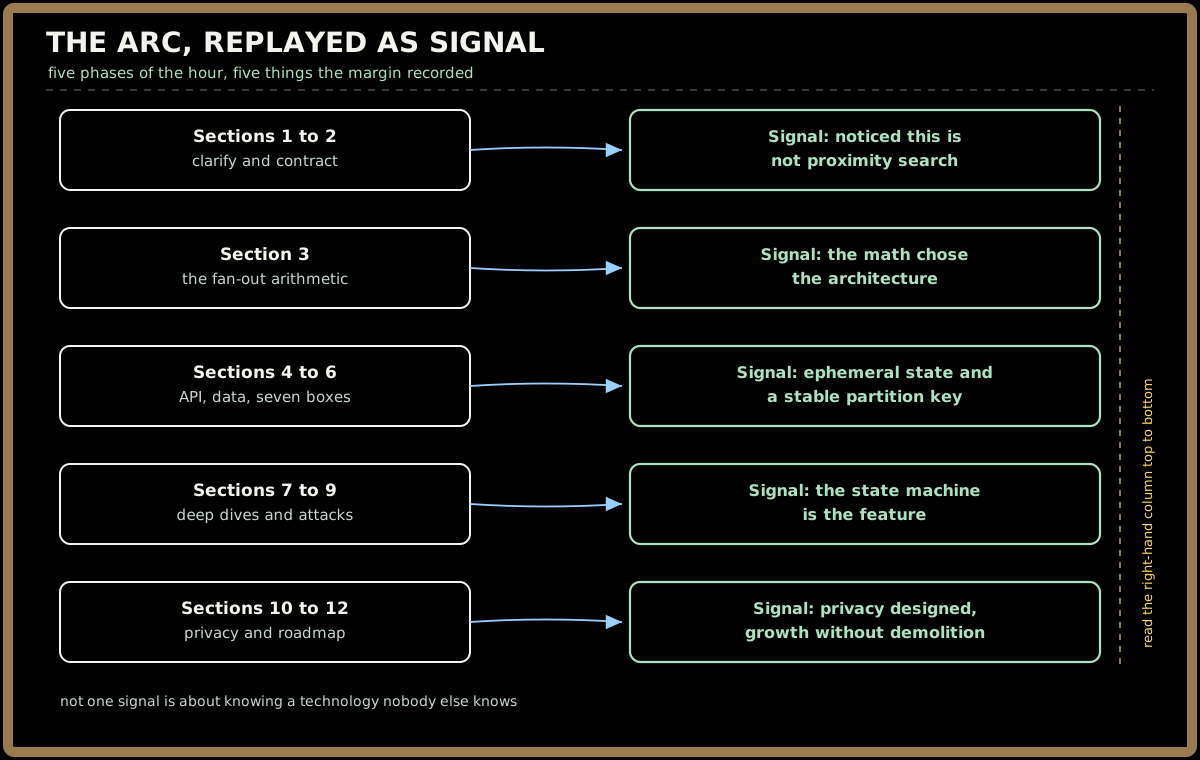
Key Insight: Read the right-hand column top to bottom and notice that not one signal is about knowing a technology nobody else knows. Every signal is about reading a problem correctly and then deploying ordinary machinery in proportion to it. That is why the same five signals survive a swap of the prompt: presence systems, driver-rider matching, fleet tracking — the friend list is the index in all of them.
Sign in to continue reading
The rest of this lesson is available with a free account. Signing in with Google or Microsoft is free.
Sign in to read the full lesson