Section 13: The Bike Leaves the Board - Final Summary & Candidate Scorecard
Executive Summary: This closing section turns the module into a way to grade yourself. We replay the interview arc and name the signal each phase was recording, then lay out a 100-point scorecard across six dimensions, weighted so judgment counts for more than machinery. For each one you get what a top score sounds like and where candidates lose points, tied to this module's numbers and decisions. Score bands tell you what to practise next, a short list shows where this question hides in real loops, and we close Maya's story with the bike sold.
The prompt sounds like a CRUD app with a search box, and a candidate who treats it that way draws five tidy boxes and runs dry by minute twenty. The interviewer was never grading the boxes. They were watching whether you saw four forces (supply, discovery, conversation, trust), whether your arithmetic changed your choices, and whether you held steady under escalation. You can't reliably earn points you can't name, so this section names them.
The Arc, Replayed as Signal
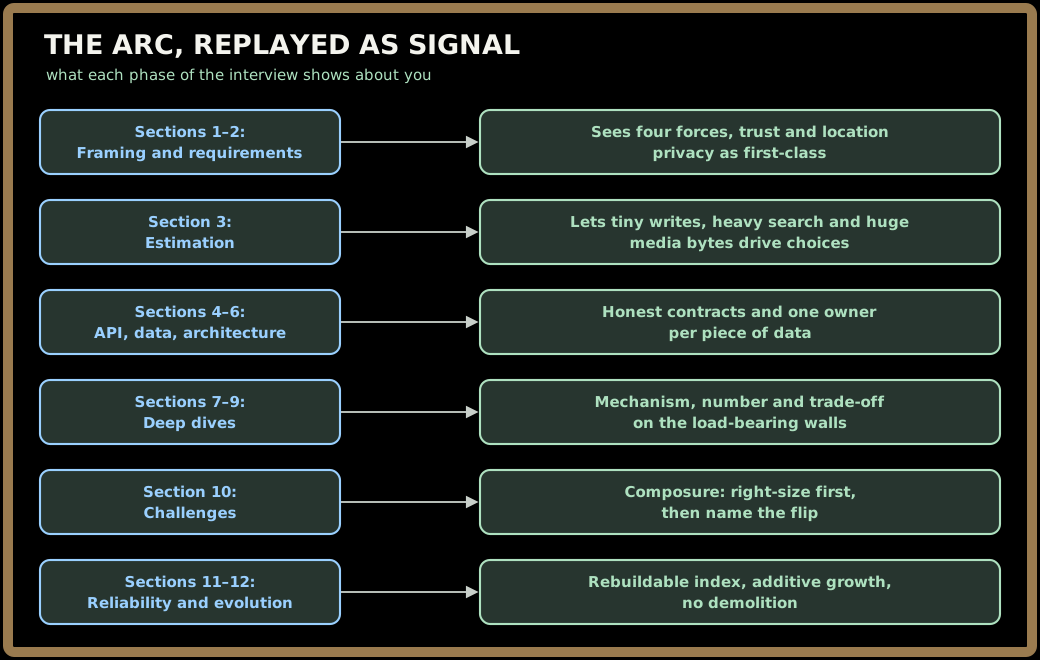
Walk down the phases and the pattern shows.
Sections 1 and 2 check whether you shrink the prompt: payments offline, US only, local pickup, "searchable within a minute". Each answer removes a subsystem or creates a testable number. The strong candidate also writes down two things nobody asked about: trust is a requirement, and the seller's exact location must never leak.
Section 3 checks whether the math governs the design. About 300 writes/s peak means one Postgres primary. 10,500 search QPS means its own cluster. 20 TB of photos a day and ~7 Gbps peak ingress mean bytes never touch the API tier. A ~120 GB index means you shard for throughput and locality, not size.
Sections 4 through 6 check honest contracts (presigned uploads, a 202 with pending_review, If-Match on edits, exact location in and a fuzzed point out) and one owner per piece of data.
Sections 7 through 9 check depth where the design bears weight: photos, the outbox-to-indexer path, masked messaging, geo-routed search, the moderation gate. Section 10 checks composure. Sections 11 and 12 check respect for what you built: an index rebuilt in about 33 minutes, and features that land as new Kafka consumers.
Key Insight: Not one of those signals is "knows an exotic technology." Postgres, Kafka, Elasticsearch, Redis, a CDN and an object store are an ordinary parts list. The marks go to fitting them to measured load and naming the number that would change your mind.
Quick check before moving on:
Sign in to continue reading
The rest of this lesson is available with a free account. Signing in with Google or Microsoft is free.
Sign in to read the full lesson