Section 12: The Count That Was Never About Throughput - Final Summary & Candidate Scorecard
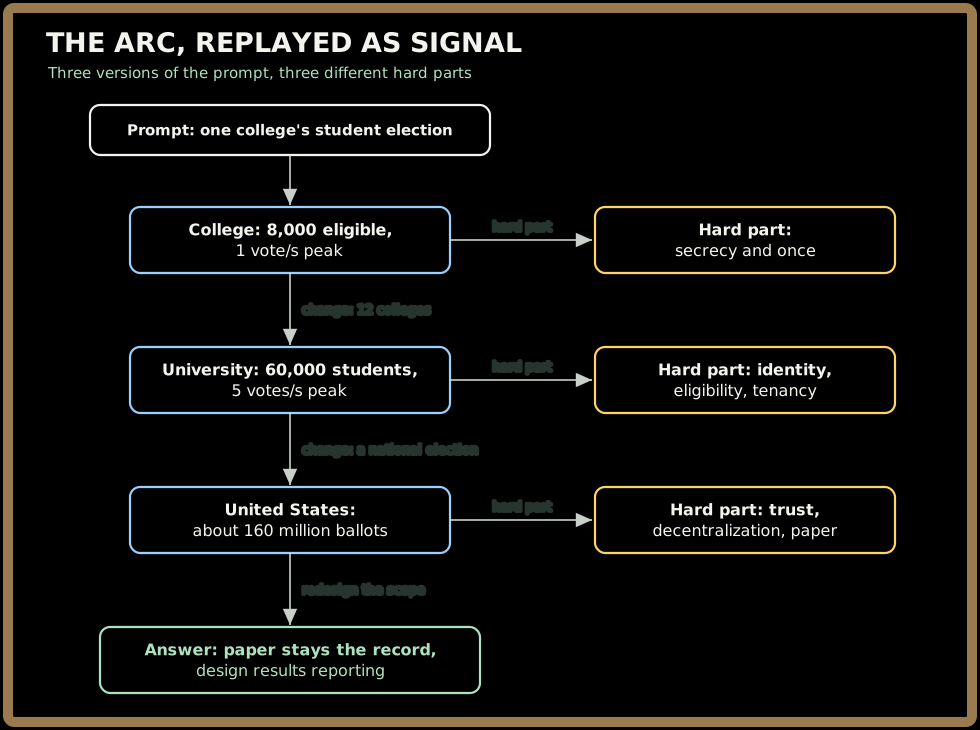
Executive Summary: We replay the interview across its three requirement changes (one college, a 12-college university, a United States election) and name the signal each section recorded. Then comes a 100-point scorecard weighted toward architecture and data model, because the secret ballot lives in how two tables are kept apart, plus the seven answers that cost the most points. Score bands, the prompts where this question hides, and Alex's last walk through all three systems close the module.
The college peaked at 1 vote/s, the university at 5 votes/s. No vote ever stressed a single managed database, and the interviewer knew that before asking. They were scoring whether you noticed that a vote must know who you are and then forget it, whether the numbers kept the design small, and whether you refused to put a national ballot on the internet.
The Arc, Replayed as Signal
| Section | What you did | Signal recorded |
|---|---|---|
| 1. Problem Understanding & Clarifications | Asked about eligibility, revoting and threats | Found the write that must forget its writer |
| 2. Requirements (Functional & Non-Functional) | Four invariants; p99 ≤ 1 s, 99.9% (about 2.9 minutes over 48 hours) | Requirements a test could check |
| 3. Scale Estimation & Workload Analysis | 4,800 ballots, 1 vote/s peak, 4.8 MB; results at 400 requests/s, 400× the voting peak | Let the numbers pick a small design and found the real spike |
| 4. API Design (with Pushback) | Idempotency key, a receipt that proves nothing, identity only from the token | Contracts shaped by secrecy and retries |
| 5. Data Modeling | Participation and anonymous ballots, with no shared key or precise timestamp | Recorded that Alex voted, not how |
| 6. High-Level Architecture | One API service, one managed database, a flusher, a CDN | Defended every absence |
| 7. Deep Dive: One Person, One Vote, Secret Ballot | One transaction; shuffled flush every 15 minutes, once 25 ballots wait | Named the honest limit of a central secret ballot |
| 8. Evolution I: The University with Many Colleges | Federated identity, 51 races, about 32 ballot styles, roll frozen 7 days before voting | Grew the design without rebuilding it |
| 9. Deep Dive: Tallying, Ranked Choice & Verifiability | Deterministic ranked choice, tracking codes, suppression under 10 ballots | Reproducibility over speed |
| 10. Interviewer Deep-Dive Challenges | Coercion, the insider admin, the deadline flood | A rule for each threat |
| 11. Evolution II: A United States National Election | Refused to scale it; signed county results at 833,000 requests/s on a CDN | Changed scope when stakes changed |
Key Insight: The hard part changes in every column, and the request rate is never it. At college scale it is secrecy and exactly-once. At university scale it is identity and eligibility. At national scale it is trust, and the answer moves off the internet entirely.
Quick check before moving on:
Sign in to continue reading
The rest of this lesson is available with a free account. Signing in with Google or Microsoft is free.
Sign in to read the full lesson