Section 13: The Gavel Falls - Final Summary & Candidate Scorecard
Executive Summary: This closing section turns the module into an instrument you can score yourself with. We replay the arc and name the signal each phase was recording - whether you heard that a bid is a maximum and not a price, whether you found the fan-out and the 7 p.m. burst hiding behind a modest 5,000 bids per second, whether the secret lived on the row and the tiebreak lived in a sequence number - then lay out the 100-point scorecard across five weighted dimensions, with what a top score sounds like and what costs points on this specific problem. Three calibration rules keep the self-score honest, four score bands map to remediation by section, and a final catalogue shows where this question hides in real loops, from ad exchanges to limit-order matching engines.
Here is the uncomfortable arithmetic of the hour you just spent. The eight-box diagram that felt like the deliverable carried a quarter of the points, shared with the data model underneath it. The interviewer was scoring something else: whether you asked is a bid a maximum or a price? before drawing, whether you turned 7,100 writes per second on 32 shards into about 220 per shard and then believed it enough to leave the queue out of the bid path, whether you could say that a late closer changes when Marcus gets his email and never whether he won. None of that is knowledge. All of it is judgment, and judgment is scored on form.
The Arc, Replayed as Signal
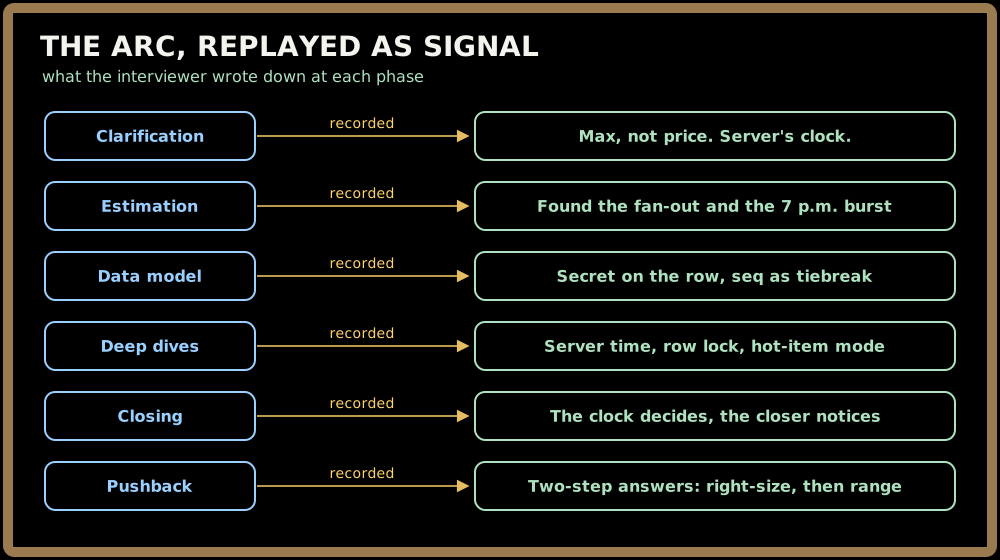
Read the right-hand column alone: not one entry rewards knowing more technology. Section 1 (Problem Understanding & Clarifications) recorded whether one question got asked before any box was drawn, because the Price Clicker builds a system that cannot proxy-bid and rewards whoever clicks last. Section 3 (Scale Estimation & Workload Analysis) recorded whether you designed for the shape rather than the total: 5,000 bids per second is calm, 200 on one row is survivable under a ceiling of 500, and the numbers that bite are 10 million uncoalesced messages per second and 1,600 closes per second in the worst evening minute. Section 9 (Closing a Million Auctions) recorded whether you understood that the cut-off already happened inside the accept transaction and the closer is bookkeeping.
Key Insight: The signals compound. You cannot score the data model without the clarification that told you a bid is a maximum - the only reason high_max_amount exists on the auction row. You cannot defend the missing queue without the arithmetic that priced it. Skip a phase and you lose every point downstream of it.
Quick check before moving on:
Sign in to continue reading
The rest of this lesson is available with a free account. Signing in with Google or Microsoft is free.
Sign in to read the full lesson