Section 13: Closing the Folio - Final Summary & Candidate Scorecard
Executive Summary: This closing section turns the module into an instrument you can score yourself with. We replay the arc and name the signal each phase was recording — what is actually being sold, whether the arithmetic governed the design, whether fungibility was a decision rather than an assumption — then lay out the 100-point scorecard across five weighted dimensions. Score bands map to readiness, calibration rules keep self-scoring honest, and a catalogue of real-loop isomorphs lands on both sides of the line the module was built around: fungibility is an architectural property.
Here is the uncomfortable arithmetic of the hour you just spent. The boxes-and-arrows diagram — the artefact that felt like the deliverable — carried a quarter of the points, shared with the data model underneath it. The interviewer was scoring something else: whether you noticed that a hotel sells room types and not rooms, whether you did the division that reveals one 220-room property absorbing 0.00076 booking writes per second, whether you then believed that number enough to delete machinery, and whether you could say out loud that a correct hotel system oversells on purpose. None of that is knowledge. All of it is judgment, and judgment is scored on form.
The Arc, Replayed as Signal
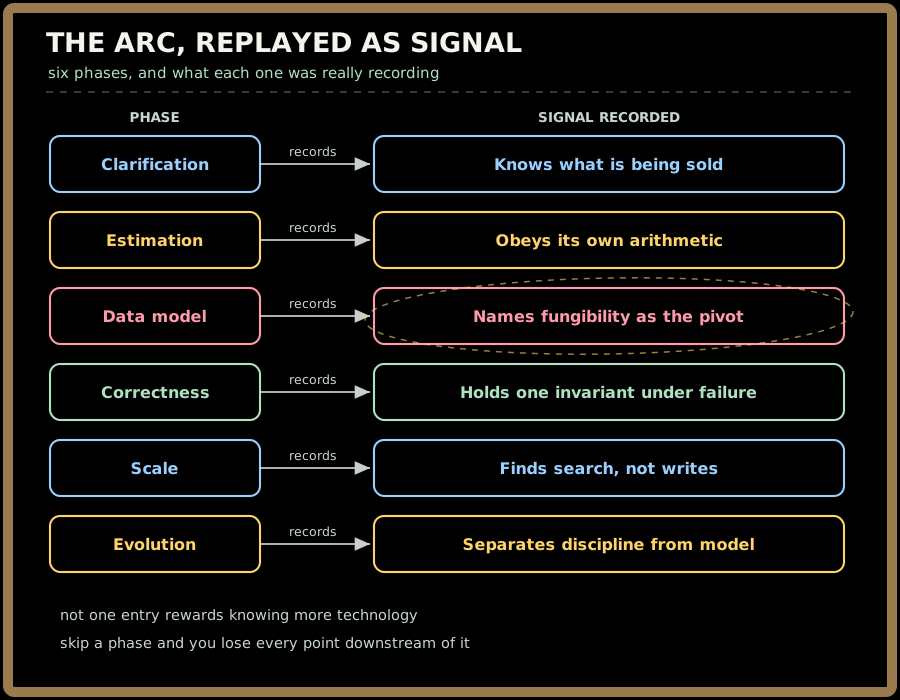
Read the right-hand column alone: not one entry rewards knowing more technology. Section 1 (Problem Understanding & Clarifications) recorded whether one question — rooms or room types? — got asked before any box was drawn, because that answer is the difference between 1,460 inventory rows and 80,300. Section 3 (Scale Estimation & Workload Analysis) recorded obedience, not multiplication: plenty of candidates derive the numbers, then build the system they had already decided on. Section 9 (Deep Dive: Overbooking & Dynamic Pricing) recorded something rarer — whether you can let a 4–8% no-show rate overrule the engineering instinct and sell a room you do not have.
Key Insight: The signals compound. You cannot score the data model without the clarification that told you what inventory is, nor defend an absent cache without the arithmetic that priced it. Skip a phase and you lose not its points but every point downstream of it.
Quick check before moving on:
Sign in to continue reading
The rest of this lesson is available with a free account. Signing in with Google or Microsoft is free.
Sign in to read the full lesson