Section 12: The Judges' Table - Final Summary & Candidate Scorecard
Executive Summary: This closing section turns the module into a way to grade yourself. We replay the interview arc and name the signal each phase was recording, then lay out a 100-point scorecard across five dimensions, weighted so judgment counts for more than machinery. Each dimension shows what a top score sounds like and where points are lost. Score bands say what to practise next, and we close Maya's story.
"Design Medium" sounds easy. One candidate installs WordPress in their head; another builds a Twitter clone and never mentions the editor. The interviewer wasn't grading either diagram. They were watching whether you saw two systems wearing one logo, whether your arithmetic changed your choices, and whether you held steady when a post went viral mid-edit. You can't reliably earn points you can't name, so this section names them.
The Arc, Replayed as Signal
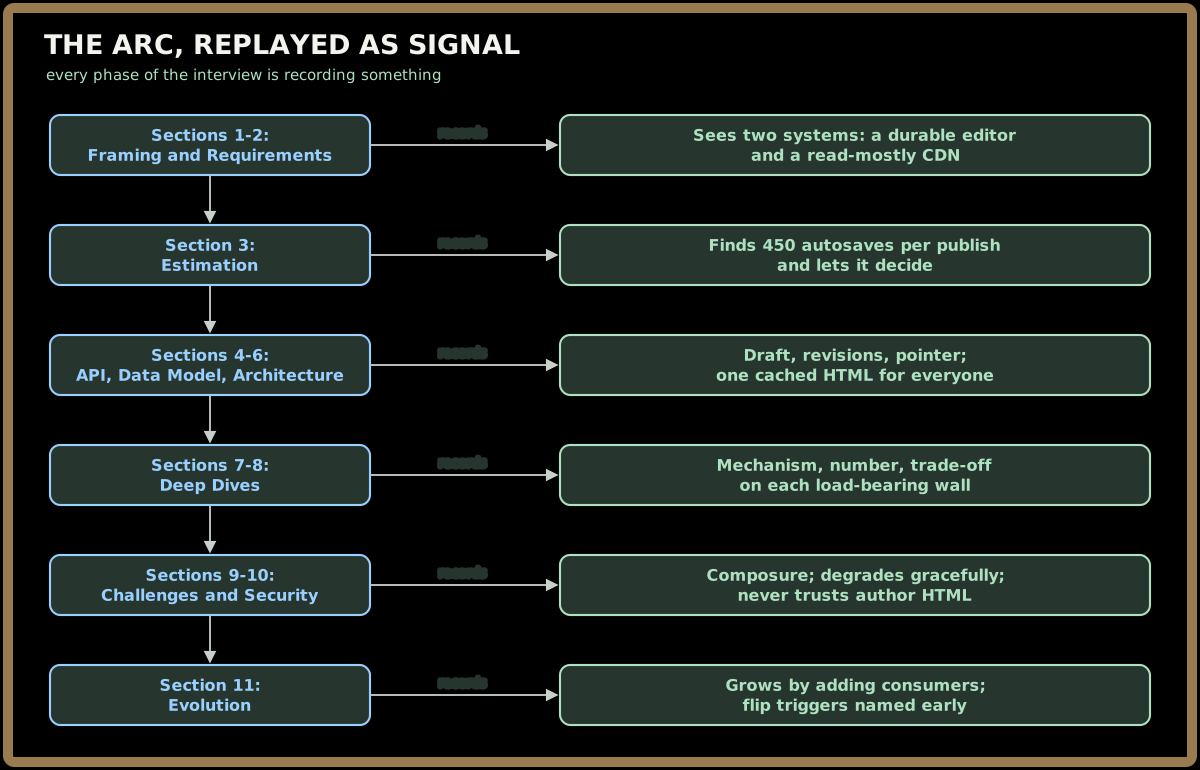
Sections 1 and 2 check whether you shrink the prompt and split it. Single author, no paywall, no recommendations: each removes a subsystem. The strong candidate names a durable write tool for 500K daily writers and a publishing CDN for 25M daily readers, sharing one data model, then sets 99.99% for reads and 99.9% for the editor, noting the stricter number is reachable only through CDN stale-if-error.
Section 3 checks whether the math governs the design. The naive write path, publish, runs at about 1.2/s. The real one is autosave at ~520/s average and ~1,560/s peak, roughly 450 saves for every publish. 100M views a day at a 95% hit ratio leave the origin at most ~175 renders a second. Postgres at ~500 GB and under 500 writes/s needs one primary. Images, 75 TB a day of egress, never touch the app tier.
Sections 4 through 6 check honest contracts and clean ownership: full-document autosave with If-Match and a 412, publish as an action carrying the exact draftVersion, a separate /me call so the HTML stays identical for everyone, and a post split into a mutable draft, immutable revisions and a pointer.
Sections 7 and 8 check depth where the design bears weight. Section 9 checks composure. Section 10 checks that you treat strangers' rich text as hostile. Section 11 checks that features land beside the core, not inside it.
Key Insight: Not one of those signals is "knows an exotic technology." Postgres, a KV store, object storage, Kafka, a CDN and OpenSearch are an ordinary parts list. The marks go to fitting them to measured load and naming the number that would change your mind.
Quick check before moving on:
Sign in to continue reading
The rest of this lesson is available with a free account. Signing in with Google or Microsoft is free.
Sign in to read the full lesson