Section 12: Sixty-Four Bits, Defended - Final Summary & Candidate Scorecard
Executive Summary: This closing section turns the module into a scoring instrument. We replay the finished design on one page, then lay out a 100-point scorecard across six dimensions, each with what a top answer sounds like on this prompt and where points leak away. The heaviest weight sits on clocks and worker-ID correctness, because that is where a Snowflake-style design either stays unique forever or quietly corrupts data. Score bands map to readiness levels with a remedy for each, and a final catalog shows where the ID generator hides inside other interview questions.
Almost every candidate can say "Snowflake," so the word earns close to nothing. The points sit in what comes after it. Can you size each field by asking it a question? Can you explain why 41 bits buys 69.7 years only because of a custom epoch? Can you say what worker 17 does when its clock steps back 40 ms? And can you say, without being pushed, that UUIDv7 would beat your whole service if 128-bit keys were allowed? This section names those points so you can check whether you're earning them.
The Design on One Page
Here is the whole answer as the interviewer will remember it at the debrief. Everything came from Section 1's three constraints: unique forever, a signed 64-bit integer, and sorted by ID to within about a second.
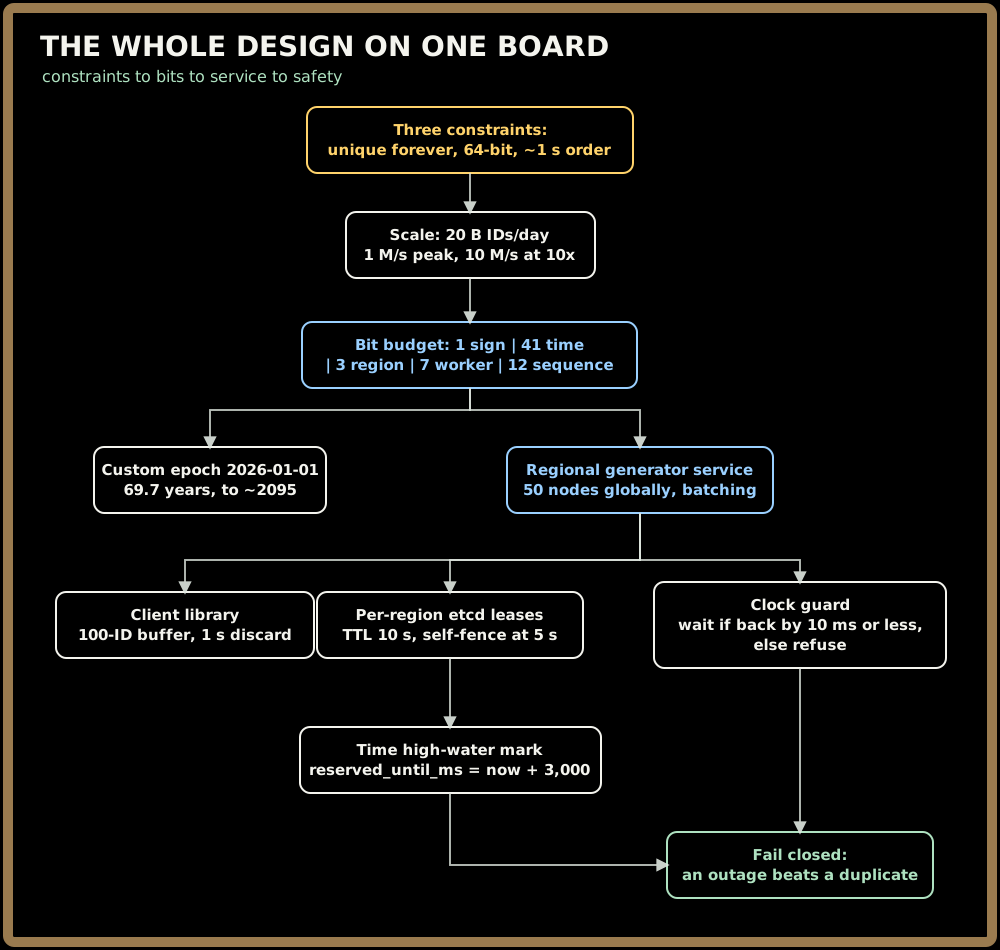
The constraints set the scale and the layout (Sections 1–3). The layout dictates a regional service with a thin client library (Sections 4–6). Section 7 explains why Snowflake beats the other four ways to mint an ID here. Section 8 shows how leases, the clock guard and the high-water mark keep it from ever duplicating. Sections 9–11 attack it, harden it and grow it.
Key Insight: Notice what is missing from the recap: no database of issued IDs, no global sequencer, no cross-region call per ID, no queue. The design is mostly absence, and every absence has a number behind it. Storing issued IDs would mean 20 billion rows a day. A global sequencer would add cross-region latency to every write in the company. You're scored on defending what isn't on the board.
Quick check before moving on:
Sign in to continue reading
The rest of this lesson is available with a free account. Signing in with Google or Microsoft is free.
Sign in to read the full lesson