Section 9: Fine, Let's Break It - Interviewer Deep Dive Challenges
Executive Summary: The design is drawn and the interviewer stops nodding. What follows is six escalations, each one a promise from the earlier sections under deliberate attack: the no-reservation cart (D7), the allergen view (D11), the versioned price (D3/D4), the kitchen display as a view of order_events, the single database (D5), and human-grade inventory (D8). Each gets the same treatment — what they're really asking, the answer with its mechanism and number, and the senior line, the sentence that shows you know where the boundary sits. The pattern across all six: name what the system guarantees, name what it only makes likely, and show that you designed the gap on purpose.
The deep dives are done, and the interviewer leans back. "Fine. Let's break it." Each question is aimed at a decision you defended earlier, to see whether you still own it under pressure. Panic and re-architect, and the decisions were borrowed; wave every challenge away, and you never saw the real failure. The passing answer says which part is physics, which is policy, and which was already handled.
Challenge 1: "You oversold: two customers, one avocado."
What they're really asking: Did you understand what you gave up when you decided carts aren't reservations — and did you design for the day the bill comes due?
You: "I accepted this race on purpose, and I shrank it before I accepted it." Carts never reserve ingredients (D7) because lettuce isn't an airline seat: carts live twenty minutes, and reserving on add-to-cart would let three abandoned browsers deadlock the avocado for everyone at the lunch peak. Instead, the final availability check runs inside the order transaction — the window where two customers can both order the last avocado narrows from the twenty-minute cart lifetime to the few seconds between Marco noticing the bin is empty and tapping 86. When the race fires anyway, the customer doesn't get an error page; they get the apology-and-substitute flow — same category, similar price, plus a comp credit. That flow costs a few dollars a few times a week. True reservations cost a locking design, a timeout policy, and a stuck menu, every day.
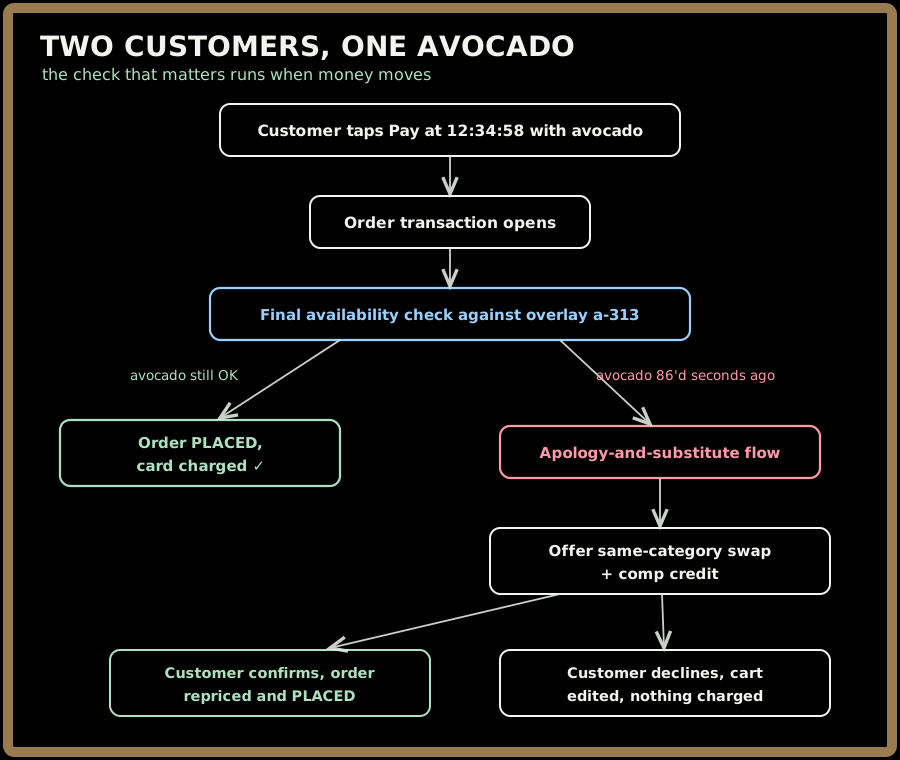
The senior line: "Design the failure's UX, not its impossibility — a cheap, graceful miss beats an expensive guarantee nobody needed."
Quick check before moving on:
Sign in to continue reading
The rest of this lesson is available with a free account. Signing in with Google or Microsoft is free.
Sign in to read the full lesson