Section 12: The Judges' Table - Final Summary & Candidate Scorecard
Executive Summary: This closing section converts the whole module into an evaluation instrument. We replay the interview arc and name the signal each phase was actually recording, score the two failure archetypes — the Dismissal and the Citadel — against it, and lay out the full 100-point rubric: five dimensions, weighted so that the data model and the judgment around it outweigh the hot-row machinery. Score bands map to readiness with targeted remediation, and a final catalog shows where this counting question hides inside real loops — including the one isomorph where this module's answer is the wrong answer.
Here is the uncomfortable truth about the hour you just spent with Priya, @astra, and a two-sentence prompt: the buffered-aggregation diagram that felt like the climax was never the deliverable. The interviewer was scoring something quieter the entire time — whether you noticed that "show the like count" hides an accuracy question nobody states, whether your long-tail arithmetic actually restrained your architecture, whether "the uniqueness constraint is the idempotency" came out of your mouth or had to be dragged out. Interviews at this level are scored on form, and you cannot consistently earn points you cannot name. This section names them.
The Arc, Replayed as Signal
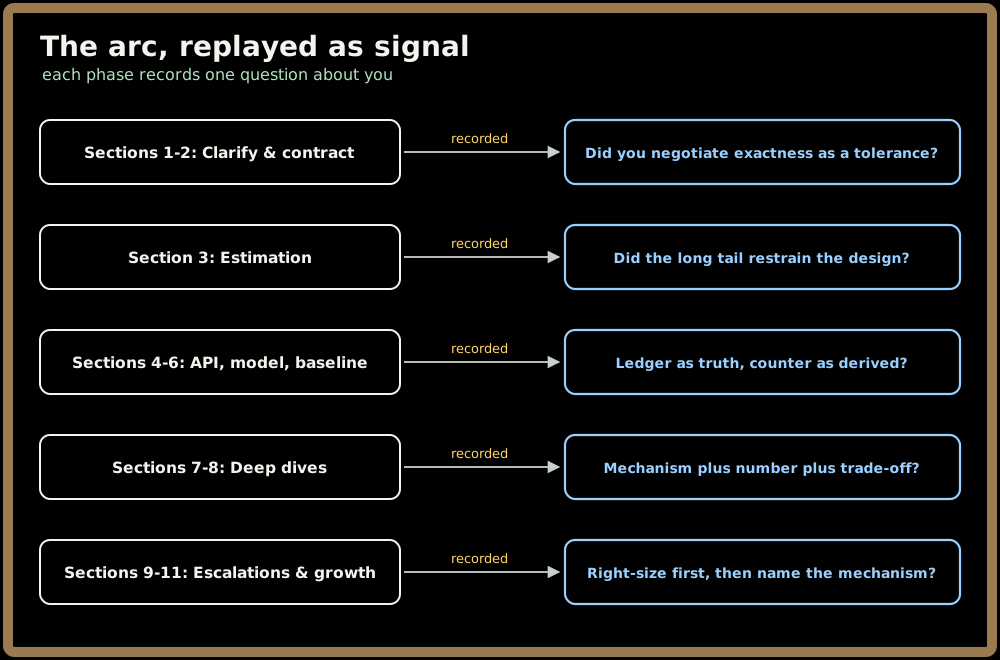
Key Insight: Read the right-hand column and notice that not one signal rewards knowing more machinery. Every signal rewards deploying well-known machinery in proportion to a measured workload — a median post with 10–15 likes ever, one celebrity row peaking at 50K likes/s. Swap the like button for any contended-counter problem and the five signals transfer intact.
Sign in to continue reading
The rest of this lesson is available with a free account. Signing in with Google or Microsoft is free.
Sign in to read the full lesson