Section 1: The Deceptively Simple Prompt - Problem Understanding & Clarifications
Executive Summary: This section dissects the opening minutes of a Staff/Principal interview built around a deliberately small system — a Color Picker Service. We decompose the prompt across four dimensions (what, who, why, how), walk through the clarifying questions that eliminate entire categories of distributed systems complexity before design begins, and convert the interviewer's answers into explicit architectural assumptions. By the end, you'll understand why interviewers weaponize simplicity, and how the questions you ask in the first ten minutes determine everything you build in the next fifty.
You settle into the interview room at a major tech company, notebook open, expecting a leviathan — design WhatsApp, design a global rate limiter, design the next planetary-scale data pipeline. Instead, the principal engineer across the table slides over a single sentence:
"Design a Color Picker Service where an authenticated user can select a color, and the system persists it so the user sees the same color next time they sign in."
A color picker. Your first instinct is relief; your second should be suspicion. Interviewers at this level do not hand out trivial problems — they hand out deceptively simple ones, because a small system offers nowhere to hide. There is no fog of complexity to bluff through, no rehearsed Kafka topology to recite. What remains, fully exposed, is your judgment. And candidates fail this prompt in two symmetric ways: some dismiss it as beneath them and skip the discipline; others panic at the emptiness and bolt on machinery the system will never need. Both failures begin here, before a single component is drawn.
Key Insight: A deceptively simple prompt inverts the usual test. In "design WhatsApp," the challenge is knowing enough machinery. Here, the challenge is restraint — proving that your process holds even when the stakes look low, because at Staff level, your process is what an entire team will inherit.
Decomposing the Innocent Sentence
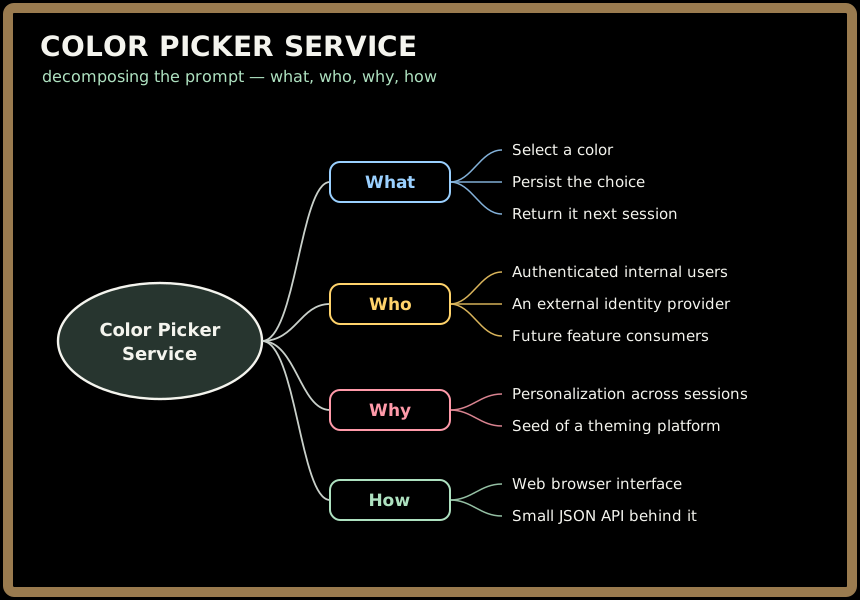
Every system, from this color picker to a global payments network, yields to the same four-way decomposition. Before asking a single question, you map the territory:
- What it does: Strip the prompt to its verbs — select, persist, retrieve. Three operations. Stating this aloud commits both of you to a scope, and feature creep now has to argue with a sentence you both heard.
- Who uses it: "Authenticated user" quietly announces two load-bearing facts — someone else owns login, and every record you store will be keyed by an identity you receive, not create. Slack's per-user preference services work exactly this way: they authenticate nobody, trusting an identity that arrives already verified and scoping every operation to it.
- Why it exists: A persisted color is personalization — the embryonic form of a theming platform. The why tells you which future features are plausible, and therefore which doors your design must not weld shut.
- How it's used: A browser, a color input, a save button. Human-driven, low-frequency, tolerant of a hundred milliseconds. Nobody is trading equities against this API.
Sign in to continue reading
The rest of this lesson is available with a free account. Signing in with Google or Microsoft is free.
Sign in to read the full lesson