Section 13: The Deploy You Never Shipped - Final Summary & Candidate Scorecard
Executive Summary: This closing section compresses twelve sections into the artifacts you can rehearse: a sixty-second recap in four verbs, three planes and three clocks; the decisions ledger, D1 through D12, each with its rejected alternative and flip trigger; the three traps from the module's opening and the move that defuses each; a scorecard for mid-level, Senior and Staff performances; the variants interviewers reach for next; and how to practice.
The interviewer's last question is "Summarize it for me," and it is not filler: a design you can't compress is a design you don't own. Everything below is that compression.
The Sixty-Second Recap
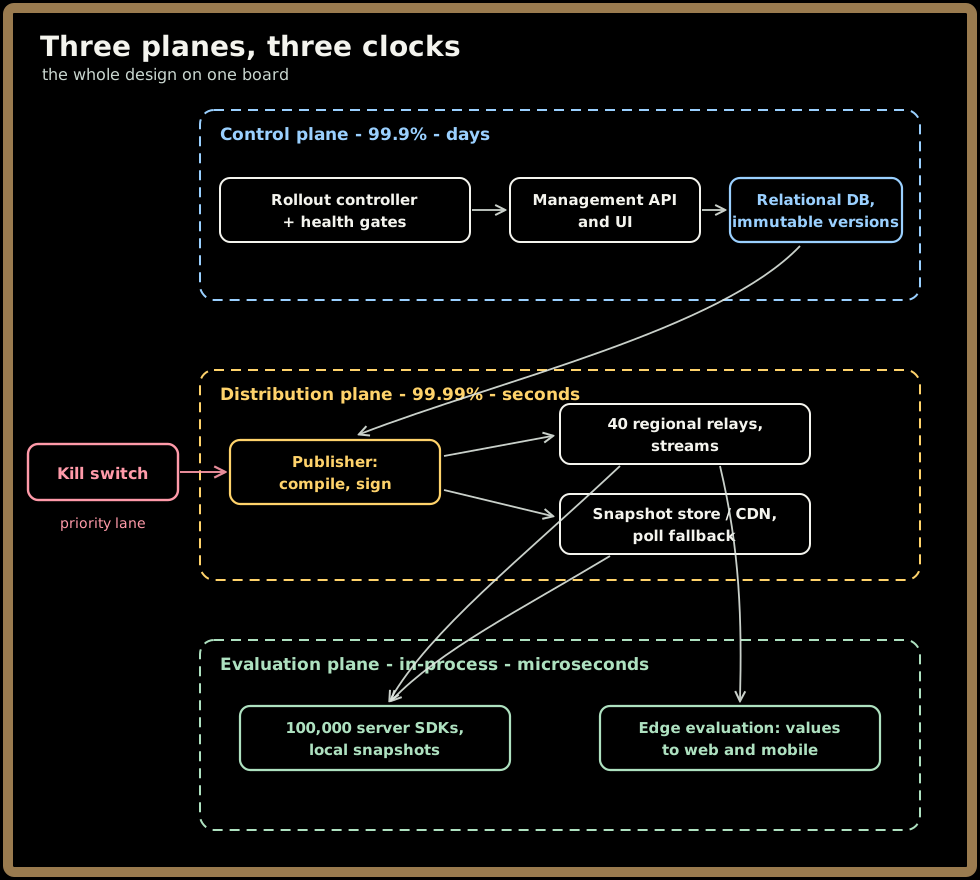
The platform does four things — define flags with ordered rules and reusable segments, evaluate them against a request's context, roll out changes step by step, and kill a feature on demand — across three planes. The control plane (99.9%), a relational database of immutable versions, absorbs 5,000 validated, audited changes a day. The distribution plane (99.99%) compiles each change into signed snapshots and pushes ~2 KB deltas through 40 regional relays to 100,000 streaming SDKs, with a 60-second poll fallback. The evaluation plane has no availability number at all, because it has no remote dependency: 50 million evaluations a second, in-process, about a microsecond each, falling back to last-known-good and then the code default.
Those planes run three clocks: rollouts tick in days (rings, bake times, approvals), propagation in seconds (p99 ≤ 5 s to servers, ≤ 10 s to web, next fetch for mobile), evaluation in microseconds (p99 ≤ 50 µs, zero network calls). The kill switch is the one change that rides the seconds clock without waiting for the days clock.
And the Day 3 story, in three sentences. At 13:55, with smart-reply-v2 at 25%, treatment errors climbed from 0.4% to 3.1% and p99 from 180 ms to 900 ms while control held steady; the gate sustained the breach five minutes, paused the rollout and paged at 14:00. The on-call investigated and pressed kill at 14:07:00, reason attached. By 14:07:04, 99% of 100,000 servers were on killVersion 9031 — and the seven minutes in between were a human deciding, exactly where the time should go.
Quick check before moving on:
Sign in to continue reading
The rest of this lesson is available with a free account. Signing in with Google or Microsoft is free.
Sign in to read the full lesson