Section 3: Thirty-Three Thousand to One - Scale Estimation & Workload Analysis
Executive Summary: This section is one division and its consequences: 5M requests a second against a 150-request-per-second vendor is a 33,000× gap that kills per-request calls, and even a 99%-effective cache in front still misses 330× too often. The budget — about 10M checks a day — can't scan IPv4 (331 days a pass) but comfortably covers what traffic actually shows: 100M daily uniques whose top 10M carry ~90% of volume. The punchline is how small the answer is: a deny set under 1 MB, a snapshot under 10 MB, a 2 µs lookup costing ~2% of a core. The napkin deletes two architectures and hands the engineering budget to the mirror and the scheduler.
The interviewer caps the marker. "Before you draw a single box: how bad is the mismatch, really?" This is the rare prompt where the first number isn't a sizing exercise — it's a verdict. Do the division out loud before anything else.
You: "Let me anchor. You said Twitter-scale: I'll use 5 million requests a second average, 12 million at peak, served from about 30 edge PoPs. The vendor — call it SentinelDB — sustains 100 to 200 requests a second; I'll design against 120, which is 80% of the 150 midpoint, keeping headroom for retries. Stop me if either end is off by an order of magnitude."
Interviewer: "Those are fair."
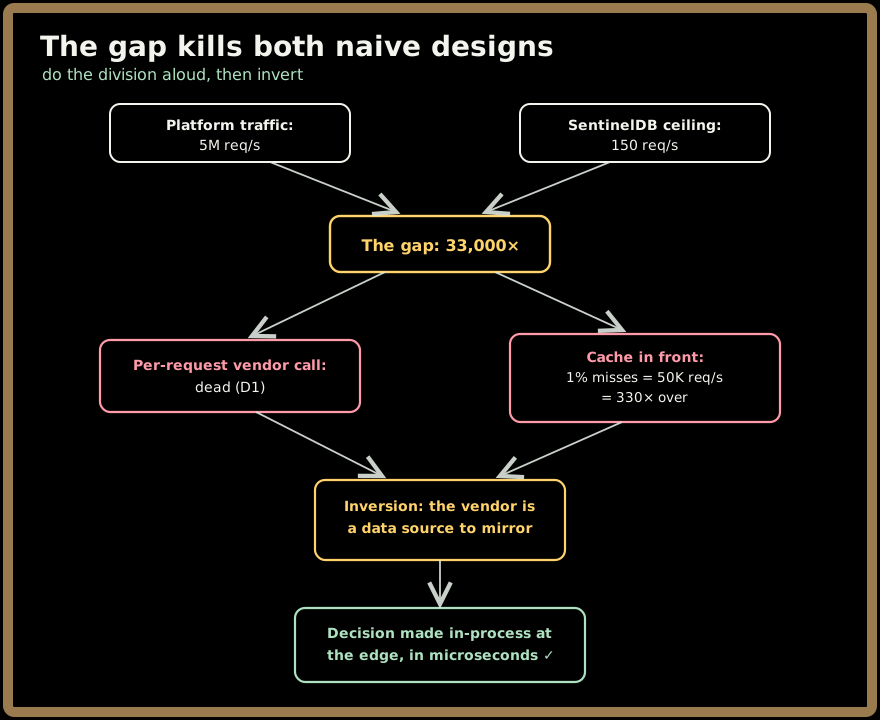
The Division That Ends Two Designs
Gap: 5,000,000 req/s ÷ 150 req/s ≈ 33,000×
Thirty-three thousand times more traffic than the dependency can carry. Not 2×, where you'd batch; not 10×, where you'd cache aggressively. At 33,000×, calling the vendor anywhere on the request path is not slow — it is arithmetic fiction. That single line is D1: SentinelDB is a data source, never a request-path dependency. And it executes the obvious rescue too:
"Just cache it":  even 1% of requests missing the cache
                  5,000,000 × 1%               = 50,000 req/s to the vendor
                  50,000 ÷ 150                 ≈ 330× over its ceiling
A cache in front needs a 99.997% hit rate on day one, with a cold cache, or the misses alone bury the vendor 330 times over. Section 10 finishes this autopsy; the napkin has already told you the shape of the real answer — invert the relationship. Don't ask the vendor questions at request time; copy its answers ahead of time and decide locally.
Sign in to continue reading
The rest of this lesson is available with a free account. Signing in with Google or Microsoft is free.
Sign in to read the full lesson