Section 13: The Delivery Truck, Inspected - Final Summary & Candidate Scorecard
Executive Summary: This closing section turns the module into an instrument you can score yourself against. We replay the arc and name the signal each phase recorded: whether you saw a software-update system with a shop window attached, whether the arithmetic moved update checks and update bytes to the centre, whether you asked who should hold the state, and whether a bad release could be stopped at 5%. Then comes the 100-point scorecard, three calibration rules, four score bands mapped to sections worth re-running, and where this question hides in real loops.
The boxes in Section 6 (High-Level Architecture) felt like the deliverable, and they were worth a quarter of the points, shared with the data model. The interviewer was recording something quieter: whether you said "updates are about 13 times installs" before anyone asked, whether 1.8 GB of release index made you delete the database from the hot path, whether you could explain why Priya's phone asks the question and the server never keeps a list of what she is owed. That is judgment, and it is scored on what you say aloud.
The Arc, Replayed as Signal
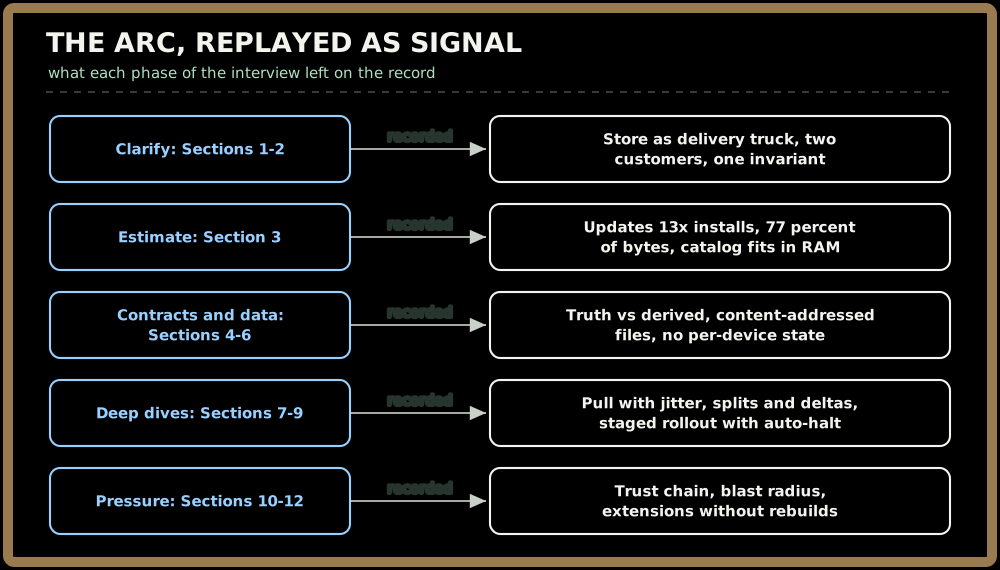
Section 1 (Problem Understanding & Clarifications) recorded whether you dodged the two archetypes: the Catalog Clerk, who models the shop window and draws "CDN" as one box at the end, and the Push Maximalist, who keeps a per-device queue of pending updates and discovers 120 billion rows to rewrite. Section 3 (Scale Estimation & Workload Analysis) recorded whether the numbers changed the design: 52 PB a day, 40 PB of it update deltas, against 80 GB of listings. Section 9 (Deep Dive: The Publishing Pipeline & Staged Rollouts) recorded whether a release was a metadata flip over files that already existed, so that both "start rollout" and "halt" are cheap.
Key Insight: The signals compound. The in-memory release index of Section 8 exists only because Section 3 found 16.8 million version lookups a second, and the cheap halt in Section 9 works only because Section 5 made a release one row and Section 8 made the check stateless. Skip a phase and you forfeit every point downstream of it.
Quick check before moving on:
Sign in to continue reading
The rest of this lesson is available with a free account. Signing in with Google or Microsoft is free.
Sign in to read the full lesson